
Grow Fargesia with morning sun, afternoon shade, and even moisture that drains. These hardy clumping bamboos stay in a tight clump — not lucky bamboo in a vase.
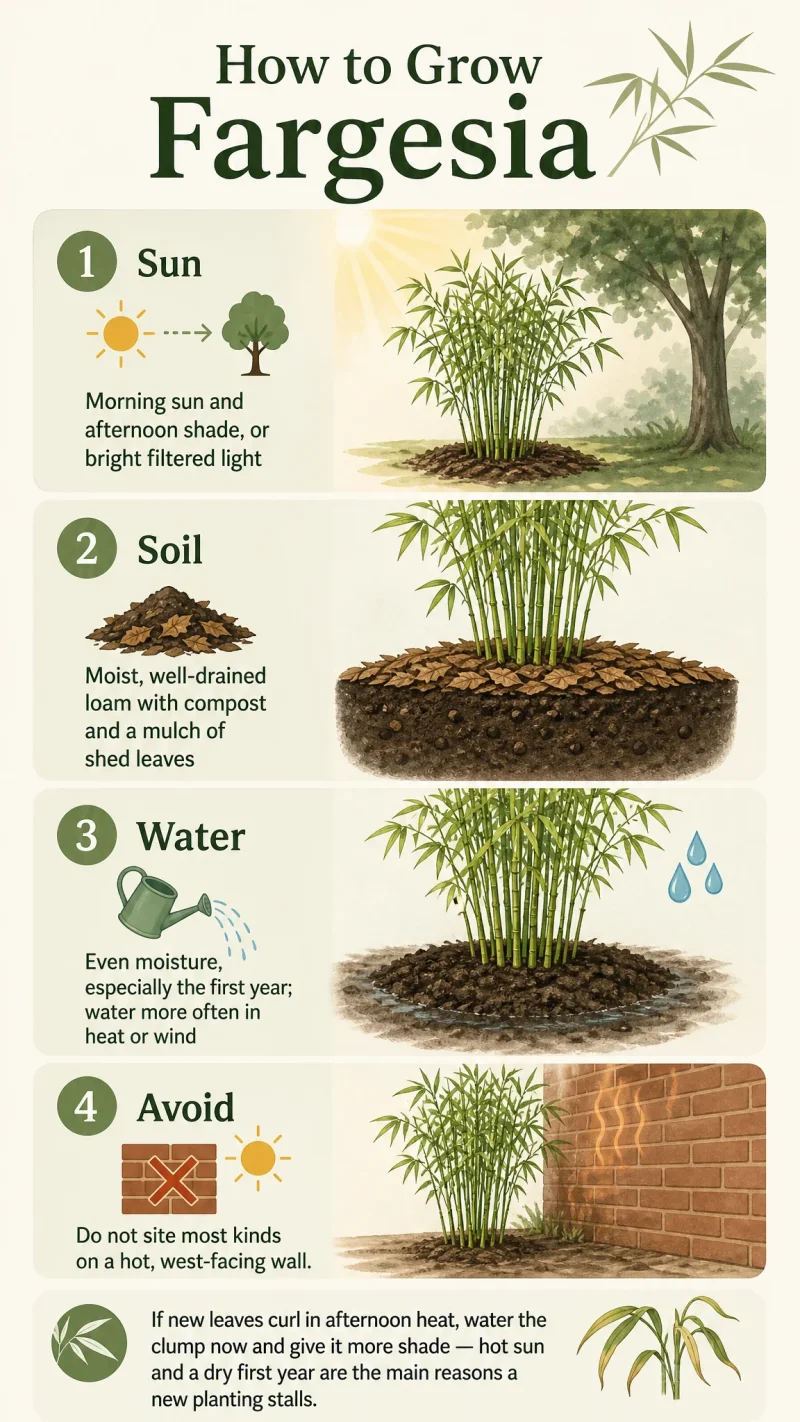
Give it morning sun and afternoon shade, and keep the soil moist
| Factor | Recommended | Avoid |
|---|---|---|
| Sun | Morning sun and afternoon shade, or bright filtered light | Do not site most kinds on a hot, west-facing wall |
| Water | Even moisture, especially the first year; water more often in heat or wind | Do not let a new planting dry out, and do not leave the crown in standing water |
| Soil | Moist, well-drained loam with compost and a mulch of shed leaves | Do not rake the leaf litter off the clump |
| Wind | A wall, fence, or neighboring plants that break drying winter wind | Do not leave evergreen leaves in an open, windy gap all winter |
| Deer | Catalog plants resist browsing | Do not treat a new screen as deer-proof if pressure is high |
Most Fargesia does best with morning sun and afternoon shade, in moist soil that still drains. Water well through the first growing season. [1] Fargesia is happier with shade in the hottest part of the day. Leave the shed leaves under the clump. They keep the soil soft and recycle silica. In spring, some leaves yellow and drop while new ones open. That turnover is normal, not a dying clump. [2] In full afternoon sun the leaves roll, yellow, and scorch, and drying winter wind burns evergreen foliage the same way. [3] The clump widens only a few inches a year, so you are not planting a running grove. [4] Match culm habit on Types of Fargesia.
Does Fargesia need full sun?
No. Give it morning sun and afternoon shade. Hot afternoon sun curls and scorches the leaves. A robusta screen takes more sun than umbrella bamboo, but it still wants even moisture.
How often do I water Fargesia?
Keep the soil evenly moist the first year, and water more often in heat or wind. An established clump is tougher, but a dry new planting stalls, and a boggy crown rots.
Is Fargesia deer resistant?
Catalog plants resist browsing. A hungry deer can still sample a new screen, so do not treat the clump as deer-proof if pressure is high.
Grow Fargesia in a pot you can shelter from winter wind
A large pot with drainage holes holds a small screen on a patio. Use a well-drained mix, water when the top feels dry, and never leave the pot in a saucer of water. Set the pot where it gets afternoon shade. Roots freeze harder in a pot than in the ground, so move it against a sheltered wall before drying winter wind hits. A pot is not a substitute for planting in the ground when you want a tall hedge.
- Choose a heavy pot with open drain holes.
- Fill with a well-drained potting mix, not garden soil that stays soggy.
- Set the root ball at the same level it grew in the nursery pot, then water until water leaves the holes.
- Keep the pot in afternoon shade, and shelter it from drying winter wind.
Can I grow Fargesia in a pot?
Yes. A draining pot holds a small screen and lets you shelter the roots from winter wind. Water when the top of the mix is dry. A pot will not make a 15-foot hedge.
Thin the oldest culms at ground level
Each culm reaches its full height in the first season and does not thicken later. Older culms stiffen, then turn brittle as the clump replaces them. Thin so light reaches the center and new shoots have room.
- Thin in early spring before the new shoot flush, or after new culms have hardened.
- Cut dead, damaged, and the oldest culms just below the soil so you do not leave a stub to trip on.
- Do not take more than about one-third of the live culms in one year.
- Do not hedge-shear the whole plant like a boxwood. You want a fountain of culms, not a clipped cube.
When do I thin the culms?
Early spring, or after new culms harden. Cut the oldest canes at the soil. Do not take more than about one-third of the live culms in one year.
Not running bamboo — and not tropical Bambusa
Running bamboo is Phyllostachys. Rhizomes travel sideways and send up culms far from the first plant; see How to Grow Running Bamboo. Fargesia stays in a clump that widens slowly. Lucky bamboo is Dracaena grown in water or a pot indoors; see How to Grow Dracaena. Heavenly bamboo is Nandina, a shrub with compound leaves and berries; see How to Grow Nandina. A bamboo palm is an indoor palm. Tropical clumping Bambusa wants more heat and sun; see How to Grow Bambusa. If the tag says only bamboo, read the Latin.
Is this the same as running bamboo?
No. Fargesia is a hardy clumper. Running bamboo is Phyllostachys, which sends rhizomes sideways.
Is lucky bamboo the same plant?
No. Lucky bamboo is Dracaena. Fargesia is a woody grass with a tight clump of culms.
If new leaves curl in afternoon heat, water the clump now and give it more shade — hot sun and a dry first year are the main reasons a new planting stalls.
FAQ
Will the clump flower and die?
These plants flower on a long cycle, then some clumps die. That is the life cycle, not an insect kill. Buy a potted plant instead of waiting on seed.
Can I eat the shoots?
Young shoots of some kinds are eaten after cooking. Ornamental clumps here are grown for screens and culms, not as a food crop on this page.
What pests hit Fargesia?
Watch for aphids and mites on dry, stressed clumps. Wipe them off when you notice them. Slugs can chew new shoots in a wet spring.
Related guides


Recommended plants


References
- [1] NC State Extension Gardener -
https://plants.ces.ncsu.edu/plants/fargesia-nitida/ - [2] American Bamboo Society -
https://www.bamboo.org/bamboo-planting-and-care/ - [3] American Rhododendron Society -
https://scholar.lib.vt.edu/ejournals/JARS/v57n2/v57n2-shannik.html - [4] University of Arkansas Division of Agriculture -
https://www.uaex.uada.edu/yard-garden/resource-library/plant-week/Fargesia-nitida-Clumping-Bamboo-Fountain-Bamboo-05-20-2016.aspx
This note is part of Fargesia Guides.
More first-season notes by plant are gathered in How to Grow Guides.
Updated: Reviewed by Bosquelle Editors