
Grow English daisy in cool weather, in moist soil that drains. English daisy is Bellis perennis. Shops also say lawn daisy or common daisy. Pomponette is the double kind. A tall white daisy on a tag is usually a Shasta daisy.
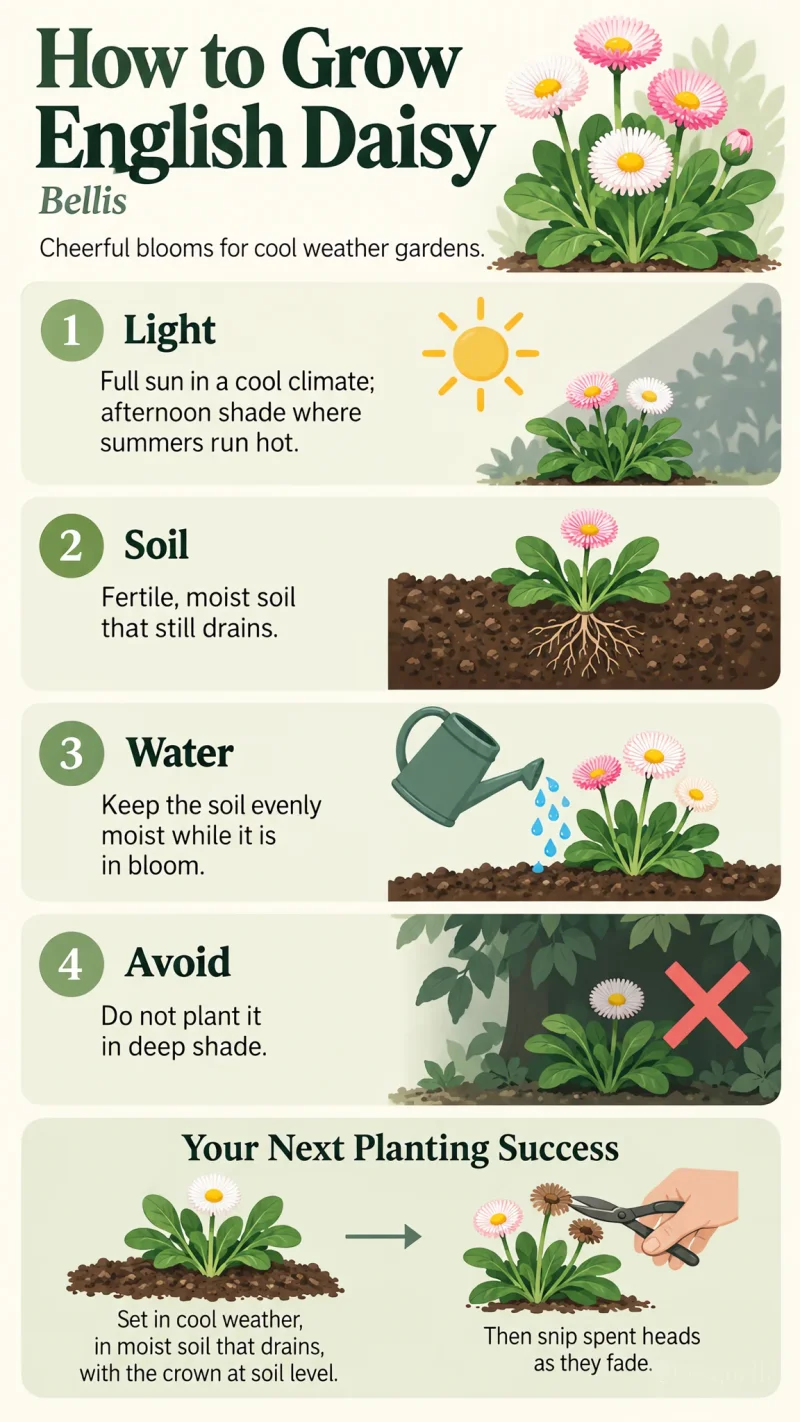
Give it cool weather, moist soil that drains, and sun or afternoon shade
| Factor | Recommended | Avoid |
|---|---|---|
| Light | Full sun in a cool climate; afternoon shade where summers run hot | Do not plant it in deep shade |
| Soil | Fertile, moist soil that still drains | Do not let the crown sit in a puddle |
| Water | Keep the soil evenly moist while it is in bloom | Do not let it dry out; this plant is not drought-tolerant |
| Season | Cool spring (and a cool fall flush in some gardens) | Do not expect a summer show in heat |
| Kind | A low rosette, 3 to 6 inches tall; Pomponette is the double form | Do not treat a 2-foot Shasta as this plant |
| Deer | They usually leave this plant | Do not treat it as a fence; a hungry deer can still browse |
English daisy is a low rosette of spoon-shaped leaves with small daisy heads on short stems. Give it cool weather and soil that stays moist but still drains. Full sun is fine where summers stay cool. Where summers run hot, afternoon shade keeps the bloom going a little longer. [1] Keep the soil evenly moist. This plant is not drought-tolerant, and a dry week in bloom is enough to stop the flowers. In heat it fades, and many gardeners grow it as a biennial in the South or as an annual in the North, then pull it once the heads are gone. [2]
How much sun does English daisy need?
Full sun in a cool climate. Give it afternoon shade where summers run hot. Deep shade makes a thin rosette with few flowers.
How often do I water it?
Keep the soil evenly moist while it is in bloom. Do not let it dry out, and do not leave the crown in standing water.
Plant it in cool weather, with the crown at soil level
Set nursery plants in spring after frost, or in fall where winters are mild, so the first flush hits cool weather. Put the crown at soil level, not buried, and not perched high on a dry mound. Water until new roots hold. [3]
- Plant in cool weather, in moist soil that drains.
- Set the crown at soil level, even with the surrounding ground.
- Space plants about 6 inches apart so the rosettes can meet without crowding.
- Water well at planting, then keep the soil evenly moist.
Grow it in a pot that drains
A pot with a hole in the bottom can hold a spring display on a patio. Use a potting mix that drains, and water more often than you would in the ground, because a small pot dries faster. This is an outdoor bedding plant, not a houseplant. When heat stops the bloom, empty the pot and start again next cool season.
- Choose a pot with a hole in the bottom.
- Fill it with a potting mix that drains, and plant with the crown at the mix surface.
- Keep the mix evenly moist, and empty water that sits in a saucer.
How do I plant it?
Plant in cool weather, with the crown at soil level, about 6 inches apart, and water until the roots hold.
Can I grow it in a pot?
Yes, in a pot with a drainage hole. Keep the mix moist, and treat it as a cool-season display, not a houseplant.
Deadhead spent flowers, then cut the plant back when heat stops the bloom
Snip spent heads so the plant keeps sending new ones, and so seed does not drop into a lawn you want clean. When summer heat stops the bloom, cut the spent stems back, or pull the plant if you grew it as a one-season bedding plant. [4]
- Snip each spent head down near the leaf rosette as it fades.
- Keep deadheading through the cool spring flush so new buds can open.
- When heat stops the bloom, cut the spent stems, or pull the plant if you do not want it to seed.
- Do not wait for a woody prune. This is a low rosette, not a shrub.
When do I deadhead?
Snip spent heads as they fade, down near the leaf rosette. When heat stops the bloom, cut the stems or pull the plant.
Surface-sow the seed so light can reach it
The seed needs light to sprout, so press it onto the surface of a moist mix and do not bury it. Start a tray indoors about eight to ten weeks before you set plants out, at about 70°F, and expect seedlings in 10 to 25 days. Outdoors, sow in midsummer to early autumn for flowers the next spring, or in early spring where the soil stays cool. Bought seed keeps the double Pomponette form; saved seed often reverts to single lawn heads.
- Press the seed onto moist mix. Do not cover it; the seed needs light.
- Keep the mix bright and evenly moist at about 70°F until seedlings appear, usually in 10 to 25 days.
- Grow them on until they are a few inches tall, harden them off, then set them out in cool weather with the crown at soil level.
- Buy seed if you want the double pompon form. Saved seed often comes back as single lawn daisies.
Split a crowded clump after bloom
A mature clump that you kept as a perennial can be split in spring or after the flowers fade. The roots are shallow. Dig around the rosette, cut it into pieces with a shoot and roots on each, and replant at once at soil level.
- Wait until the flowers fade, or lift in spring before the next flush.
- Dig around the clump, then cut it into pieces that each have leaves and roots.
- Replant at once, with the crown at soil level, and water until the pieces take.
Can I grow it from seed?
Yes. Press the seed onto moist mix so light can reach it, keep it at about 70°F, and buy seed if you want the double form.
Not a Shasta daisy — and not a gerbera
A tall white daisy on a U.S. tag is usually a Shasta daisy. That plant makes a 2- to 3-foot clump with large heads, not a 6-inch rosette. This plant is English daisy. See How to Grow Shasta Daisy if the tag says Shasta, or if the plant is oxeye daisy, which lives on that same cluster.
A Gerbera daisy is a larger florist daisy with a long stem and a dry crown. See How to Grow Gerbera Daisy if that is the plant you bought. African daisy is Osteospermum — see How to Grow African Daisy if the heads are the wide Cape daisy. Painted daisy is Tanacetum — see How to Grow Painted Daisy if the rays are banded. Marguerite daisy is Argyranthemum — see How to Grow Marguerite Daisy if the tag is a woody mound, not this rosette. Marguerite printed as a nickname for this rosette is still English daisy; on a U.S. tag, marguerite daisy is usually the woody mound. Fleabane is Erigeron — see How to Grow Fleabane if the heads are the small Mexican or seaside daisy.
Lawn daisy is still this species. Single white heads in turf are the wild form of English daisy, not a second genus. A bush daisy or a crown daisy on a search list is a different plant.
Is a Shasta daisy the same plant?
No. Shasta daisy is a tall clump with large white heads. This plant is a 3- to 6-inch rosette.
Is a lawn daisy a different plant?
No. Lawn daisy is the same species, usually with single heads in turf. Pomponette is the double bedding form.
Set the next plant in cool weather, in moist soil that drains, with the crown at soil level, then snip spent heads as they fade.
FAQ
What about Habanera or Tasso?
Those are named selections of this same plant. They still want cool weather, moist soil that drains, and deadheading. Pink or red kinds are the same job as the white ones.
Is it a houseplant?
No. Grow it outdoors in a bed or in a pot that drains. A windowsill pot that stays wet will rot, and a dry indoor room will stop the bloom.
Can I eat the flowers?
Do not eat this plant. Parts of it can make a person sick. Grow it for the spring show, not as a salad crop.
Recommended plants

References
- [1] North Carolina Extension Gardener -
https://plants.ces.ncsu.edu/plants/bellis-perennis/ - [2] Missouri Botanical Garden -
https://www.missouribotanicalgarden.org/PlantFinder/PlantFinderDetails.aspx?kempercode=b749 - [3] Gardener's Path -
https://gardenerspath.com/plants/flowers/grow-english-daisy/ - [4] Royal Horticultural Society -
https://www.rhs.org.uk/plants/238291/bellis-perennis-pomponette-mixed/details
More first-season notes by plant are gathered in How to Grow Guides.
Updated: Reviewed by Bosquelle Editors