
Grow eastern gamagrass in full sun to light shade, on moist soil. Eastern gamagrass here is Tripsacum dactyloides, also sold as Fakahatchee grass or gama grass — not corn, not the houseplant called corn plant, and not blue grama.
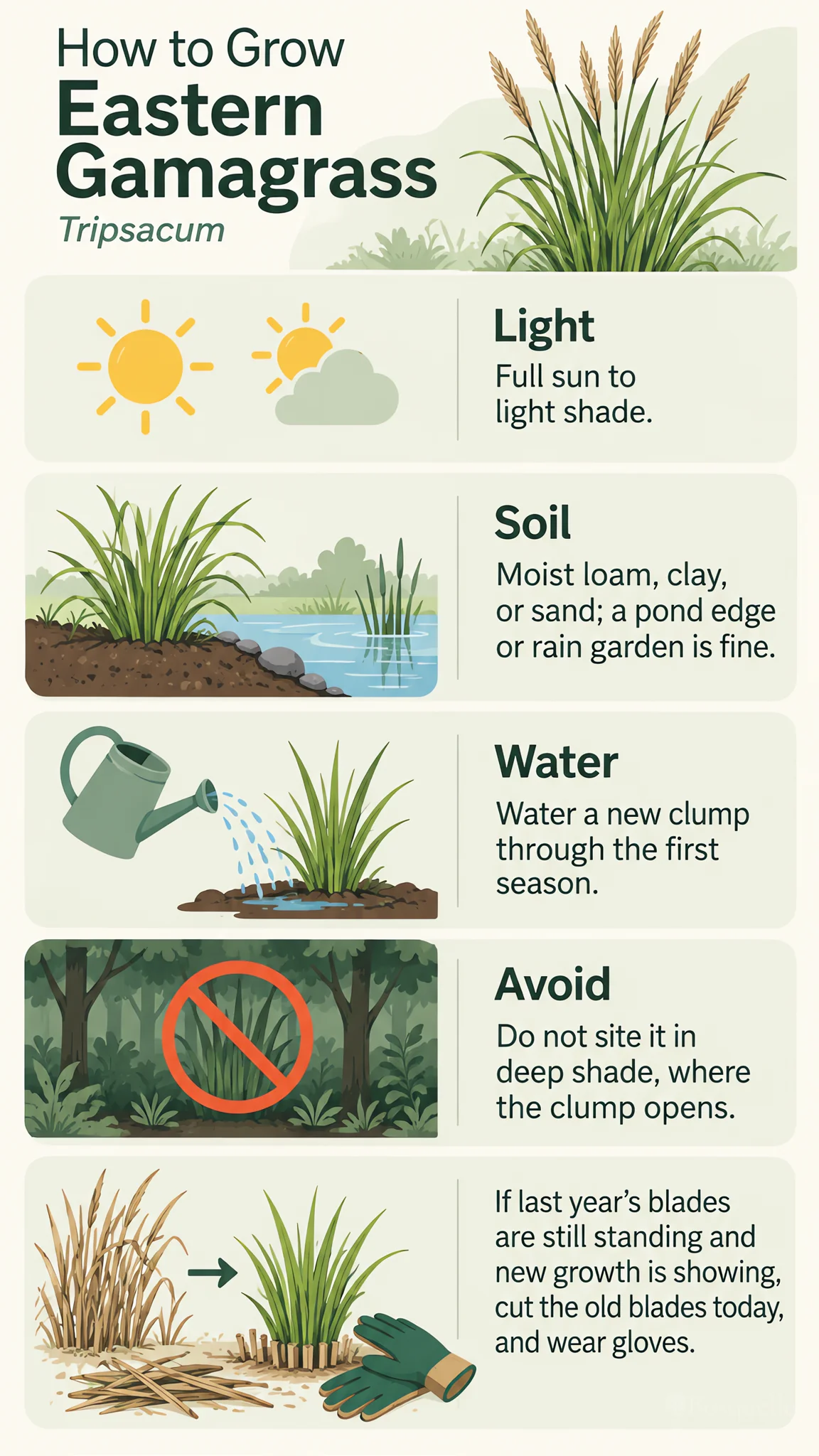
Give it full sun to light shade and moist soil
| Factor | Recommended | Avoid |
|---|---|---|
| Light | Full sun to light shade | Do not site it in deep shade, where the clump opens |
| Soil | Moist loam, clay, or sand; a pond edge or rain garden is fine | Do not plant it on a bone-dry berm the first year |
| Water | Water a new clump through the first season | Do not keep a weekly hose on an established clump |
| Flood | It takes standing water if the water moves on | Do not plant it where water sits with no way out |
| Drought | Once the clump is in, it takes a dry spell | Do not skip water the first summer |
| Kind | The full-size clump, about 4 to 8 feet | Do not treat a dwarf Fakahatchee tag as this plant |
Give it an open bed that stays moist. Full sun makes a denser clump; light shade is fine, but deep shade opens the stems. [1] A pond edge, a rain garden, or ordinary loam that stays damp all work. Water a new planting through the first summer. After that, a dry spell is normal, and so is a flood that drains away. [2] Eastern gamagrass is a warm-season bunchgrass about 4 to 8 feet tall, with broad blades and a jointed spike that looks a little like a small ear of corn.
- Set it in full sun or light shade.
- Use moist soil. Clay, loam, or sand is fine if it does not stay bone-dry the first year.
- Water through the first season. Once the clump is thick the next summer, water only in a long dry spell.
- Skip fertilizer unless a soil test says the ground is poor.
How much sun does eastern gamagrass need?
Full sun to light shade. In deep shade the clump opens and the stems lean.
How often do I water eastern gamagrass?
Water a new clump through the first season. Once it is established, water only in a long dry spell. A flood that drains away is fine.
Plant a spring clump with four to six feet of room
Wait until the soil is warm and frost is done. This is a warm-season grass, so a cold hole in early spring sits wet before roots grow. Set a nursery clump so the crown sits even with the soil, and leave room for a large plant.
- Plant after the last frost, when the soil has warmed.
- Dig a hole the size of the nursery pot. Do not bury the crown.
- Leave about four to six feet between clumps so the mature plant can stand.
- Water until the first summer's roots take. Do not add fertilizer to the hole.
When do I plant eastern gamagrass?
Plant a nursery clump after frost, when the soil is warm. Leave four to six feet between plants.
Cut last year's blades in late winter
Leave the standing blades through winter. Birds use that cover, and the crown stays protected. Cut last year's growth in late winter or early spring, before new blades get tall. Wear gloves, because the leaf edges are sharp. [3]
- Leave the standing blades through winter. Do not cut them in fall.
- In late winter or early spring, before new blades are tall, cut the old growth to about four to six inches.
- Wear gloves. The leaf edges are sharp.
- If new blades are already up, cut above them. Do not shear off this year's growth.
When do I cut back eastern gamagrass?
In late winter or early spring, before new blades get tall. Leave the stems through winter, and wear gloves.
Divide the clump when the center dies out
An old clump can die out in the middle. Divide it in spring, just as new blades show. The rhizomes are tough, so use a sharp spade or a saw, then replant the pieces at the same depth.
- Wait until spring, just as new blades show, every three or four years or when the center thins.
- Cut the old blades short so you can see the crown.
- Dig the clump and split the rhizomes with a sharp spade or a saw.
- Replant the pieces at the same depth and water until they take.
Not corn — and not blue grama or the houseplant called corn plant
Eastern gamagrass is a relative of corn. The spike has male flowers stacked above female flowers, like a small ear. It is not sweet corn, and it is not the houseplant sold as corn plant. See How to Grow Dracaena. The name gamagrass may come from grama, which is Bouteloua — a short dry-land grass, not this wet clump. See How to Grow Blue Grama. [4]
Switchgrass has an airy, branched panicle. See How to Grow Switchgrass. Big bluestem has a turkey-foot seed head. See How to Grow Big Bluestem. Indian grass holds one golden plume. See How to Grow Indian Grass. Little bluestem is a shorter copper clump. See How to Grow Little Bluestem. Those prairie grasses can share a meadow with this plant, but they are not the same shop grass.
Dwarf Fakahatchee is Tripsacum floridanum, a two-to-three-foot Florida grass. It is not this four-to-eight-foot clump.
Is eastern gamagrass the same as corn?
No. It is a relative of corn, with male and female flowers on the same spike, but it is a perennial clump, not a sweet-corn crop, and not the houseplant called corn plant.
If last year's blades are still standing and new growth is showing, cut the old blades today, and wear gloves.
FAQ
Can I grow eastern gamagrass in a pot?
A patio pot is a poor long-term home. This is a 4 to 8 foot landscape clump. Grow it in a bed.
Can I grow eastern gamagrass from seed?
A garden start is a nursery clump. Bulk seed needs a long cold-moist treatment and is for a field planting, not a border how-to.
Is dwarf Fakahatchee the same plant?
No. Dwarf Fakahatchee is Tripsacum floridanum, a 2 to 3 foot Florida grass. Eastern gamagrass here is the full-size Tripsacum dactyloides clump.
Will it come back after a freeze?
Yes. The blades brown after a hard freeze and new growth returns in spring. In frost-free gardens the clump can stay green all year.
Recommended plants
References
- [1] NC State Extension Gardener -
https://plants.ces.ncsu.edu/plants/tripsacum-dactyloides/ - [2] University of Florida IFAS -
https://gardeningsolutions.ifas.ufl.edu/plants/ornamentals/fakahatchee-grass/ - [3] LSU AgCenter -
https://www.lsuagcenter.com/profiles/astrahan/articles/page1709320433748 - [4] Lady Bird Johnson Wildflower Center -
https://www.wildflower.org/plants/result.php?id_plant=trda3
More first-season notes by plant are gathered in How to Grow Guides.
Updated: Reviewed by Bosquelle Editors