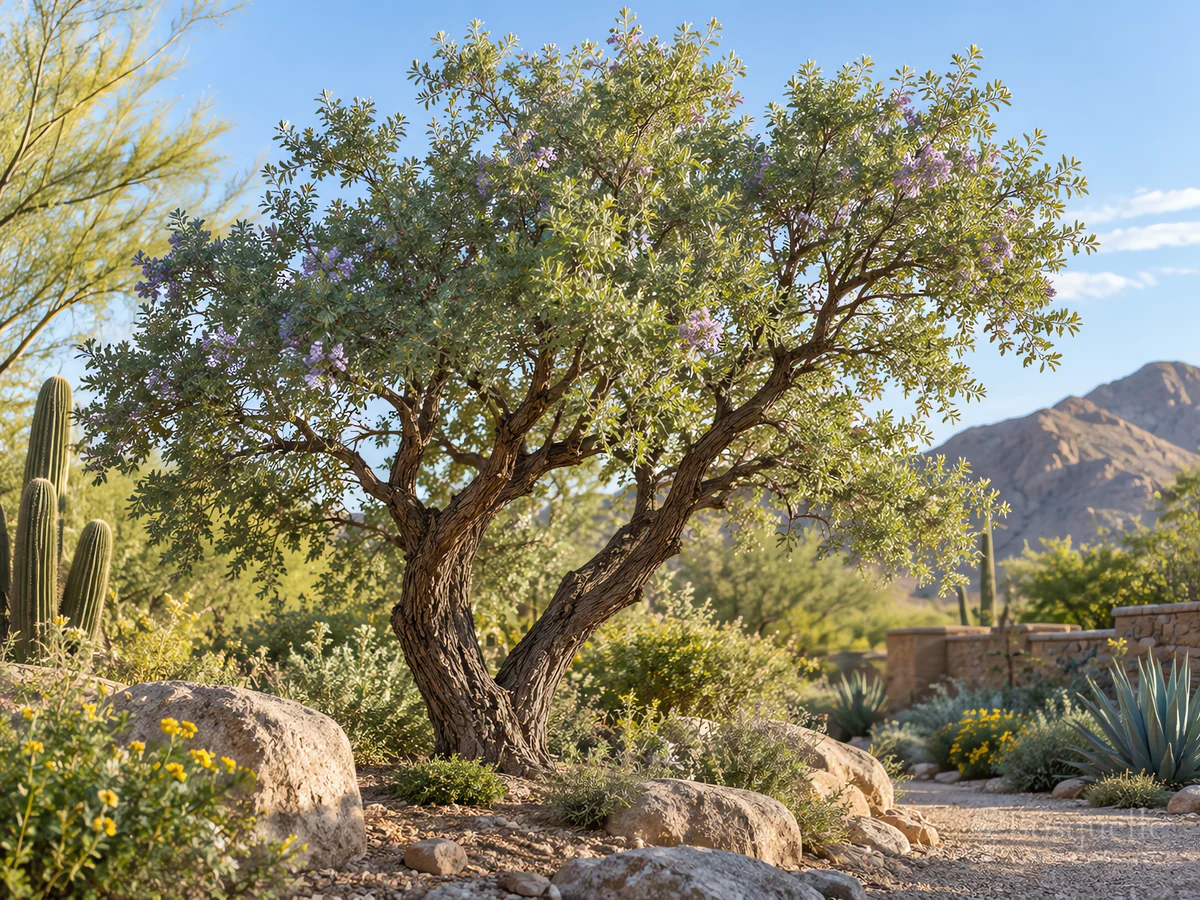
Grow desert ironwood in full sun and soil that drains, and water it deeply while it is young, then back off. Desert ironwood is Olneya tesota, also called tesota or palo de hierro — a Sonoran Desert tree, not palo verde and not mesquite.
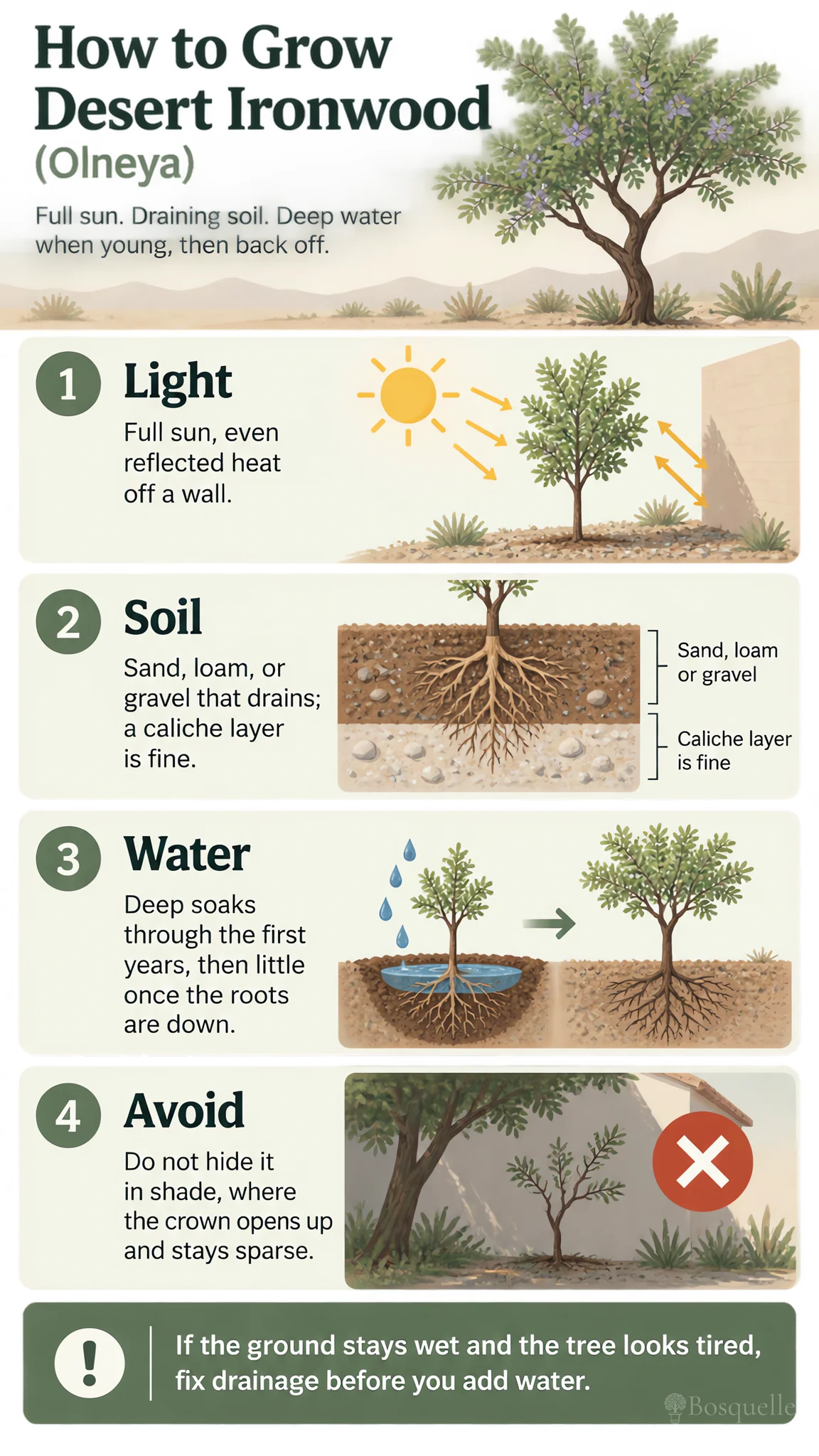
Give it full sun, soil that drains, and deep water while it is young
| Factor | Recommended | Avoid |
|---|---|---|
| Light | Full sun, even reflected heat off a wall | Do not hide it in shade, where the crown opens up and stays sparse |
| Soil | Sand, loam, or gravel that drains; a caliche layer is fine | Do not plant it in a wet lawn or a low hole that stays soggy |
| Water | Deep soaks through the first years, then little once the roots are down | Do not keep the soil wet after the tree is settled |
| Cold | A sheltered site for a young tree; cover it on a hard freeze | Do not plant a young tree in a frost pocket |
| Feed | Skip nitrogen fertilizer | Do not treat yellow leaves as a missed feeding if the ground is still wet |
| Size | Leave room for about 15 to 30 feet tall and as wide | Do not site it under a low line or against a walk it will overgrow |
Desert ironwood is a slow Sonoran Desert tree with gray-green paired leaflets and a pair of small curved spines at each leaf base. Give it open sun. It will grow in most soils that drain, even when caliche sits near the surface, and it makes filtered shade once the crown opens. [1]
Water it deeply through the first years so the roots go down, then water less. After that, a deep soak every month or two in a long dry spell is enough, and many established trees live on rainfall. Soggy soil around the roots is the usual cause of decline, not a missed watering. Skip nitrogen fertilizer; the tree fixes its own. [2] [3]
Each leaf carries a pair of small curved spines at the base, so keep young wood off a narrow walk. [4] A young tree can be hurt near 25 F, and an older one near 20 F. Plant it out of a frost pocket, and cover a first-year tree if a hard freeze is coming. In a long drought it may drop leaves and leaf out again when water returns; that is rest, not death. When you are ready to set a nursery tree in the ground, read Planting Desert Ironwood.
How much sun does desert ironwood need?
Give it full sun. Shade makes a sparse crown and a thinner bloom.
How often do I water an established tree?
Little or none after the first years. A deep soak every month or two in a long dry spell is enough. Wet soil around the roots is the usual cause of decline.
Is desert ironwood drought tolerant?
Yes, once the roots are down. Water it deeply while it is young, then back off. It still wants soil that drains.
Will a freeze kill a young tree?
A hard freeze near 25 F can damage a young tree. Site it out of a frost pocket, and cover it the first winter if a hard freeze is coming. Older trees hold closer to 20 F.
It flowers in late spring, then the pods follow
Clusters of small lavender to pink pea flowers open in late April and May, sometimes into June. The show can last only a couple of weeks, and a heavy bloom is not guaranteed every year. Bees work the flowers. After bloom the tree sets short brown pods with one to a few hard, dark seeds.
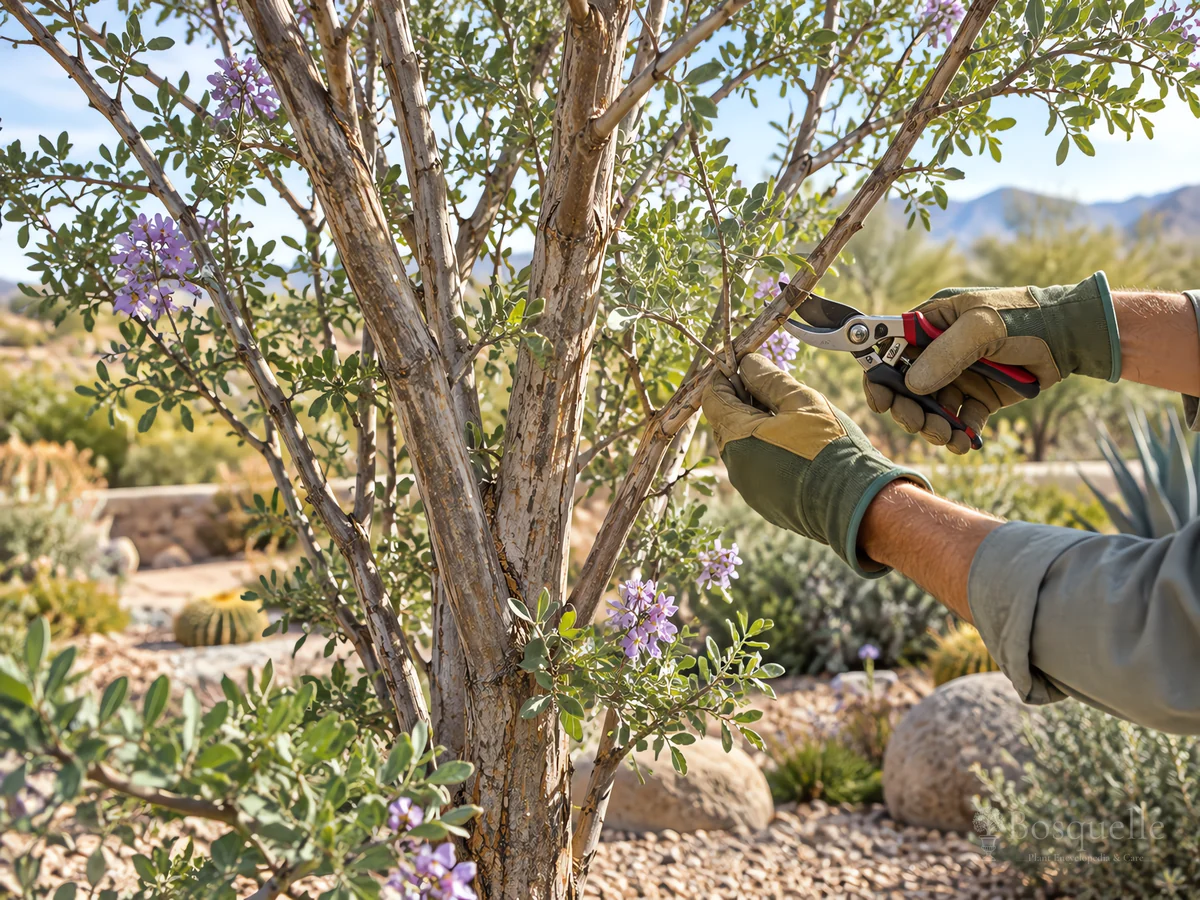
The tree may drop some leaves just before it flowers. That is normal. If you need to lift low, spiny wood off a walk, that cut is a prune job, not a change in watering. That method is on Pruning Desert Ironwood.
When does desert ironwood flower?
Late spring, usually April into May. The pods follow in early summer. A heavy bloom is not guaranteed every year.
Not palo verde — and not mesquite or another ironwood
Palo verde is Parkinsonia, the green-bark tree with yellow flowers. If the tag says palo verde, read How to Grow Palo Verde instead. Mesquite is Prosopis, with darker bark and a different pod; that job is How to Grow Mesquite.
Ironwood is a nickname for several unrelated trees. Catalina ironwood is a Channel Islands evergreen with fern-like leaflets and no spines; read How to Grow Catalina Ironwood. Persian ironwood is Parrotia, a deciduous tree with mottled bark and fall color — How to Grow Persian Ironwood. This tree is Olneya, the thorny Sonoran shade tree.
Is this the same as palo verde?
No. Desert ironwood is Olneya tesota, with gray-green leaflets and lavender pea flowers. Palo verde is Parkinsonia, with green bark and yellow flowers.
If the ground stays wet and the tree looks tired, fix drainage before you add water. Next season, keep the first years watered and the soil dry once the tree is settled.
FAQ
Is there more than one kind of desert ironwood?
This catalog holds one species, Olneya tesota. Shops sometimes sell a named clone called AZT with a more upright form. Both want full sun, drain, and the same first-year water.
Can I grow desert ironwood in a pot?
Only as a nursery tree you plan to plant out. It makes a long taproot and stays stunted in a small pot. It is not a houseplant.
What can I plant under desert ironwood?
Sun-tender desert plants that want filtered shade once the crown opens — cactus, and other dry-ground neighbors such as creosote bush or ocotillo. Keep a wet lawn off the trunk.
Is desert ironwood used for wood?
The wood is very hard and dense. On wild Arizona trees it is a protected native plant, so do not cut a wild trunk for carving or firewood. Grow the tree for shade, not to harvest the wood.
Are desert ironwood seeds edible?
People roast the seeds, and the flowers can be eaten. That is not a harvest job on this page. If you try seed, cook it; do not eat a raw handful as a snack.
What about desert mistletoe on the tree?
Desert mistletoe can load an older tree. Cut the clumps out when they get heavy. That is a prune cut, not a spray job.
Related guides


Recommended plants

References
- [1] Arizona-Sonora Desert Museum -
https://www.desertmuseum.org/visit/sheets/Olntes.pdf - [2] Southwest Gardener -
https://swgardener.com/ironwood/ - [3] Garden Oracle -
https://gardenoracle.com/images/olneya-tesota.html - [4] University of Arizona Cooperative Extension, Yavapai County -
https://yavapaiplants.extension.arizona.edu/olneya-tesota
This note is part of Olneya Guides.
More first-season notes by plant are gathered in How to Grow Guides.
Updated: Reviewed by Bosquelle Editors