
Grow dayflower in full sun, in dry sand that drains. Dayflower is Commelina erecta. Shops also say widow's tears. It is not a spiderwort, and it is not a daylily.
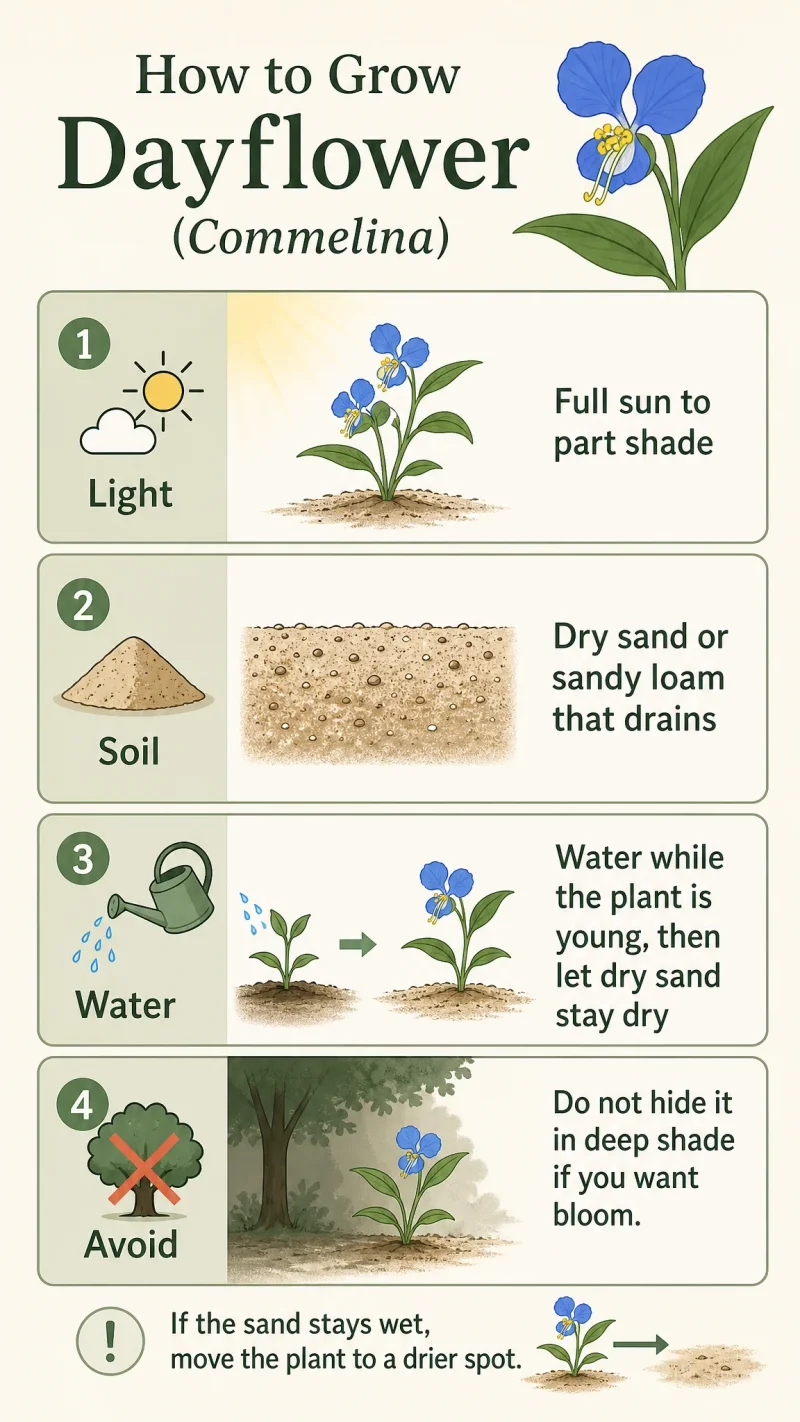
Give it full sun and dry sand that drains
| Factor | Recommended | Avoid |
|---|---|---|
| Light | Full sun to part shade | Do not hide it in deep shade if you want bloom |
| Water | Water while the plant is young, then let dry sand stay dry | Do not keep the bed as wet as a lawn weed |
| Soil | Dry sand or sandy loam that drains | Do not plant it in a soggy, rich patch |
| Spread | A wildflower strip where stems can sprawl | Do not toss cut stems in the compost pile if you do not want more plants — they re-root |
| Winter | Leave the clump in drained ground | Do not lift it like a tender bulb |
Dayflower is Commelina erecta, a native perennial whose two large blue petals sit above a small white petal. Each flower opens in the morning and is finished by afternoon, but later buds keep the clump in bloom. Give it full sun to part shade and dry sand, because a wet, rich bed favors the weedy Asiatic annual instead. [1] Water a young plant until the roots take, then let the sand dry. Established clumps take drought. Stems start upright, then sprawl along the ground. [2]
How do you care for a Commelina plant?
Give native dayflower full sun to part shade and dry sand that drains. Water while it is young, then let the sand dry.
How do you grow a Commelina plant?
Site it in dry sand, start a stem cutting in the growing season, and plant the rooted piece after frost.
What type of soil does Commelina grow in?
Dry sand or sandy loam that drains. Skip a soggy, rich patch.
Plant a rooted cutting in spring
The usual start is a stem cutting in the growing season. Seed works, but a cutting is faster if you already have a plant. Set a rooted piece out after frost, in the same dry sand you would give a mature clump.
- Cut a stem with one to three nodes, and strip the lower leaves.
- Tuck a bare node into moist sandy mix that drains, and keep it barely moist until the cutting resists a gentle tug. [3]
- Grow it on until the plant is at least six inches tall.
- After frost, set it in dry sand at the same depth it grew in the pot, and water the first weeks so the roots take.
- Then taper the water. An established plant in sand does not need a wet calendar.
Can I start a new plant from a cutting?
Yes. A stem with one to three nodes roots in moist sandy mix. Set the plant out after frost when it is at least six inches tall.
Seed works, but a cutting is faster
Sow seed in a warm pot in spring and keep the mix barely moist. Move seedlings out after frost the same way as a cutting. If you already have a clump, a cutting is the quicker copy.
Not Asiatic dayflower — and not spiderwort
Asiatic dayflower is Commelina communis, a weedy annual that roots at every node in moist ground. Its spathe is open to the base, and the yellow false anthers often show a maroon spot. Native dayflower has a spathe fused along the bottom third, and it wants dry sand, not a wet lawn edge. [4] Spiderwort is Tradescantia: three petals the same size and color, and the buds sit in an open cluster, not in a folded boat bract — see How to Grow Tradescantia. Daylily is Hemerocallis, a clump of strap leaves with big trumpets — see How to Grow Daylilies. A shop search for widow's tears is often Tradescantia, spotted Tinantia, or hot water plant — see How to Grow Hot Water Plant. This dayflower is a sandy native for a bed, not a hanging-basket houseplant.
How do you care for Commelina communis?
That query is usually the weedy annual. Native dayflower wants dry sand and does not need a wet lawn.
What is a widow's tears plant?
Shops use widow's tears for this dayflower and for spiderwort or a houseplant. Check for two blue petals and a small white mouth in a folded bract.
Is this a daylily?
No. Daylily is Hemerocallis, with strap leaves and big trumpets. Dayflower has two blue petals and a small white mouth.
If the sand stays wet, move the plant to a drier spot. If the flower has three equal petals, you have a spiderwort, not this dayflower.
FAQ
Can I grow dayflower in a pot?
A drained pot of sandy mix can hold a plant outdoors. This is a bed wildflower, not an indoor hanging basket.
Are widow's tears a good houseplant?
That search is usually Tradescantia or Tinantia in a pot. Native dayflower is a sandy outdoor plant.
Can I eat dayflower?
Some people cook young shoots. Grow this plant for the morning flowers, not as a kitchen crop.
Is dayflower poisonous to pets?
This plant is not on the usual pet-toxin list. Still keep dogs and cats from chewing garden plants.
Will it take over the bed?
Stems can sprawl and re-root where they touch soil. Pull extras if they leave the strip. It does not usually run like Asiatic dayflower.
Recommended plants

References
- [1] Lady Bird Johnson Wildflower Center -
https://www.wildflower.org/plants/result.php?id_plant=coer - [2] University of Florida IFAS -
https://edis.ifas.ufl.edu/publication/EP668 - [3] USDA NRCS Plant Materials -
https://plants.sc.egov.usda.gov/DocumentLibrary/plantguide/pdf/pg_coer.pdf - [4] Minnesota Wildflowers -
https://www.minnesotawildflowers.info/flower/slender-dayflower
More first-season notes by plant are gathered in How to Grow Guides.
Updated: Reviewed by Bosquelle Editors