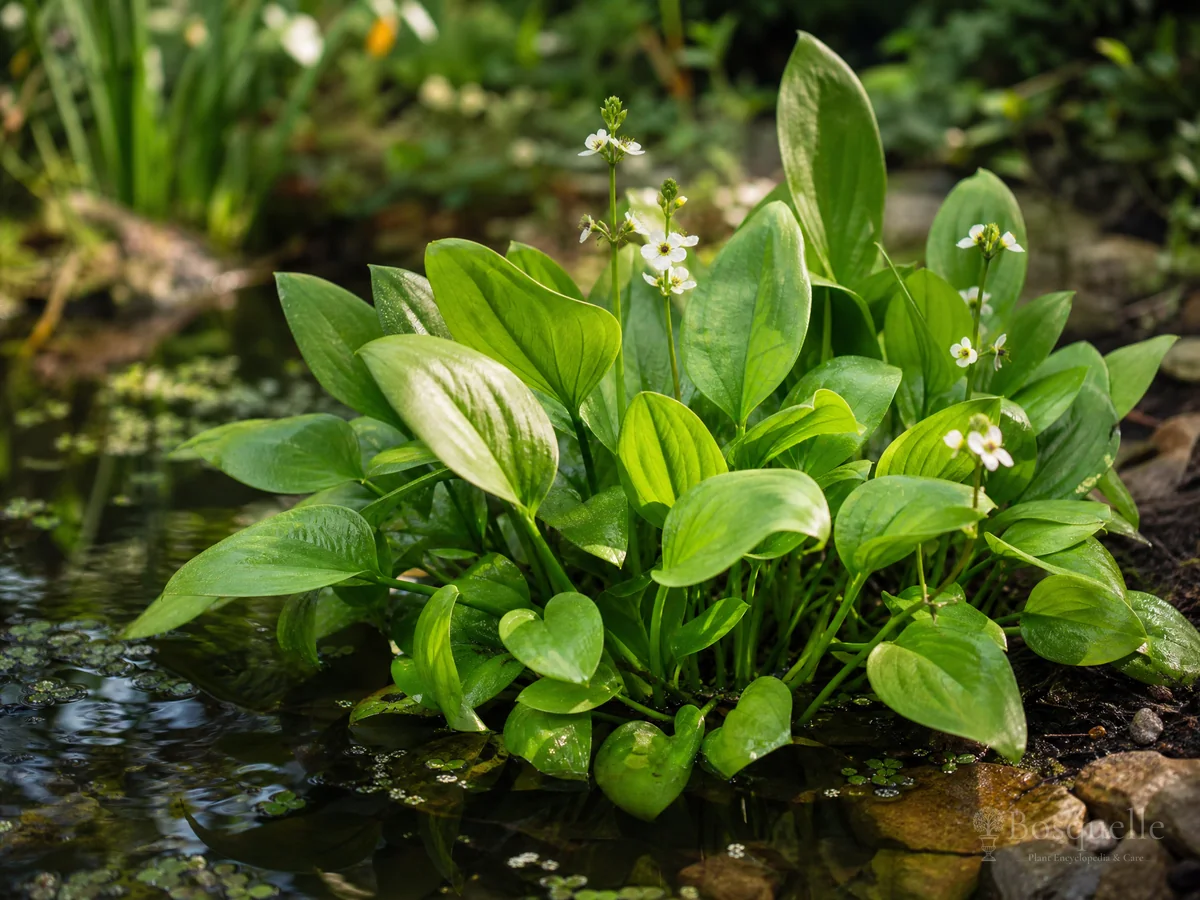
Grow creeping burhead in wet mud or shallow water, in sun or part shade. Echinodorus is also sold as radican sword. It is not a tank Amazon sword and not pond arrowhead.

Keep it in wet mud or shallow water, in sun or part shade
| Factor | Recommended | Avoid |
|---|---|---|
| Light | Sun to part shade. A slightly shaded wet bank is fine | Do not plant it on a dry bank in full sun |
| Water | Wet mud, a pond shelf, or shallow water. After it takes, up to about 1 foot in the growing season | Do not let the crown dry out |
| Soil | Heavy loam, clay, or muck that stays wet | Do not plant it in a mix that drains in a day |
| Pot | A mesh pond basket if you need a contained clump | Do not toss extras into a lake, ditch, or storm drain |
| Winter | Leave the clump in wet mud. Deeper water is fine when growth stops | Do not lift it into a dry pot for winter |
Creeping burhead wants wet mud or shallow water. Sun to part shade is the usual pond-edge home, and a slightly shaded wet bank still works when the mud never dries. [1] creeping burhead uses that wet as a basal clump of heart-shaped to egg-shaped leaves and an arching flower stalk. It is a short-lived perennial, and in some ponds it behaves like a hardy annual. It is not a dry-bed weed and not a windowsill houseplant.
How much sun does creeping burhead need?
Give it sun to part shade. A slightly shaded wet bank is fine. A dry bank in full sun crisps the leaves.
How wet does it need to stay?
Keep the crown wet. Wet mud, a pond shelf, or shallow water is the home. A dry week crisps the leaves.
Plant a transplant in wet mud or a pond basket, and keep the water shallow until it takes
Plant in spring or fall from a potted plant or a rooted plantlet. Set the crown in heavy loam in wet mud or a mesh pond basket, with the buds facing up. Keep the water about 1 to 2 inches until the clump takes, then it can sit in up to about 1 foot of water in the growing season. [2] Leaves should stand above the surface while it is settling. Do not drop a small transplant off a deep shelf. A pond basket works when the mix stays wet. [3]
- Plant in spring or fall, once the water will stay up. Year-round planting is possible, but spring and fall are less stressful.
- Set the crown in heavy loam in wet mud or a mesh pond basket, with the buds facing up, not buried in a deep hole. Cut any attached flower stalks on a new transplant so it settles.
- Keep the water about 1 to 2 inches until the clump takes. Then it can sit in up to about 1 foot of water in the growing season; do not drop a small plant off a deep shelf.
- Space clumps about 2 to 3 feet apart. Cap the basket with a little gravel so the mix does not float, and keep extras in the pot.
- If you need to stop it filling every inch of shallow shelf, surround the patch with water deeper than about 1 foot. Bag extras. Do not toss them into a lake, ditch, or storm drain.
How do I plant creeping burhead?
Set the crown in heavy loam in wet mud or a mesh pond basket in spring or fall, buds up. Keep the water about 1 to 2 inches until it takes, then up to about 1 foot.
Let the flower stalk bend and root, then lift the plantlets
The flower stalk starts upright, then lengthens and bends onto wet mud. New plantlets form at the nodes and at the tip once they touch wet ground. That creeping stalk is how the clump spreads, not a problem you have to spray.
- Let a flower stalk lengthen and bend onto wet mud or the basket if you want more plants.
- Wait until a plantlet at a node has roots and a few leaves.
- Snip it free and pot it at once in wet mud or a fresh basket, crown up, in about 1 to 2 inches of water until it takes.
- If you do not want more plants, cut the stalk before it roots on the mud.
How do I get more plants?
Let a flower stalk bend onto wet mud. When a plantlet has roots and a few leaves, snip it free and pot it at once. You can also split a crowded clump in spring or fall.
Split a crowded clump in spring or fall
Most gardeners start a new patch from a rooted piece, not from seed. Lift a crowded clump in spring or fall while the mud is wet, keep a bud and some roots on each piece, and replant at once in wet mud or a fresh basket.
- Lift a crowded clump in spring or fall while the mud is wet and workable.
- Pull or cut a piece that has roots and at least one bud. Small plantlets around the parent are easier than splitting a huge crown.
- Replant at once in wet mud or a fresh basket, and keep it wet while it takes.
Not pond arrowhead — and not water plantain, a tank Amazon sword, or a snake plant
A tag that says arrowhead is often pond arrowhead, Sagittaria, with arrow-shaped leaves — see How to Grow Pond Arrowhead. Creeping burhead has heart-shaped to egg-shaped leaves and a globe of bur-like seeds, not a flat ring.
Water plantain is Alisma, the same family with a tall spray of tiny flowers and seeds in a ring — see How to Grow Water Plantain. A houseplant sold as arrowhead plant is Syngonium — see How to Grow Arrowhead Plant. [4] A tank Amazon sword is usually a different Echinodorus, sold for a submerged aquarium, not this pond plant. A tag that says sword plant is often a snake plant — see How to Grow Dracaena.
Is this pond arrowhead?
No. Pond arrowhead is Sagittaria, usually with arrow-shaped leaves. Creeping burhead has heart-shaped to egg-shaped leaves and a globe of bur-like seeds.
Is this an Amazon sword?
No. A tank Amazon sword is usually a different Echinodorus kept fully underwater. This shop card is creeping burhead, a pond plant with an arching flower stalk.
Set creeping burhead in wet mud or shallow water, plant a transplant in 1 to 2 inches of water until it takes, and let the flower stalk root if you want more plants.
FAQ
Can I grow creeping burhead as a tank Amazon sword?
It will try to make floating and emergent leaves once the light is strong. A tank stay-underwater setup is a different job. Grow this card as a pond plant, with leaves standing above the water.
Can I grow it in a dry pot?
No. A mix that dries in a day crisps the leaves. A pond basket works when the soil stays wet or sits under a few inches of water. It is not a dry patio plant.
Is tall burhead the same plant?
Tall burhead is usually Echinodorus berteroi, an erect annual with a branched flower stalk. This shop card is creeping burhead, a perennial whose flower stalk bends and roots. Both want wet mud. Do not toss extras into a wild pond.
Can I grow it from seed?
You can, but most gardeners pot a rooted plantlet or split a clump. The fruit is a bur-like head, and the baskets still have to stay wet.
Recommended plants

References
- [1] USDA NRCS Plant Materials Center -
https://plants.usda.gov/DocumentLibrary/factsheet/pdf/fs_ecco3.pdf - [2] Mississippi State University Extension -
https://extension.msstate.edu/publications/creeping-burhead-echinodorus-cordifolius - [3] Lady Bird Johnson Wildflower Center -
https://www.wildflower.org/plants/result.php?id_plant=ecco3 - [4] Missouri Department of Conservation -
https://mdc.mo.gov/discover-nature/field-guide/tall-burhead
More first-season notes by plant are gathered in How to Grow Guides.
Updated: Reviewed by Bosquelle Editors