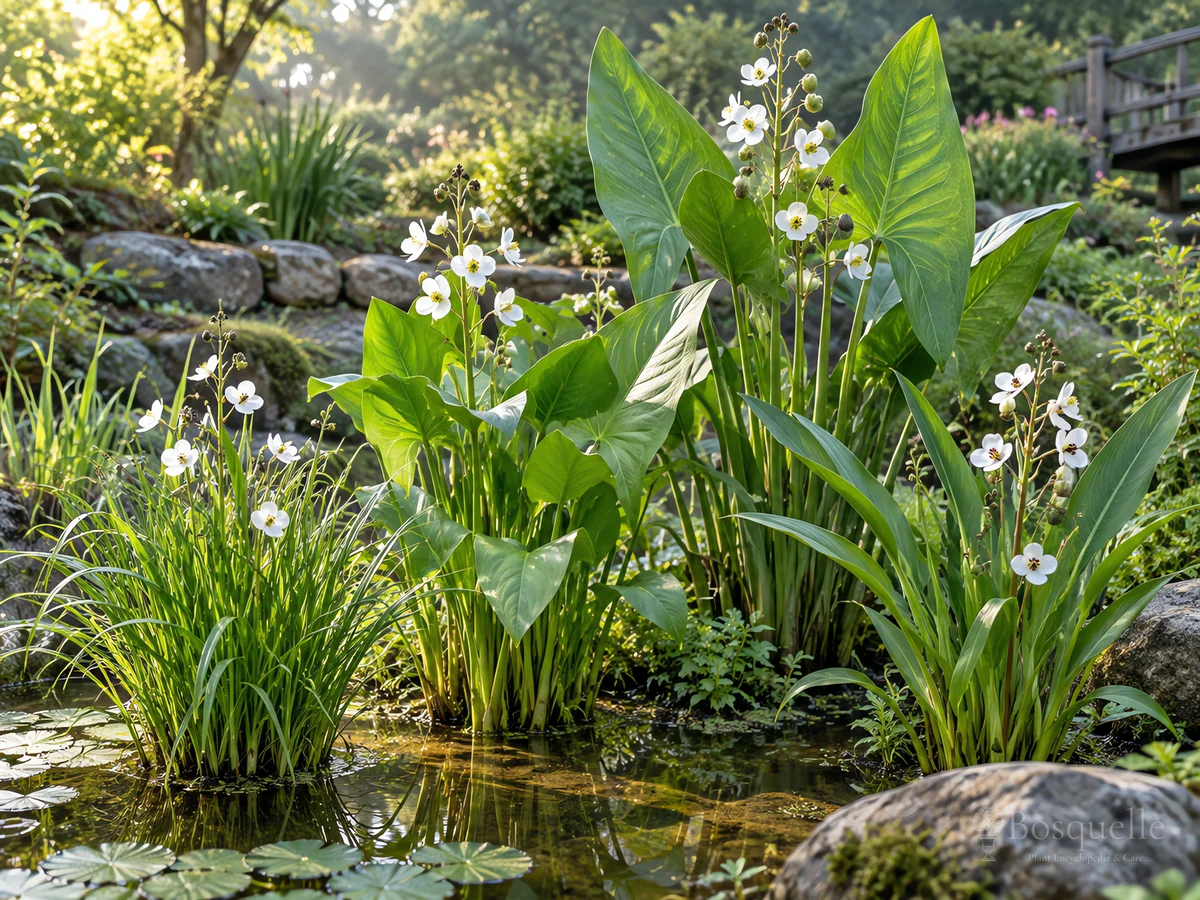
Grow pond arrowhead in wet mud or shallow water and full sun. Shops also call it duck potato. This shoreline plant is Sagittaria — not a houseplant arrowhead plant.

Keep the mud wet, and give it full sun
| Factor | Recommended | Avoid |
|---|---|---|
| Sun | Full sun, several hours of direct light | Do not site it in a dim corner or under a heavy eave |
| Water | Wet mud or shallow standing water that never dries | Do not plant it in a dry border, or in a bed that crusts over in heat |
| Site | A pond edge, a lined tub, or a rain-garden low spot you can keep wet | Do not set it in an open ditch that floods into a creek |
| Spread | Thin crowded clumps so other plants still get light | Do not let rhizomes wash out of the pond |
The plant wants bright sun and soil that stays wet so the leaves stand above the water and the white flowers open. A dry bed kills the corms, and deep shade cuts bloom. Rhizomes run through the mud and set new corms at the ends. [1] [2] A native shoreline plant such as broadleaf arrowhead shares that same wet mud and sun. Match kind on Types of Pond Arrowhead.
If leaf tips brown while the mud is still wet, check sun first. These plants take nutrients from the pond; extra feed in a small tub only thickens algae.
Does this plant need full sun?
Yes. Give it several hours of direct sun so the leaves stay upright and the flowers open. Deep shade keeps the stalks weak and cuts bloom.
Can I grow it in a dry border?
No. Keep the mud wet, or set it in shallow standing water. A dry bed is the usual reason the corms rot back to nothing.
Keep extras in the pond, and never toss giant arrowhead into a lake
Corms, rhizomes, and seed start new plants. A backyard pond can hold a clump. A lake, canal, or ditch cannot take the extras.
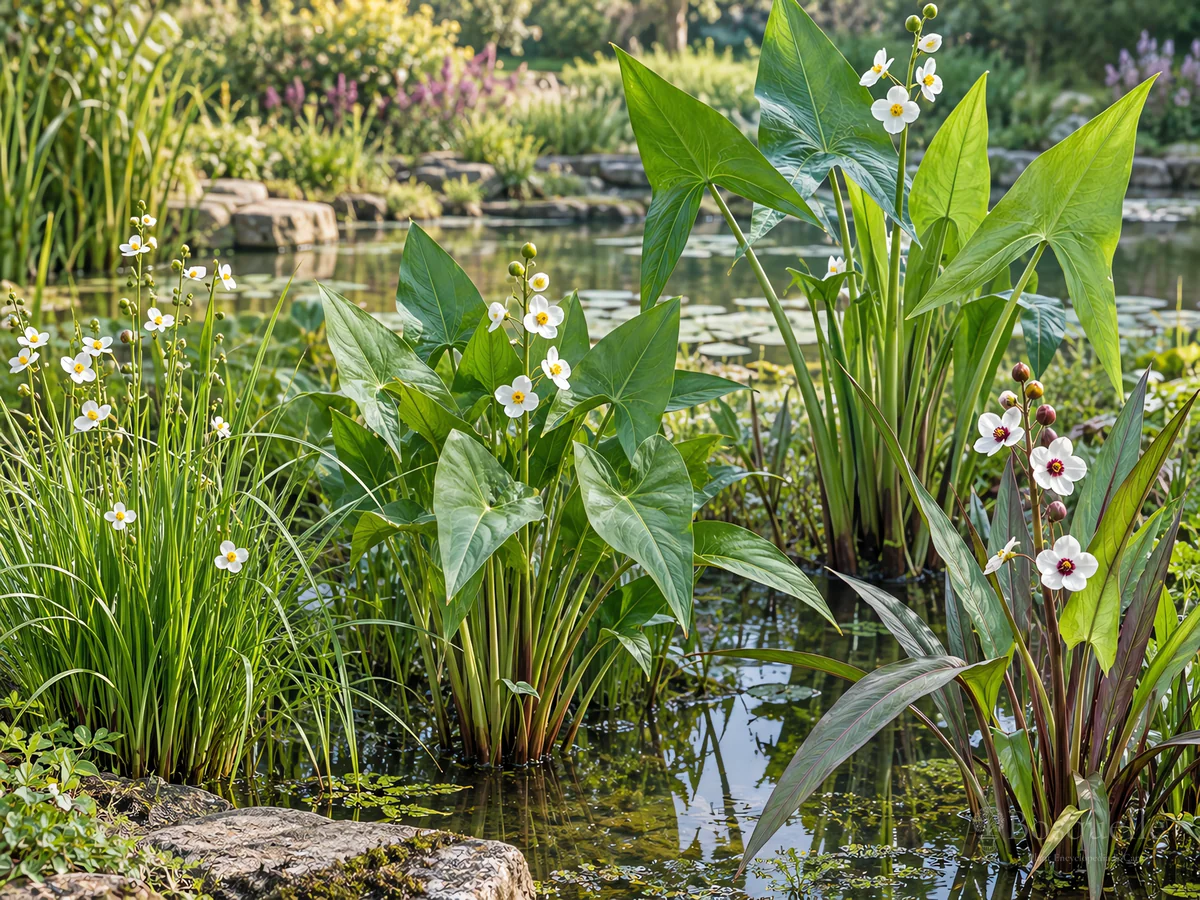
- Read the tag before you buy. giant arrowhead is non-native in many U.S. ponds. It shows a brownish-purple spot at the base of each petal. [3]
- Keep the clump inside the pond or tub. Scoop loose leaves, rhizomes, and corms out of the overflow.
- Cut spent flower stalks before they drop seed, so seed does not wash downstream.
- Put unwanted plants in a sealed bag in the trash. Do not toss them on a bank, into a storm drain, or into a public lake. [4]
- If leaves cover the whole shoreline, thin them so fish and other plants still get light. If you are setting a new plant, use Planting Pond Arrowhead.
Can I toss extras in a nearby lake?
No. Corms and seed start new stands. Put unwanted plants in a sealed bag in the trash.
Not a houseplant arrowhead plant
Garden shops sell a houseplant called arrowhead plant. That plant is Syngonium, a vine for a pot indoors. This pond plant is an aquatic with rhizomes and corms in wet mud. Grow the houseplant on How to Grow Arrowhead Plant.
Aquarium shops sell dwarf sagittaria as a submerged grass. That plant is a different species, and it is not in this catalog. Do not treat a tank carpet as this pond plant.
Some pond leaves look a little like taro. Taro and elephant ear sit in a different genus. Grow those on How to Grow Colocasia.
Is this the same as a houseplant arrowhead plant?
No. This pond plant is Sagittaria in wet mud. A houseplant arrowhead plant is Syngonium, a vine for a pot indoors.
Leave the corms in wet mud through winter
Leaves die back when the weather turns cold. The corms stay alive in wet mud, so do not let the bed dry or freeze into a cracked crust.
- Leave the corms in wet mud or in the basket you already planted. Do not dump the clump on a dry bank for winter.
- After the leaves brown, cut the dead stalks and scoop rotting leaves out of the pond so they do not foul the water.
- If the pond will drain or freeze solid down to the mud, lift the basket and keep the corms moist and cool until spring. Do not store them dry on a shelf.
- When the pond warms, return the basket to shallow water. Set a new plant on Planting Pond Arrowhead.
Can I leave the corms in the pond all winter?
Yes, if the mud stays wet. Leaves die back. Lift the basket only if the pond will drain or freeze solid down to the mud, and keep those corms moist until spring.
If the mud has dried, or extras wash toward a ditch, wet the site and bag the extras now — do not wait for a stand on the next lake.
FAQ
Can I eat the corms?
Some kinds have starchy corms that people have cooked after boiling. Do not eat a plant you pulled from a wild marsh unless you can name it for sure — arrow arum looks similar and is not a food plant.
What about aquarium dwarf sagittaria?
That is a different, low submerged species sold for tanks. It is not in this catalog. This plant is an emergent shoreline plant.
What pests show up on pond arrowhead?
Aphids and spider mites sometimes sit on the stalks. Wipe or rinse them off. Do not pour herbicide into a backyard pond without a permit for that water.
Related guides

Recommended plants


References
- [1] Pond Informer -
https://pondinformer.com/common-arrowhead-sagittaria-latifolia/ - [2] NC State Extension Gardener -
https://plants.ces.ncsu.edu/plants/sagittaria-lancifolia/ - [3] Mississippi State University Extension -
https://extension.msstate.edu/publications/arrowhead-sagittaria-spp - [4] Texas A&M AgriLife AquaPlant -
https://aquaplant.tamu.edu/plant-identification/alphabetical-index/arrowhead/giant_arrowhead/
This note is part of Sagittaria Guides.
More first-season notes by plant are gathered in How to Grow Guides.
Updated: Reviewed by Bosquelle Editors