
Grow chirita in bright indirect light, keep the mix evenly moist, and water around the crown so the hairy leaves stay dry. Chirita is Deinostigma tamiana. Shops also say Asian violet. An African violet is Saintpaulia, a fuzzier rosette with a different flower.

Give it bright indirect light, keep the mix evenly moist, and water around the crown
| Factor | Recommended | Avoid |
|---|---|---|
| Light | Bright, indirect light; a north or east window, or a sheer curtain | Do not set it in harsh midday sun, which scorches the hairy leaves |
| Water | Keep the mix evenly moist, and water at the rim when the top feels just dry | Do not pour water into the center of the rosette, and do not leave the pot sitting in water |
| Mix | A loose, well-drained mix that still holds moisture, such as an African-violet mix | Do not use a dense, soggy mix that stays wet around the small roots |
| Winter | Keep it as a houseplant, and water a little less if growth slows | Do not leave a patio pot out through a freeze |
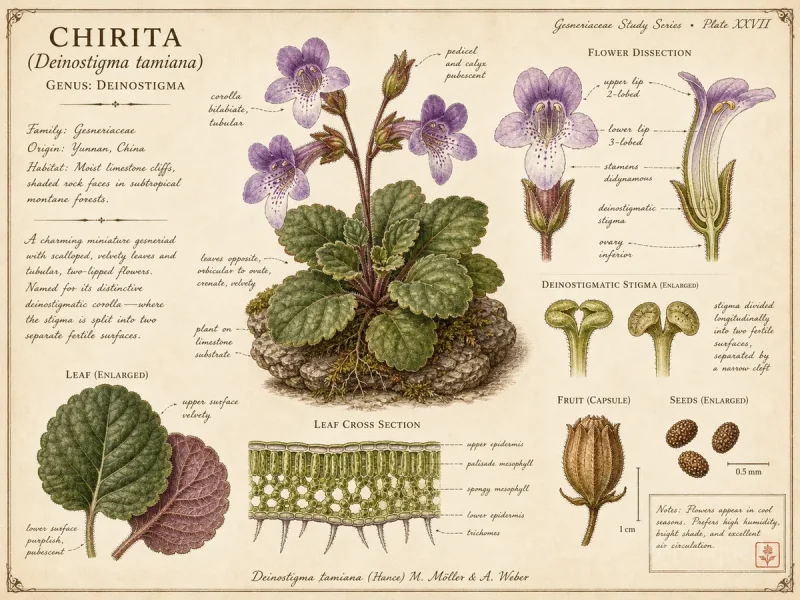
chirita is Deinostigma tamiana, a miniature gesneriad from Vietnam. It makes a small rosette of hairy, ovate leaves, then holds white trumpet flowers with dark purple marks in the throat. [1] Set it in bright, indirect light. Shade to filtered sun is fine; harsh light scorches the leaves. Keep the mix evenly moist, not bone-dry and not waterlogged. [2] Water at the rim of the pot, or from below, so the hairy crown stays dry. Empty the saucer. The plant copes with ordinary room air, though a humid windowsill or a closed jar helps the leaves stay plump.
It flowers almost year-round in good light. If bloom stalls, move it a little warmer or brighter, still off hot glass.
- Place it in bright, indirect light. A north or east window is enough.
- Water when the top of the mix feels just dry. Water at the rim until it runs out, then empty the saucer.
- Keep water off the hairy crown. Wet leaves that sit in the center of the rosette rot.
- Feed at half strength every few weeks while it is growing. Skip fertilizer if growth slows in winter.
How do you care for chirita?
Give it bright indirect light, keep the mix evenly moist, and water around the crown so the hairy leaves stay dry.
How often should I water chirita?
Water when the top of the mix feels just dry. Keep the rest of the mix moist, not soggy, and empty the saucer.
Why are the leaves scorching or the crown rotting?
Harsh sun scorches the leaves. Water sitting in the hairy crown, or a pot left in a saucer, rots the base. Move it out of hot sun and water at the rim.
Pinch spent flower stems, and bring the pot in before a freeze
This plant does not need pruning like a shrub. When a flower stem browns, pinch or cut it at the base so new stems can rise. Pull off yellow or tatty leaves the same way. A second plant from a leaf is a separate job on How to Propagate Chirita.
It will not take a freeze. Grow it as a houseplant, or bring a patio pot in before a freeze. Water a little less if growth slows in winter, and skip fertilizer until new leaves show.
Use a small pot that drains, and wait to repot
Chirita has a small root system. A three-inch pot with a drainage hole is enough for one rosette. [3] Use a loose mix that drains, such as an African-violet mix, so the roots stay moist without sitting wet. Wait to repot until the mix has broken down or the plant is pushing over the rim, usually in spring. Step up only one size. Leaf cuttings and a long neck belong on How to Propagate Chirita.
- Choose a small pot with a drainage hole, about three inches across for one plant.
- Fill it with a loose mix that still holds moisture. Set the rosette so the crown sits at the mix surface, not buried.
- Water at the rim until it runs out, then empty the saucer. Set it in bright, indirect light.
- Wait to repot until spring, when the mix is tired or the clump is crowded. Go up one size.
Can chirita grow indoors?
Yes. Give it a north or east window, a small pot that drains, and water at the rim when the top of the mix is just dry.
When should I repot it?
When the mix has broken down or the rosette is crowding the rim, usually in spring. Stay one size up. A three-inch pot is plenty for one plant.
Not an African violet, not a Cape primrose, and not florist gloxinia
A shop tag that says Asian violet or chirita is sometimes confused with African violet (Saintpaulia): a fuzzier, usually larger rosette with rounder flowers. This plant stays miniature, with white trumpets and purple marks in the throat. [4] A Cape primrose is Streptocarpus: long strap leaves and larger flowers. See How to Grow Cape Primrose if that is the plant you bought. Florist gloxinia is Sinningia, grown from a tuber, not this tiny evergreen rosette. Primulina and Metapetrocosmea on a tag are older or newer names for this same plant, not a second kind we hold.
Is chirita the same as an African violet?
No. African violet is Saintpaulia. This plant is a miniature Vietnamese gesneriad with white trumpets and purple throat marks.
Is this a Cape primrose?
No. Cape primrose is Streptocarpus, with long strap leaves. This plant is a tiny rosette.
Keep it in bright indirect light, with evenly moist mix and a dry crown. Take a leaf cutting if you want a second plant.
FAQ
Why do tags say Primulina or Metapetrocosmea?
Those are older or newer botanical names for this same miniature plant. The light, water, and small pot still apply.
Does it need a cooler night to bloom?
A slightly cooler night can help it set buds. If it is already flowering in bright indirect light, leave it. Do not move it into a cold draft.
Is chirita toxic to cats?
This species is not listed on the ASPCA plant list. African violet is listed as non-toxic, but that is a different plant. Keep pets from chewing the leaves.
What about mealybugs or other sucking insects?
Wipe them off the leaves as soon as you notice them, and keep the mix from staying soggy. Do not soak the crown with a spray.
Related guides

Recommended plants
References
- [1] National Parks Board Singapore -
https://www.nparks.gov.sg/florafaunaweb/flora/6/0/6017 - [2] Pumpkin Beth -
https://www.pumpkinbeth.com/2020/10/growing-deinostigma-tamiana/ - [3] Hermetospheres -
https://hermetospheres.com/2026/05/02/collected-once-and-never-again-since/ - [4] Pumpkin Beth -
https://www.pumpkinbeth.com/plants/deinostigma-tamiana/
This note is part of Deinostigma Guides.
More first-season notes by plant are gathered in How to Grow Guides.
Updated: Reviewed by Bosquelle Editors