
Grow carrots in full sun, in deep, loose soil that drains, and keep the moisture even so the roots stay sweet. Carrot is Daucus, a cool-season biennial grown as an annual for the taproot.
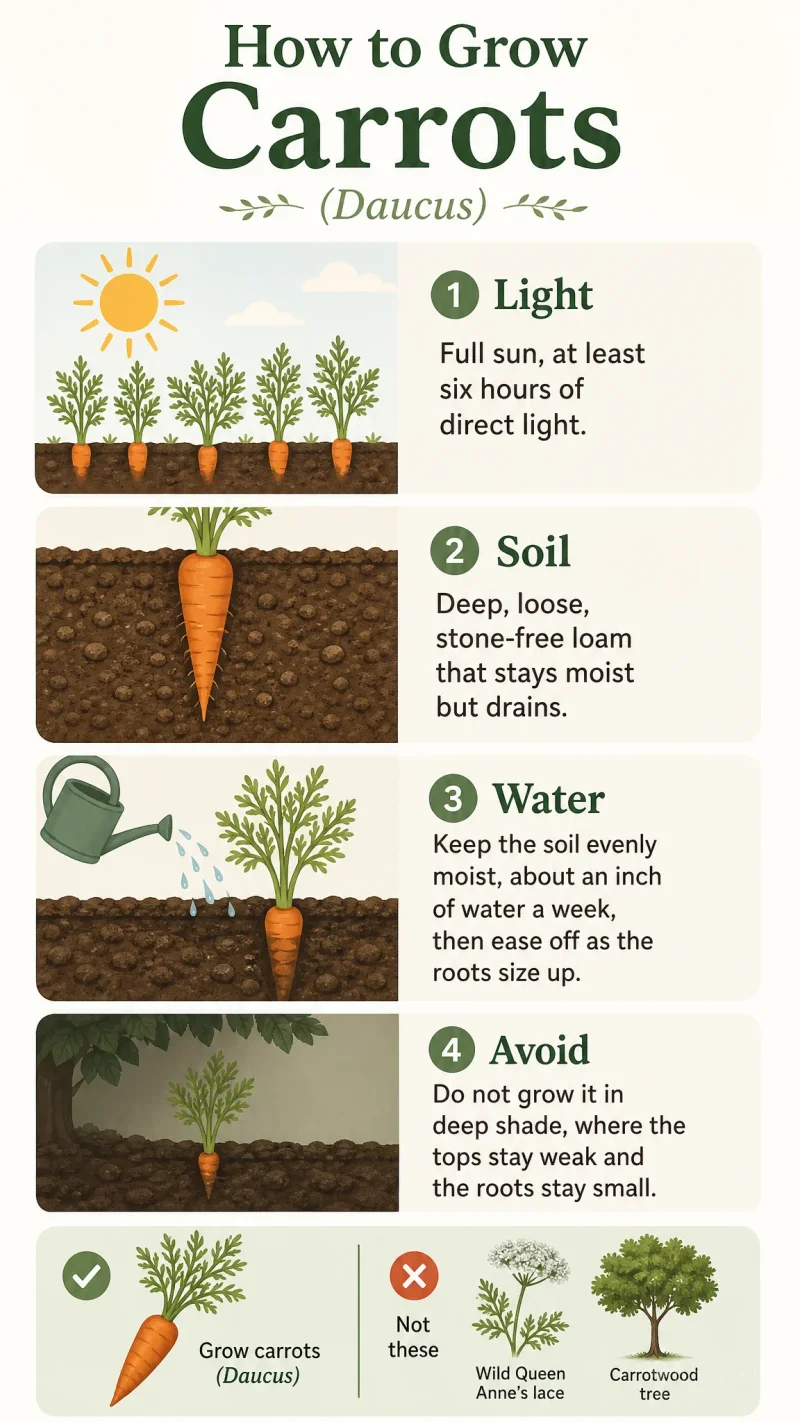
Give it full sun, loose soil that drains, and even moisture
| Factor | Recommended | Avoid |
|---|---|---|
| Light | Full sun, at least six hours of direct light | Do not grow it in deep shade, where the tops stay weak and the roots stay small |
| Water | Keep the soil evenly moist, about an inch of water a week, then ease off as the roots size up | Do not let the bed dry hard, then soak it, because that splits the roots |
| Soil | Deep, loose, stone-free loam that stays moist but drains | Do not plant into rocky or compacted ground, which forks the taproot |
| Feed | A moderate start from compost worked in before sowing | Do not pile on nitrogen, which grows lush tops and little root |
carrot wants an open, sunny bed of deep, loose soil that stays evenly moist. [1] Stones, clods, and hardpan bend the taproot into a fork, so work the bed deep and pick the rocks. [2] Give it at least six hours of direct light, and about an inch of water a week when rain does not do that job. [3] If the shoulder of the root pushes above the soil, hill a little soil over it so the top does not turn green. [4] If you are sowing this spring, the seed depth and thinning are on Planting Carrots. When the roots are ready to pull, see Harvesting Carrots.
- Set the row in full sun. Shade keeps the tops soft and the roots small.
- Work the soil deep and pick out stones and hard clods. A raised bed helps if the native ground is heavy clay.
- Water enough to wet the root zone, then keep that moisture even. Do not let the bed dry hard and then flood it.
- Weed shallow so you do not nick the shoulders, and hill soil over any root that shows above the surface.
Do carrots need full sun?
Yes. Give them at least six hours of direct light. Deep shade keeps the tops weak and the roots small.
How often should I water carrots?
Keep the soil evenly moist, about an inch of water a week when rain does not do it. Ease off a little as the roots size up so they do not split.
What is the trick to growing carrots?
Deep, loose, stone-free soil and even moisture. Rocks fork the root, and a dry spell followed by a heavy soak splits it.
Not Queen Anne's lace — and not a carrotwood tree
This plant is the garden taproot of Daucus. Wild Queen Anne's lace is the weedy biennial umbel of the same genus, not a vegetable row. Poison hemlock has hairless stems with purple blotches and a musty smell; do not eat a roadside umbel because you want a carrot. False Queen Anne's lace is Ammi, an annual cut flower — see How to Grow Ammi. Cow parsley is Anthriscus — see How to Grow Cow Parsley. Parsley, dill, and fennel are related kitchen herbs, not this swollen root — see How to Grow Parsley, How to Grow Dill, and How to Grow Fennel. A carrotwood tree is a street tree with the same nickname. Parsnip is Pastinaca, a longer white root you leave in the ground later into fall.
Is carrot the same as Queen Anne's lace?
No. Garden carrot is the first-year taproot. Queen Anne's lace is the weedy wild umbel. Do not eat a roadside plant because you want a carrot.
Is a carrotwood tree a carrot?
No. Carrotwood is a street tree. This crop is a cool-season taproot in a vegetable bed.
Set the row in full sun in deep, loose, stone-free soil, keep the moisture even, and confirm the tag is not wild Queen Anne's lace or a carrotwood tree.
FAQ
How many carrots does one plant make?
One plant makes one taproot. Thin the row so each seedling has room.
How long does a carrot take to grow?
Most rows size up in about two months. Pull them when the root is large enough to eat. That check is on Harvesting Carrots.
Will carrots come back next year?
The plant is a biennial, but you grow it as an annual for the root. If you leave a root in the ground, it can send up a flower stalk the second year. Sow a fresh row for another crop.
What can I plant with carrots?
Give the row its own sunny strip of loose soil. A few radish seeds can mark the slow carrot line. Keep tall fennel or dill from shading the bed.
Can I grow carrots in a pot?
A pot usually does not give the taproot enough room. A raised bed of deep, loose soil is the better home. If a pot is all you have, use a deep draining one and a short-rooted kind, and sow in that pot so you never move the root.
Are Nantes or Chantenay a different plant?
No. Those names are shapes of this same garden carrot. A shorter, broader root is easier in heavy or shallow soil. A long supermarket shape wants deep, stone-free ground.
Is Dara a different plant?
Dara is this same species grown for the umbels, not a second vegetable we hold. For a lacy annual cut flower, see How to Grow Ammi.
What is eating the roots?
Maggots and weevils can tunnel a root. Pull a damaged plant, keep weeds down, and rotate the bed next year. Do not spray the part you mean to eat.
Related guides
Recommended plants

References
- [1] University of Maryland Extension -
https://extension.umd.edu/resource/growing-carrots-home-garden - [2] University of Minnesota Extension -
https://extension.umn.edu/vegetables/growing-carrots-and-parsnips - [3] Iowa State University Extension -
https://yardandgarden.extension.iastate.edu/how-to/growing-carrots-and-parsnips - [4] West Virginia University Extension -
https://extension.wvu.edu/lawn-gardening-pests/gardening/wv-garden-guide/growing-carrots-in-west-virginia
This note is part of Daucus Guides.
More first-season notes by plant are gathered in How to Grow Guides.
Updated: Reviewed by Bosquelle Editors