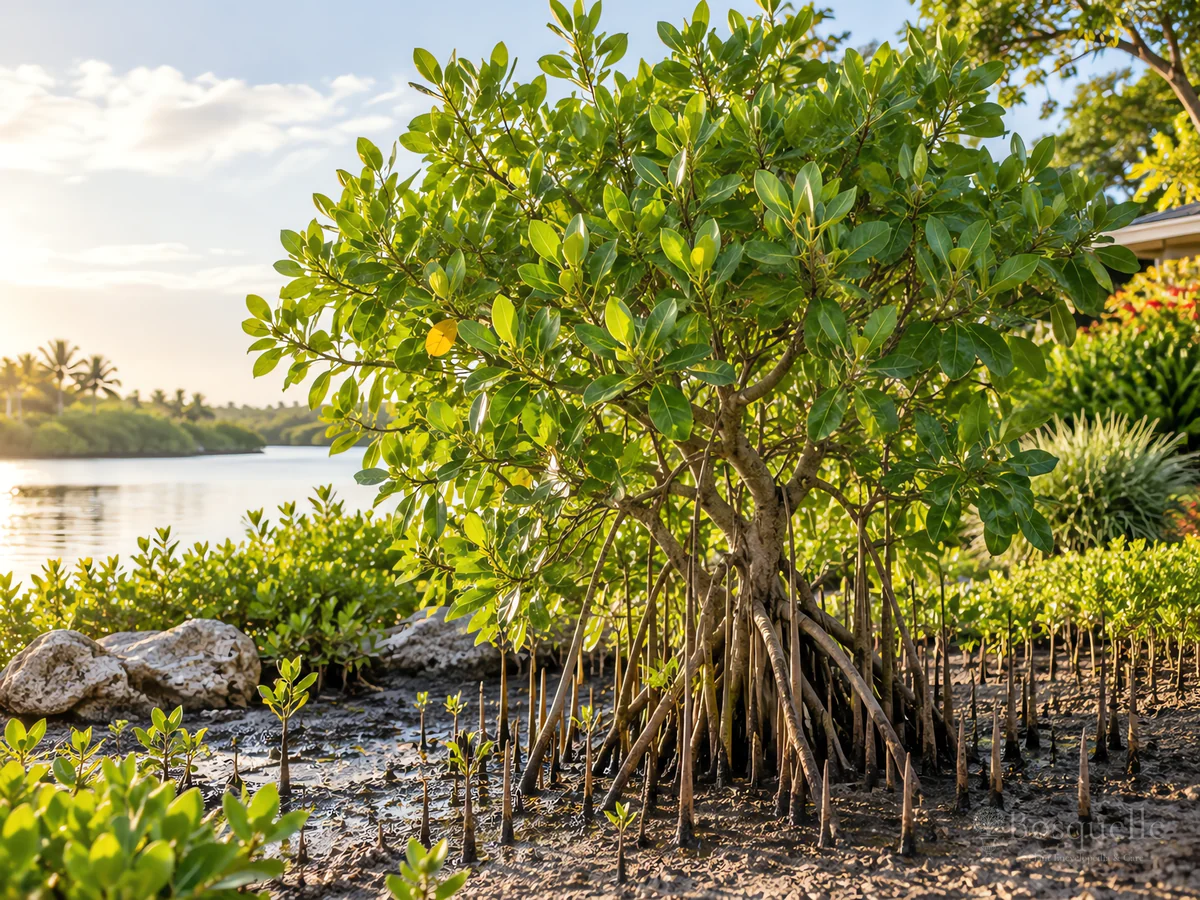
Grow black mangrove in full sun on wet, salty ground. Black mangrove is Avicennia.

Give it full sun on wet, salty ground
| Factor | Recommended | Avoid |
|---|---|---|
| Light | Full sun | Do not site it in shade as a woodland understory tree |
| Soil | Tidal mud, a brackish bank, or wet salt ground | Do not plant it on dry inland ground that dries between waterings |
| Water | Keep the root zone wet. A tide that covers and uncovers the root collar is the natural pattern | Do not let a new planting dry, and do not leave a young plant in water that never recedes |
| Salt | Salt in the air and the soil. White crystals on the leaves are normal | Do not treat the crystals as a disease, and do not plant it as a freshwater lawn tree |
| Kind | Black mangrove for a salt shoreline or a brackish bank | Do not buy a red mangrove with prop roots and expect pencil roots |
black mangrove is an evergreen coastal tree with opposite leathery leaves, dark green above and pale and hairy below. Site it in full sun on ground that stays wet with salt or brackish water. [1] It sends up pneumatophores, the pencil roots that stand just above high tide so the underground roots can take in air. White crystals on the leaves are salt the plant has moved out of the tissue, so wipe them off if they bother you, but do not spray for a disease that is not there. On the northern Gulf it turns shrubby, and a hard freeze can kill the top. [2] It is a shoreline screen or a shade tree on a brackish bank, not a dry-lot street tree, and it is not drought-tolerant.
How much sun does black mangrove need?
Give it full sun. Shade as a woodland understory tree is the wrong site.
How often should I water black mangrove?
Keep the root zone wet. A tide that covers and uncovers the root collar is the natural pattern. If the bank can dry, water so it never sits dry.
Are the white crystals on the leaves a problem?
No. The plant moves salt out through the leaves, so the crystals are normal. They are not a disease.
Plant a nursery seedling after frost, with the tide over the root collar
Plant a nursery seedling after the last frost, in mud or wet salt ground where the tide will cover and uncover the root collar. A plant about 18 inches tall with a full root mass is the usual start. [3]
- Buy a nursery seedling with a solid root mass, not a dried seed from a jar.
- Wait until after the last frost. A hard freeze can kill a young plant.
- Dig where the tide will cover and uncover the root collar. Skip a high, dry berm.
- Set the plant at the same depth it grew in the pot, and backfill with the mud you removed.
- If waves are strong, stake or baffle the plant until the roots hold.
- Keep the root zone wet until new shoots stiffen.
When should I plant black mangrove?
Plant after the last frost, in ground that is already wet. Do not plant into a dry hole and hope to catch up with the hose.
How deep do I set the plant?
Set it at the same depth it grew in the pot, where the tide will cover and uncover the root collar. Do not perch it above the tide.
Start from a fresh seed — do not let it dry
The fruit is a flattened seed, like a lima bean, that starts on the tree. Use it fresh. Direct-sowing on a live shore has poor survival, so grow the seed in a pot and plant the seedling later.
- Use a fresh seed. Do not let it dry out.
- Soak it in water up to 24 hours and slip off the fleshy covering.
- Plant it soon in a pot of ordinary potting mix, and sit the pot in a tray of water so the mix stays wet.
- Grow it on until the seedling is about 18 inches tall with a full root mass, then plant it out as above.
Can I start black mangrove from seed?
Yes, from a fresh seed that has not dried. Soak it, slip off the covering, and keep the pot wet. A nursery seedling is the surer start in the ground.
Check the rules before you trim, and leave the pencil roots
Check local rules before you cut. In Florida these trees are protected, and you may need permission before you trim or gather seed. [4]
- Ask the local office that handles shoreline plants before you cut. A waterfront view is not permission on its own.
- Leave the pneumatophores in place. Cutting those pencil roots wounds the underground system that feeds the tree.
- Do not strip the tree of its leaves.
- If a rule allows a view cut, leave the upper canopy. An old tree recovers poorly if you take the top out.
When can I trim black mangrove?
Check the rules first. Leave the pencil roots, and do not strip the leaves. Florida protects these trees, so a waterfront view is not permission on its own.
Not red mangrove — and not white mangrove or buttonwood
Red mangrove is Rhizophora, the tree with arched prop roots that stands in standing water. White mangrove is Laguncularia, usually farther up the bank, with two glands at the leaf base and usually no pencil roots. Buttonwood is Conocarpus, above the tide, with alternate leaves — not a true mangrove. Mangrove lily is a crinum, a wet-ground bulb, not this tree — see How to Grow Crinum. Grey mangrove is Avicennia marina, an Old World cousin that still wants wet salt ground; it is not a second shop card here.
Is black mangrove the same as red mangrove?
No. Red mangrove has arched prop roots. Black mangrove has a carpet of pencil roots and salt crystals on the leaves.
Keep the ground wet and salty, and leave the pencil roots in place.
FAQ
Does it come back after a freeze?
A hard freeze can kill the leaves, and a colder night can kill the top. New seed can wash in on the tide. Do not treat it as a plant you lift and store.
Can I grow it as a houseplant?
No. It wants outdoor wet salt ground, or a nursery pot only until you plant it out. A windowsill bowl is the wrong size and the wrong water.
Is Avicennia nitida a different plant?
No. Avicennia nitida is an old name for the same black mangrove. It is not a second species in this catalog.
Is grey mangrove the same plant?
Grey mangrove is Avicennia marina, a cousin from the Old World tropics. It still wants wet salt ground. This catalog holds black mangrove.
Do the flowers make honey I can harvest?
Bees work the small white flowers, and some coasts take a mangrove honey. Do not treat the tree as a crop you pick or a recipe you cook from the leaves.
What else grows on that salt shoreline?
Other mangrove trees and salt-marsh plants that take wet, salty ground. Do not pair it with a dry-bank shrub that needs the same bed to drain.
Recommended plants

References
- [1] UF/IFAS Extension -
https://ask.ifas.ufl.edu/publication/FR321 - [2] Lady Bird Johnson Wildflower Center -
https://www.wildflower.org/plants/result.php?id_plant=AVGE - [3] NRCS Plant Materials -
https://plants.usda.gov/DocumentLibrary/plantguide/pdf/pg_avge.pdf - [4] Florida Native Plant Society -
https://www.fnps.org/plant/avicennia-germinans
More first-season notes by plant are gathered in How to Grow Guides.
Updated: Reviewed by Bosquelle Editors