
Grow bush anemone in sun or afternoon shade and soil that drains. It is also sold as tree anemone. It is not a Japanese anemone.
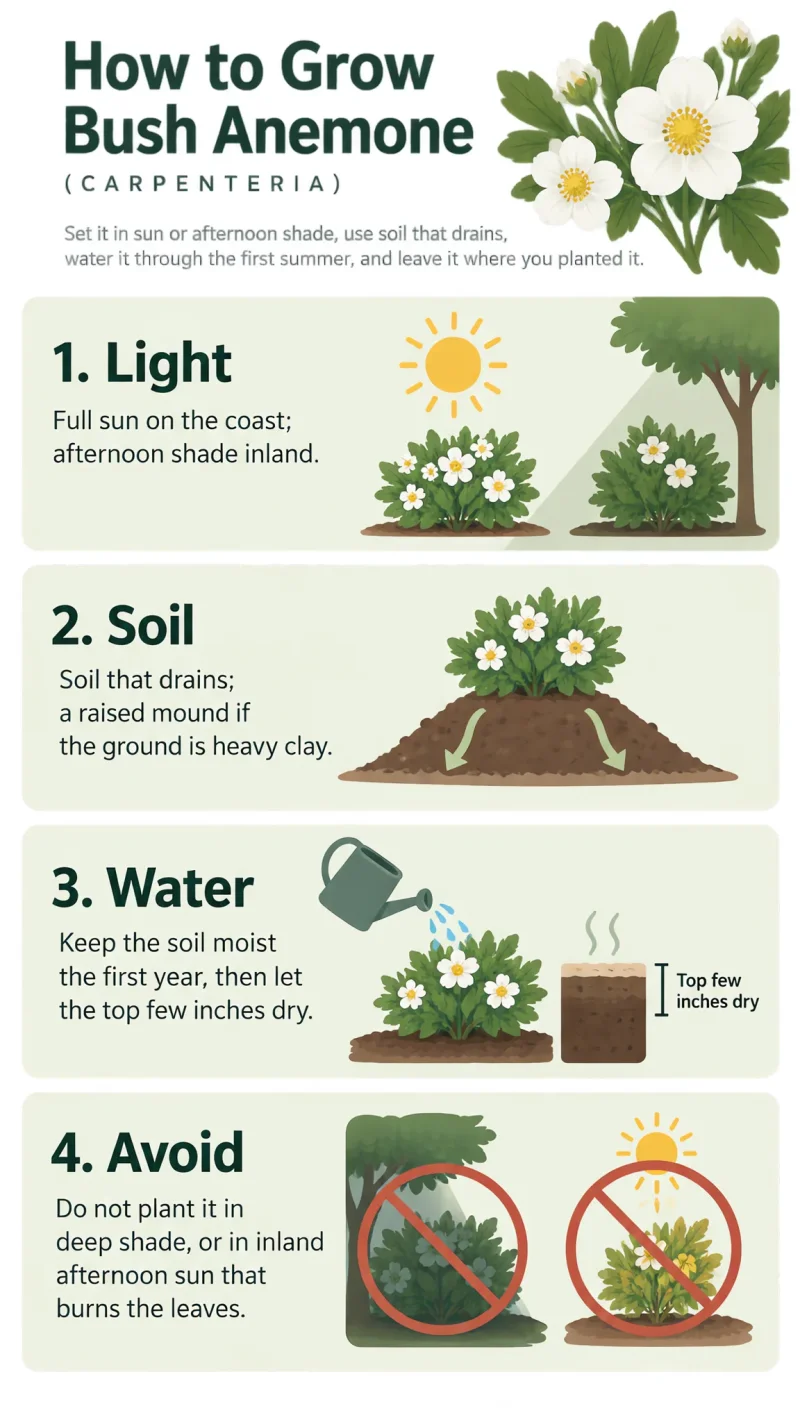
Give it sun or afternoon shade, and water the first year, then less
| Factor | Recommended | Avoid |
|---|---|---|
| Light | Full sun on the coast; afternoon shade inland | Do not plant it in deep shade, or in inland afternoon sun that burns the leaves |
| Water | Keep the soil moist the first year, then let the top few inches dry | Do not spray the leaves from overhead, and do not keep the crown wet |
| Soil | Soil that drains; a raised mound if the ground is heavy clay | Do not plant it in a soggy hole |
| Shelter | A south or west wall, out of a hard wind | Do not leave a young plant where a hard freeze hits with no wall |
Bush anemone wants a sheltered spot and soil that drains. Along the coast it takes full sun. Inland, afternoon shade keeps the leaves from burning. [1] bush anemone is Carpenteria californica, an evergreen California shrub with leathery leaves and fragrant white flowers with yellow stamens. Water a new plant through the first summer so the roots go down. After that, let the top few inches of soil dry between waterings. A wet crown is the primary cause of root rot. [2]
How much sun does bush anemone need?
Give it full sun on the coast. Inland, give it afternoon shade so the leaves do not burn. Deep shade leaves few flowers.
How often do I water bush anemone?
Keep the soil moist the first year. After that, water when the top few inches are dry. Water the roots, not the leaves.
Plant in fall on a mound, and do not move it
Plant a nursery pot in fall so the roots grow while the soil is still warm. If the ground is heavy clay, set the plant on a raised mound so water runs away from the crown.
- Choose a draining spot with room for a shrub about 4 to 8 feet tall and wide.
- If the soil stays wet, build a low mound or plant on a slope.
- Dig a hole as wide as the root ball. Set the crown at the same level it sat in the pot.
- Backfill with the soil you dug out. Water once to settle it, and mulch the surface.
- Leave it there. The roots go deep, and a mature plant sulks if you move it. [3]
When do I plant bush anemone?
Plant in fall from a nursery pot. Spring works if you can water it through the first summer. Do not move a plant once the roots go down.
After the flowers fade, cut it back lightly
The shrub keeps a decent shape with little cutting. After the white flowers fade, shorten rangy stems to a lower bud if you need to tidy it.
- Wait until the flowers fade in summer.
- Cut long stems back to a lower pair of leaves so the plant stays full.
- Strip brown leaves that cling to the stems in late summer. They do not drop on their own.
- Do not saw thick old wood expecting a flush of new shoots. Those stubs often stay bare.
Do I prune bush anemone?
Cut it back lightly after the flowers fade if the stems look rangy. Do not cut it to the ground.
Start from a cutting or a nursery plant
A nursery plant is the sure start. If you already have a healthy shrub, take a cutting in late spring or summer.
- Cut a 4- to 6-inch stem that is not in flower, just below a leaf joint.
- Strip the lower leaves. Dip the cut end in rooting hormone.
- Stick it in a mix that drains, such as peat and perlite, in a pot with a hole.
- Keep it bright, out of hot sun, and barely moist until new leaves show. [4]
- Grow it on for a season before you plant it in the garden.
Sow seed thinly if you have it
- Sow the tiny seed on the surface of a draining mix. Press it in; do not bury it deep.
- Keep the mix moist, not soggy. Thick sowing rots the seedlings.
- Do not collect seed from wild plants.
Can I grow bush anemone from a cutting?
Yes. Take a 4- to 6-inch stem that is not in flower, stick it in a draining mix, and keep it bright and barely moist until new leaves show.
Not Japanese anemone — and not deciduous mock orange
Bush anemone is an evergreen woody shrub. A Japanese anemone is a herbaceous perennial that dies back. If the tag says windflower or Japanese anemone, read How to Grow Anemones.
Mock orange is a close relative, but it drops its leaves. If the tag says mock orange, read How to Grow Mock Orange. If the tag says Japanese mock orange or Mexican orange, that is a different evergreen — How to Grow Pittosporum or How to Grow Mexican Orange.
Is this a Japanese anemone?
No. Bush anemone is an evergreen shrub with leathery leaves. Japanese anemone is a herbaceous plant that dies back in winter.
Set bush anemone in sun or afternoon shade and draining soil, water it through the first summer, and leave it where you planted it.
FAQ
Is there more than one kind of bush anemone?
Carpenteria californica is the plant here. Compact plants sold as Elizabeth want the same sun, drainage, and first-year water.
Can I grow it in a pot?
A large pot with a hole can hold a young plant outdoors. Water it more often than a plant in the ground, and keep the mix draining. This is not a dim indoor plant.
Can I grow it indoors as a houseplant?
No. Keep it outdoors in sun or afternoon shade. A dark room will not make flowers.
Recommended plants

References
- [1] UC Master Gardener Program of Sonoma County -
https://ucanr.edu/site/mg-sonoma/carpenteria-californica-bush-anemone - [2] Royal Horticultural Society -
https://www.rhs.org.uk/plants/3135/carpenteria-californica/details - [3] Harvest to Table -
https://harvesttotable.com/how-to-grow-carpenteria-bush-anemone/ - [4] Gardeners Path -
https://gardenerspath.com/plants/flowers/grow-bush-anemone/
More first-season notes by plant are gathered in How to Grow Guides.
Updated: Reviewed by Bosquelle Editors