
Grow Bismarck palm in full sun and soil that drains, and soak deeply after the soil has dried. Bismarck palm is Bismarckia. It is not Mexican blue palm.

Give it full sun, soil that drains, and a deep soak after the soil has dried
| Factor | Recommended | Avoid |
|---|---|---|
| Light | Full sun; part sun is tolerated | Do not park a young plant against hot, dry glass that scorches the fans |
| Soil | Sand, loam, or clay that drains; acid to alkaline is fine | Do not sit the trunk in a soggy well |
| Water | Soak deeply, then wait until the soil has dried some; once roots are in, it takes dry spells | Do not water on a daily calendar after the palm is established |
| Feed | A controlled-release palm fertilizer with potassium and magnesium, spread under the canopy | Do not pile fertilizer against the trunk, and do not cut spotted older fans to hide a shortage |
| Cold | Frost-free ground, or a pot you can move in before a freeze | Do not leave a young plant out through a freeze |
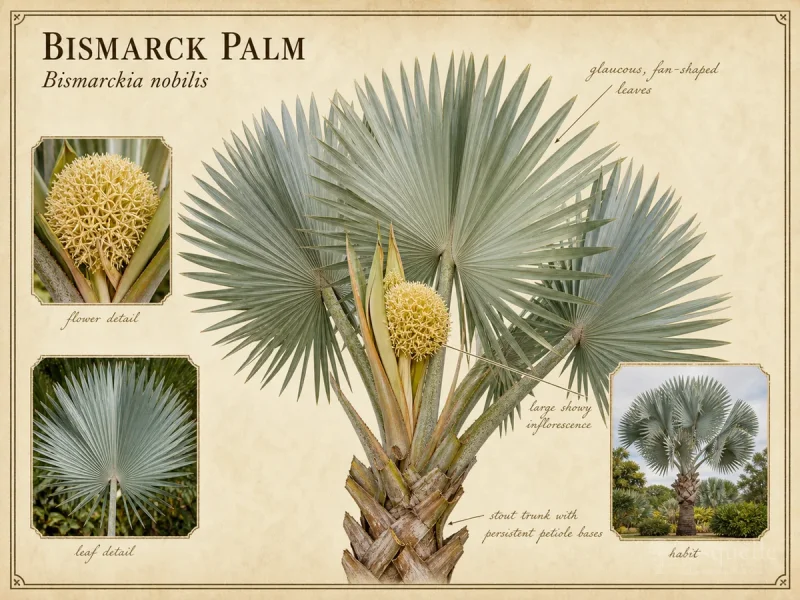
bismarck palm is Bismarckia nobilis, a solitary fan palm with a stout gray trunk and stiff, costapalmate leaves that read silver-blue from the waxy coat. The crown is huge, so pick a spot with room before you buy a small plant. [1] Give it full sun and ground that drains. Clay is fine if water does not stand. A wet low spot is a poor home for this palm. [2] Soak the root zone deeply, then wait until the soil has dried some before you water again. Once the roots are in, it takes dry spells, though it looks better with those spaced soaks than with none at all. Spread a palm fertilizer that is about 8-2-12 with 4 percent magnesium, in a slow-release form, under the whole canopy every few months in the growing season. Yellow-orange specks and dead tips on the oldest fans are usually a potassium shortage. Leave those fans until they are fully dead, because they still hold potassium the new leaves need. [3] [4] If you have frost-free ground, the plant-out is on Planting Bismarck Palm. Brown-frond cleanup is How to Prune Bismarck Palm. A new plant from seed is How to Propagate Bismarck Palm.
Does Bismarck palm need full sun?
It grows best in full sun. Part sun is tolerated. Do not park a young plant against hot, dry glass.
How often should I water Bismarck palm?
Soak deeply, then wait until the soil has dried some. Once the roots are in, it takes dry spells. Do not water on a daily calendar.
Grow a young plant in a pot with a hole, in bright sun
A young plant can live in a large, heavy container on a sunny patio while it is small. It is still a landscape palm, so it will outgrow a dim indoor corner. Use a pot with a drainage hole and a mix that drains.
- Choose a heavy pot with a hole, only a size or two wider than the nursery pot, so the mix can dry between waterings.
- Fill it with a sandy or cactus mix that drains. Do not use a cachepot with no hole as the only pot.
- Set the root ball so the stem sits at the same depth it sat in the nursery pot.
- Water once to settle the mix, wait about half an hour, then empty the saucer.
- Keep the pot in the brightest sun you have. A potted plant dries faster than one in the ground, so soak it, then wait until the top of the mix has dried.
- Move the plant into the ground, or into a much larger tub, before the crown is cramped. A mature palm is not a houseplant.
Can I grow Bismarck palm in a pot?
A young plant can sit in a heavy pot with a hole, in bright sun. Water more often than in the ground. It will outgrow indoor space as the crown widens.
Not a Mexican blue palm — and not a Mexican fan palm
Mexican blue palm is Brahea, another silver-blue fan, but the leaves are narrower and the plant takes a harder freeze in dry air. If the tag says Mexican blue palm, blue Hesper palm, or Brahea, read How to Grow Mexican Blue Palm.
Mexican fan palm is Washingtonia, a tall, skinny green street palm that grows fast and keeps a skirt of dead leaves unless someone cuts it. If the tag says Mexican fan palm, California fan palm, or Washingtonia, see How to Grow Mexican Fan Palm. Blue latan is Latania, a smaller silver fan for tropical yards. Windmill palm is Trachycarpus, a hairy-trunk green fan for cooler gardens. European fan palm is Chamaerops, usually a short clump. Chinese fan palm is Livistona, a greener fan that likes more humidity. Date palm is Phoenix; see How to Grow Date Palm. Ponytail palm is Beaucarnea, a swollen-stem houseplant, not a fan palm; see How to Grow Ponytail Palm. Sago is a cycad, not a palm.
Is Bismarck palm the same as Mexican blue palm?
No. Bismarck palm is Bismarckia, a large silver-blue fan from Madagascar. Mexican blue palm is Brahea, a slower desert fan with toothed leaf stalks.
If the oldest fans speckle yellow-orange, spread a palm fertilizer under the canopy and leave those fans until they are fully dead.
FAQ
Is there a green Bismarck palm as well as a silver one?
Yes. Most nursery plants are silver-blue. A light olive-green form exists and is hurt by a freeze sooner than the silver one. Sun, drain, and watering are the same.
Will Bismarck palm flower?
A mature palm makes hanging brown flower clusters on separate male and female trees. Female trees then set olive-brown fruit about an inch and a half across. Young potted plants almost never flower. The fruit is messy on a walk, not a kitchen crop.
Related guides


Recommended plants
References
This note is part of Bismarckia Guides.
More first-season notes by plant are gathered in How to Grow Guides.
Updated: Reviewed by Bosquelle Editors