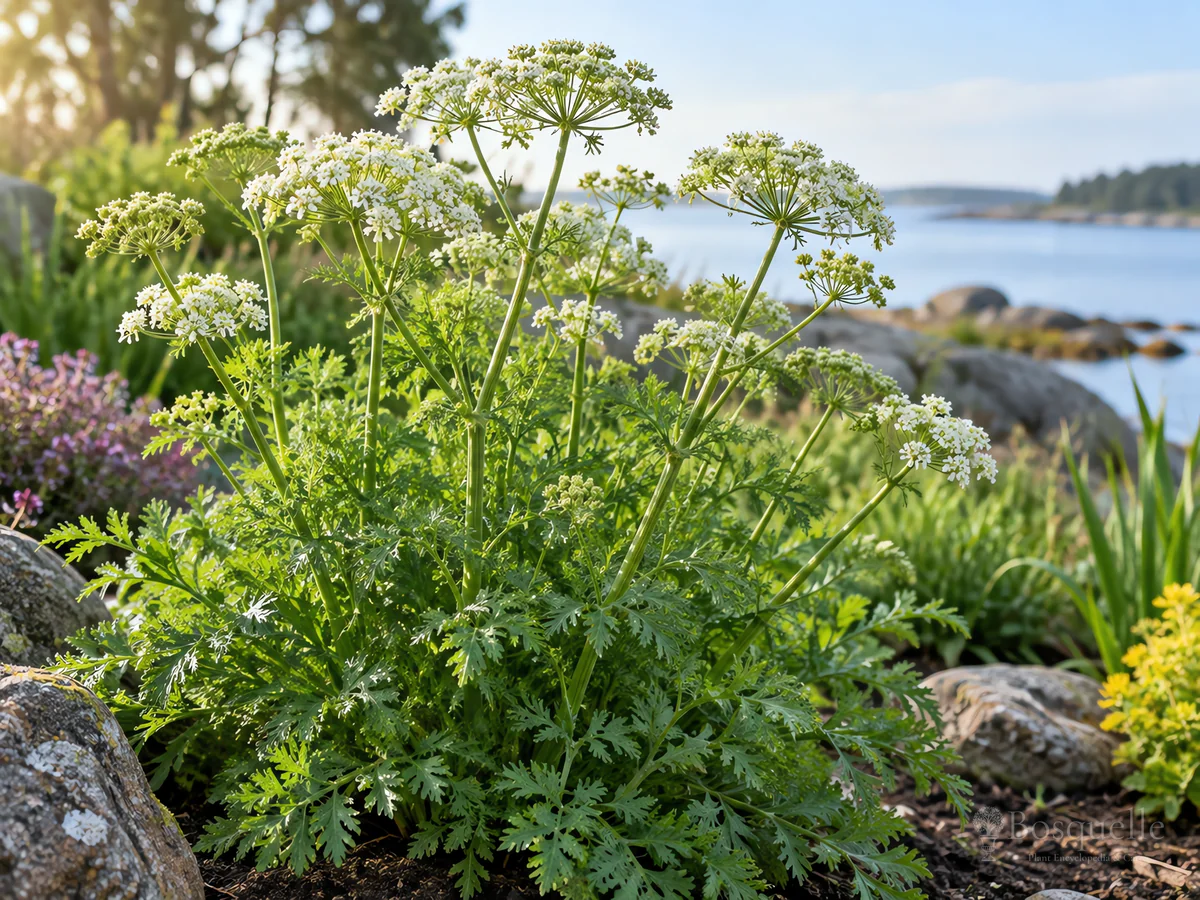
Grow Baltic parsley in sun or light shade, in soil that stays moist but still drains. Baltic parsley is Cenolophium denudatum.
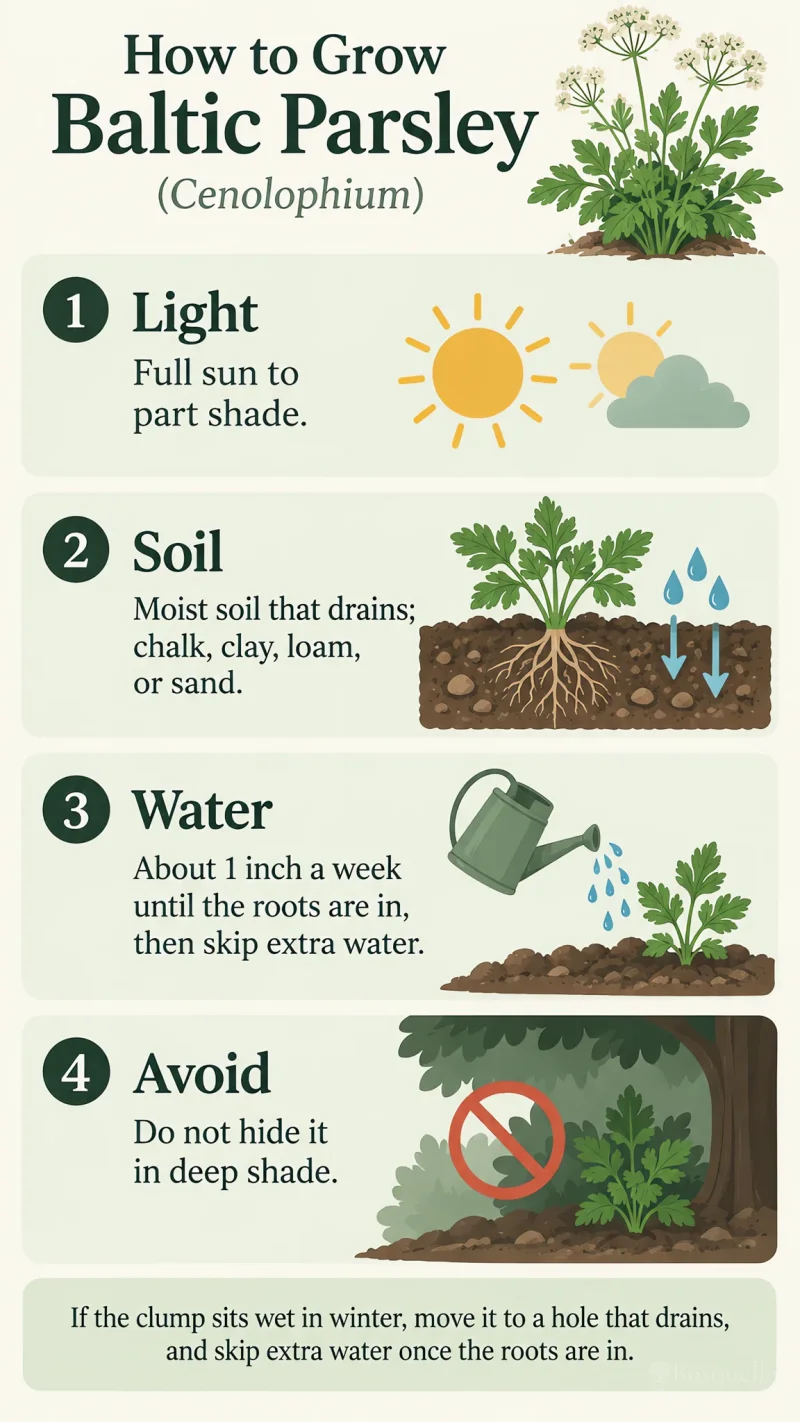
Give it sun, moist soil that drains, and room to stand 3 to 4 feet
| Factor | Recommended | Avoid |
|---|---|---|
| Light | Full sun to part shade | Do not hide it in deep shade |
| Water | About 1 inch a week until the roots are in, then skip extra water | Do not keep the crown in standing water, especially in winter |
| Soil | Moist soil that drains; chalk, clay, loam, or sand | Do not plant it in a bog |
| Size | 3 to 4 feet tall and 1 to 2 feet wide; space about 2 feet | Do not crowd it so the umbels have no air |
Baltic parsley wants sun or light shade and a hole that stays moist after rain but still drains. Water a new clump through the first dry season, then ease off; an established plant takes missed water better than a soggy crown. [1] Baltic parsley is a clump-forming perennial about 3 to 4 feet tall, with finely cut dark-green leaves and creamy-white umbels on purple-flushed stems from mid-summer into fall. [2]
How much sun does Baltic parsley need?
Give it full sun or part shade. Deep shade makes weaker stems and fewer umbels.
How often do I water Baltic parsley?
Give a new clump about 1 inch of water a week in dry spells. Once the roots are in, skip extra water. Standing water around the crown is the primary cause of rot.
Is Baltic parsley a perennial?
Yes. It comes back from the crown each spring. Hard frost may cut the leaves to the ground, then new growth follows.
Plant after frost, or in autumn, at the same depth as the pot
A pot-grown clump goes in after the last frost, or in autumn while the soil is still workable. Set it at the same depth it sat in the pot so the crown stays at the soil line.
- Plant after the last frost, or in autumn while you can still work the soil. [3]
- Set the clump at the same depth it sat in the pot. Do not bury the crown.
- Space clumps about 2 feet apart so the umbels have air.
- Water in, and keep the soil moist until new growth shows.
How deep do I plant Baltic parsley?
Set it at the same depth it sat in the pot. Do not bury the crown.
When do I plant Baltic parsley?
Plant a pot-grown clump after the last frost, or in autumn while the soil is still workable.
Leave the stems for winter, then cut them back in spring
Leave the flower stems standing through winter so insects can use them. Cut last year's growth to the ground in spring, before new leaves are growing strongly.
- Leave the flower stems standing through winter. Cut them only if they flop onto a path.
- In spring, before new growth is strong, cut last year's leaves and stems to the ground.
- Deadhead faded umbels during summer if you do not want seedlings next year. [4]
When do I cut Baltic parsley back?
Leave the stems for winter. In spring, before new growth is strong, cut last year's leaves and stems to the ground.
Sow seed after a cold spell
The seed needs a cold spell before it sprouts. Chill it in the refrigerator, or sow it outdoors in fall so winter does the work.
- Mix the seed with damp vermiculite or sand.
- Refrigerate it for 30 to 60 days, or sow outdoors in fall so winter does the chill.
- After the cold spell, sow the seed just covered and keep the mix barely moist until it sprouts.
- Move seedlings to the bed after frost, at the same depth as the pot.
Can I grow Baltic parsley from seed?
Yes. Chill the seed for 30 to 60 days, or sow it outdoors in fall. After the cold spell, sow it just covered and keep the mix barely moist until it sprouts.
Root a mid-winter cutting
You can also start a new clump from a root piece in mid-winter.
- In mid-winter, lift a pencil-thick piece of root.
- Lay it in a pot of mix and keep the mix barely moist.
- Wait for shoots, then pot on and plant after frost.
Not culinary parsley — and not cow parsley
Kitchen parsley is a shorter herb grown for leaves. If the tag says parsley, curly parsley, or Italian parsley, read How to Grow Parsley.
Cow parsley is a hedgerow umbel that seeds hard. If the tag says cow parsley or Ravenswing, read How to Grow Cow Parsley. The annual lace flower sold for one summer of umbels is Ammi; that keep-alive is How to Grow Ammi. Bronze fennel and dill are kitchen herbs with a different scent — How to Grow Fennel and How to Grow Dill.
Baltic parsley is not Queen Anne's lace, and it is not poison hemlock. Ferny leaves and clean purple-flushed stems are the garden plant. Do not eat it as a parsley substitute.
Is Baltic parsley edible?
No. It is an ornamental umbel. Grow kitchen parsley if you want leaves for cooking.
Is this the same as kitchen parsley?
No. Baltic parsley is a 3- to 4-foot perennial with white umbels. Kitchen parsley is a shorter herb grown for leaves.
Does cow parsley come back every year?
Cow parsley is a different plant. Baltic parsley is a perennial umbel that returns from the crown. Cow parsley seeds hard along hedgerows.
If the clump sits wet in winter, move it to a hole that drains, and skip extra water once the roots are in.
FAQ
Can I grow Baltic parsley in a pot?
A large pot with a hole can hold one clump outdoors in sun, if you water it in dry spells. This is a 3- to 4-foot border plant, not a kitchen-window herb.
Can I divide Baltic parsley?
Yes, if the clump is crowded. Lift and split it in spring or autumn, then replant at the same depth and water it in.
When do I cut Baltic parsley for a vase?
Cut a stem when about three-quarters of the florets have started to open. Strip the lower leaves and stand it in clean water.
Is there more than one kind of Baltic parsley?
Cenolophium denudatum is the plant here. Extra shop names are the same perennial, not a second type.
Recommended plants

References
- [1] Select Seeds -
https://www.selectseeds.com/products/baltic-parsley-seeds - [2] Royal Horticultural Society -
https://www.rhs.org.uk/plants/42450/cenolophium-denudatum/details - [3] BBC Gardeners' World Magazine -
https://www.gardenersworld.com/how-to/grow-plants/cenolophium-denudatum/ - [4] Crocus -
https://www.crocus.co.uk/plants/_/cenolophium-denudatum/classid.2000009910/
More first-season notes by plant are gathered in How to Grow Guides.
Updated: Reviewed by Bosquelle Editors