
Grow arrow arum in wet muck and shallow water that never dries, in sun or part shade. Arrow arum is Peltandra virginica, also sold as green arrow arum or tuckahoe — a pond plant with a green spathe, not the houseplant sold as arrowhead plant.
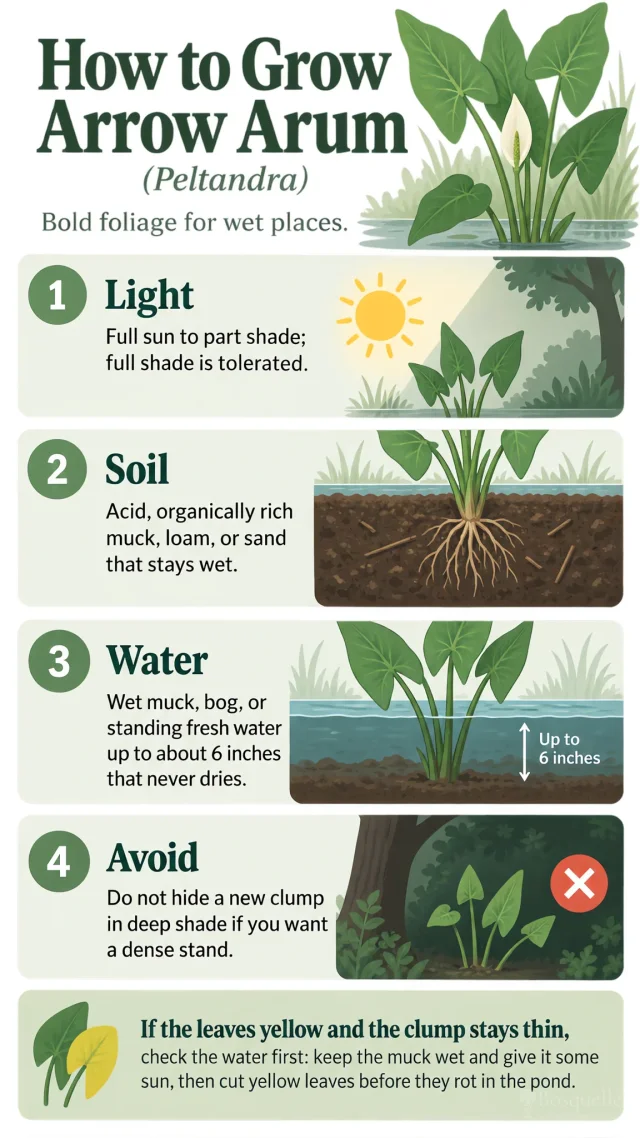
Keep it in wet muck and shallow water
| Factor | Recommended | Avoid |
|---|---|---|
| Light | Full sun to part shade; full shade is tolerated | Do not hide a new clump in deep shade if you want a dense stand |
| Water | Wet muck, bog, or standing fresh water up to about 6 inches that never dries | Do not grow it in a mix that dries between waterings |
| Soil | Acid, organically rich muck, loam, or sand that stays wet | Do not plant it in lightweight mix that dries in a day |
| Winter | Leave the rhizomes in wet mud | Do not lift them into a dry pot |
Arrow Arum is Peltandra virginica, a native pond plant with glossy arrow-shaped leaves and a green spathe around the spadix. It wants soil that stays wet, and it takes sun or part shade. [1] The clump spreads slowly and does not take over a small pond the way some aquatics do. [2] Leaves stay glossy when the muck never dries. The basket recipe and the rhizome depth sit on Planting Arrow Arum.
How much sun does arrow arum need?
Full sun to part shade. Full shade is tolerated, but a new clump fills in faster with some direct light.
How deep should the water stay?
Keep about 6 inches of fresh water over wet muck, or grow it in a bog that never dries. Do not let the soil dry out.
Cut yellow leaves before they rot in the pond
Yellow or torn leaves rot in the water and cloud a small pond. Cut them down near the crown when the color fades, and cut faded spathes the same way unless you want the berries for waterfowl. Leave the rhizomes in wet mud through winter. Cut dead leaves at the waterline if they clutter the pond, then wait for new leaves when the water warms.
- Cut yellow or torn leaves down near the crown so they do not rot in the water.
- Cut faded spathes after the color dulls, unless you want the berries.
- Leave the rhizomes in wet mud through winter. Do not store them in a dry pot.
When do I cut the leaves?
Cut yellow leaves when the color fades, before they rot in the water. Cut dead leaves at the waterline after frost if they clutter the pond.
Not the houseplant arrowhead — and not pond arrowhead
A tag that says arrowhead plant is usually a dry-pot houseplant with climbing stems. That plant is Syngonium — see How to Grow Arrowhead Plant. Pond arrowhead is Sagittaria: three-petaled white flowers and leaf veins that radiate from one point at the base. Arrow arum has a central vein with side veins, and the spadix sits inside a green spathe — see How to Grow Pond Arrowhead. [3] Pickerelweed has a heart-shaped leaf and a blue flower spike, not a spathe. [4] A florist calla has a showy white hood — see How to Grow Calla Lily. Golden club has elliptic leaves and a yellow club without a showy spathe — see How to Grow Golden Club. Elephant ear is a huge tropical leaf, not this swamp arum — see How to Grow Colocasia.
Is this the houseplant arrowhead?
No. The houseplant sold as arrowhead plant is Syngonium, a climbing pot plant. Arrow arum is a pond plant with a green spathe.
Is this pond arrowhead?
No. Pond arrowhead has three-petaled white flowers. Arrow arum hides the flowers inside a green spathe, and the leaf veins run from a central midrib.
If the leaves yellow and the clump stays thin, check the water first: keep the muck wet and give it some sun, then cut yellow leaves before they rot in the pond.
FAQ
Are there other kinds of arrow arum?
The plant sold as arrow arum is Peltandra virginica. White arrow arum is a rare southern swamp plant, not a second pond type in the shop.
Can I grow it in a dry pot?
No. A mix that dries in a day dries the rhizome out. A pond basket works when the soil stays under water. It is not a patio houseplant.
Does it come back after ice?
Leave the rhizomes in wet mud. New leaves return when the pond warms. If the pond freezes to the bottom, move the basket to a wet, frost-free tub.
Can I eat tuckahoe?
Do not eat it raw, and do not eat plants you pull from a ditch. The plant holds calcium oxalate crystals that irritate the mouth and gut. Keep pets from chewing the leaves.
Is tuckahoe a mushroom?
No. Tuckahoe is a common name for this pond plant. A fungus sold under the same name is a different organism.
Related guides
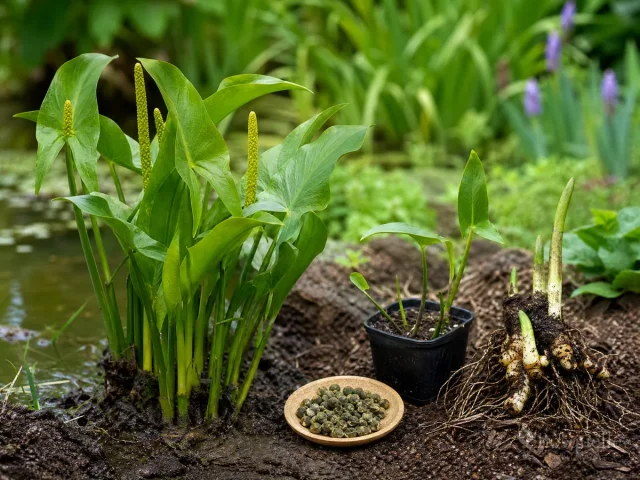
Recommended plants
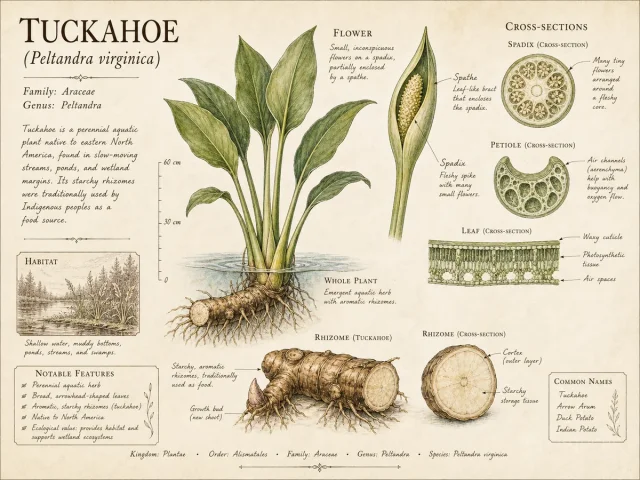
References
- [1] NC State Extension -
https://plants.ces.ncsu.edu/plants/peltandra-virginica/ - [2] Lady Bird Johnson Wildflower Center -
https://www.wildflower.org/plants/result.php?id_plant=PEVI - [3] Illinois Wildflowers -
https://www.illinoiswildflowers.info/wetland/plants/arrow_arum.html - [4] University of Florida IFAS Extension -
https://ask.ifas.ufl.edu/publication/AG400
This note is part of Peltandra Guides.
More first-season notes by plant are gathered in How to Grow Guides.
Updated: Reviewed by Bosquelle Editors