
Grow American eelgrass fully under sunlit freshwater. American eelgrass is Vallisneria, also sold as tape grass and wild celery. It is not the marine eelgrass of salt bays.
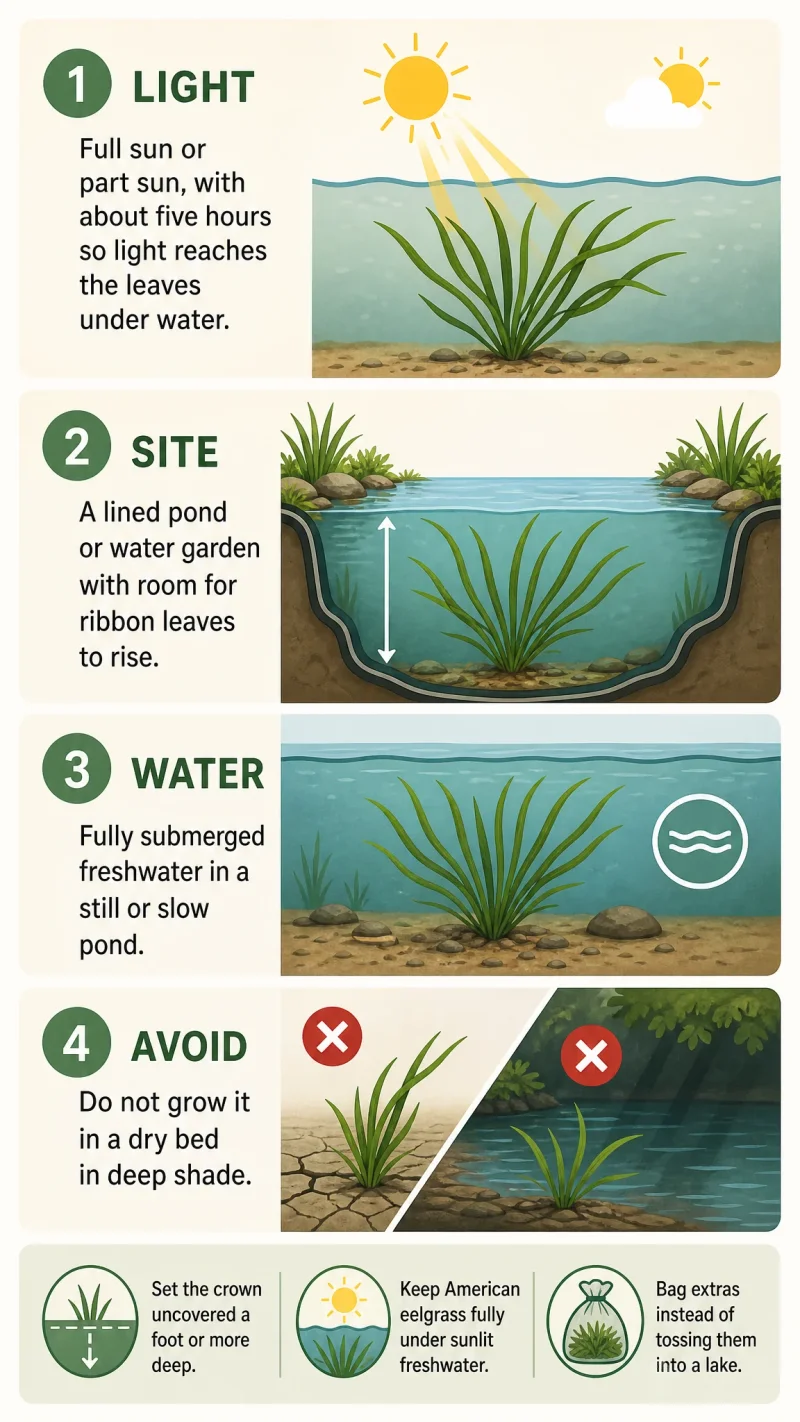
Keep it fully under sunlit freshwater
| Factor | Recommended | Avoid |
|---|---|---|
| Light | Full sun or part sun, with about five hours so light reaches the leaves under water | Do not grow it in a dry bed in deep shade |
| Water | Fully submerged freshwater in a still or slow pond | Do not let the crowns dry in air |
| Site | A lined pond or water garden with room for ribbon leaves to rise | Do not plant it into a salt bay as if it were marine eelgrass |
| Season | Leave it in the pond through winter; in cold water it dies back to tubers and sprouts again in spring | Do not lift the crowns into a dry garage for winter |
American eelgrass has to stay under water. Full sun or part sun in a freshwater pond is the usual home, and about five hours of light keeps the ribbon leaves green. [1] The leaves grow in a cluster from a short crown, not along a long stem. They are flat and tape-like, with rounded tips and a raised midrib, and the upper ends may trail on the surface in shallow water. [2] [3] Crowns that dry on a bench do not recover. In cold winters the tops collapse and the plant lives on winter buds, sometimes called tubers, then new leaves rise in spring. It is not a dry-bed grass.
How to grow American eelgrass?
Keep it fully under sunlit freshwater in a pond. Leave the crown uncovered when you plant. Do not let the plant dry.
Does it need full sun?
Full sun or part sun both work if light reaches the leaves under water. About five hours a day is enough. Deep shade under a dense cover of pads slows it.
Does it come back after winter?
Yes, if it stays in the pond. The tops often die back in cold water after tubers form, then new leaves sprout in spring. Do not lift the crowns into dry air.
Plant with the crown uncovered, a foot or more under water
Shop plants arrive as a rooted crown. Keep them wet from the bag to the pond. Set the roots in sand, fine gravel, or aquatic soil, and leave the pale base of the leaves uncovered. If you bury that crown, it rots. In a home pond, at least a foot of water over the crown is enough, and one to four feet is the usual range so light still reaches the leaves. A mesh aquatic basket slows runners if you need the stand to stay in one spot.
- Keep the plant wet from the bag to the pond. Discard mushy leaves in the trash, not in a ditch.
- Push the roots into sand, fine gravel, or aquatic soil. Leave the pale crown, the bottom inch or two of the leaves, in the open water.
- Lower the plant so at least a foot of water covers it. One to four feet is the usual home-pond depth.
- Use a mesh aquatic basket if you need to slow runners. Cover the soil with a little gravel so fish do not root it out.
- Bag extras. Do not toss crowns, runners, or mud into a lake, a ditch, or a storm drain.
How do I plant American eelgrass?
Keep the crown wet, bury only the roots, and leave the pale base of the leaves uncovered. Set it a foot or more under water. Bag extras instead of tossing them into a lake.
Snap runners for new plants, and bag extras
New plants start from runners that creep along the pond floor, not from a seed packet. Wait until a daughter has its own leaves, then snap the runner and replant that crown the same way, or bag it. Clip extras before the stand mats the surface, and bag every piece you do not keep.
- Wait until a daughter has its own cluster of leaves.
- Snap or cut the runner between the parent and the daughter.
- Replant the daughter with the crown uncovered, or bag it the same day.
- Bag what you do not keep. Runners start new plants in the next pond they reach.
How do I get more plants?
Snap a runner after the daughter has its own leaves, and replant that crown with the base uncovered. Seed is for restoration work, not a home start.
Not marine eelgrass — and not pond arrowhead
Marine eelgrass is Zostera, a seagrass of salt bays, not this freshwater plant. A tag that says eelgrass on this shop card is still American eelgrass. Pond arrowhead is Sagittaria, with pointed leaf tips and three white petals on a stalk above the water — see How to Grow Pond Arrowhead. Tape grass has rounded tips and a raised midrib, and the female flower stalk coils after pollination. [4] American bur-reed is Sparganium, an emergent with round bur heads — see How to Grow American Bur-Reed. Hydrilla and Canadian waterweed have small leaves in whorls on a stem, not a basal ribbon cluster — see How to Grow Canadian Waterweed. Tank light and a gravel crown are on American Eelgrass in an Aquarium.
Is this marine eelgrass?
No. Marine eelgrass is Zostera in salt water. American eelgrass is a freshwater tape grass with ribbon leaves from a crown.
Is this pond arrowhead?
No. Pond arrowhead is Sagittaria, with pointed tips and flowers on a stalk above the water. American eelgrass has rounded tips and stays under water.
Keep American eelgrass fully under sunlit freshwater, set the crown uncovered a foot or more deep, and bag extras instead of tossing them into a lake.
FAQ
Can I grow it from seed?
Seed is a restoration tool, and it is slow. The shop start is a rooted crown. Snap a runner instead.
Can I grow it in a patio tub?
Only if the tub holds water and the plant stays fully under it. A draining flower pot of mix dries and kills the crown.
Can I eat wild celery?
Leave it for waterfowl. Ducks eat the tubers and leaves. It is not a kitchen crop, and pond water is not a salad bowl.
Will goldfish eat it?
Goldfish and some turtles graze the leaves. The plant is not toxic. A strong stand usually keeps up if the fish do not strip every crown.
Related guides

Recommended plants

References
- [1] Pond Informer -
https://pondinformer.com/vallisneria-americana/ - [2] UF/IFAS EDIS -
https://edis.ifas.ufl.edu/publication/AG437 - [3] UF/IFAS Center for Aquatic and Invasive Plants -
https://plant-directory.ifas.ufl.edu/plant-directory/vallisneria-americana/ - [4] Washington State Department of Ecology -
https://fortress.wa.gov/ecy/gisresources/lakes/AquaticPlantGuide/descriptions/valame.html
This note is part of Vallisneria Guides.
More first-season notes by plant are gathered in How to Grow Guides.
Updated: Reviewed by Bosquelle Editors