
Grow sweetshrub in part shade with moist soil that drains. It is Calycanthus, also called Carolina allspice. It is not spicebush — that is Lindera benzoin, a different shrub.
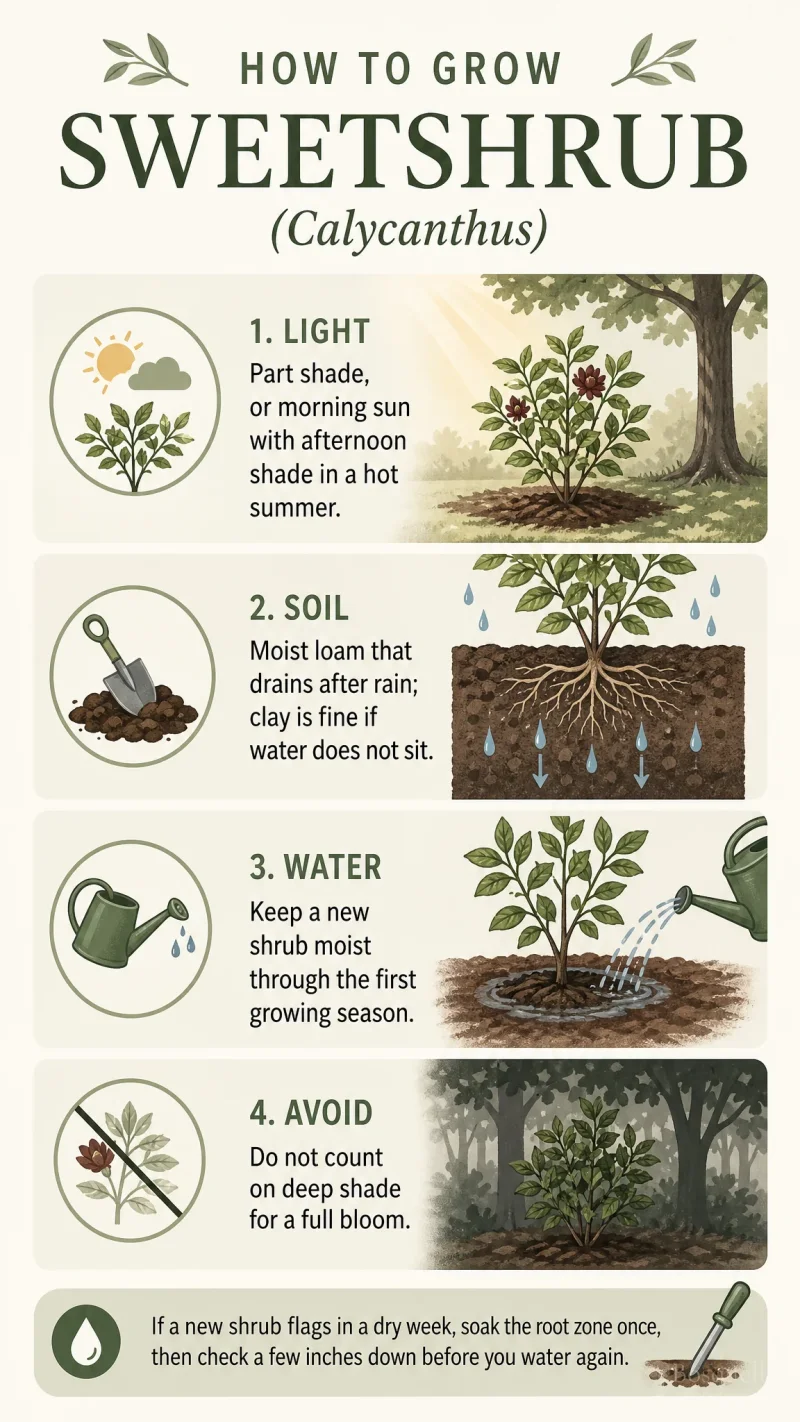
Give it part shade and moist soil that drains
| Factor | Recommended | Avoid |
|---|---|---|
| Light | Part shade, or morning sun with afternoon shade in a hot summer | Do not count on deep shade for a full bloom |
| Soil | Moist loam that drains after rain; clay is fine if water does not sit | Do not plant into a sandy dry bank, or a hole that stays flooded |
| Water | Keep a new shrub moist through the first growing season | Do not let a new transplant dry out, and do not leave the roots waterlogged |
| Deer | Eastern sweetshrub is seldom browsed | Do not treat a spicebush tag as the same plant |
| Salt | Keep it off a salted roadside | Do not use it as a seaside shrub |
Sweetshrub wants the same kind of ground it uses in a moist woodland: loam that stays evenly moist and still drains. Part shade is the reliable setting. [1] eastern sweetshrub takes full sun to deep shade, but in shade it grows taller and opener, with fewer flowers. Afternoon shade helps in a hot climate. [2] It is not a salt plant. A short dry spell is survivable once the shrub is established, but sandy ground without water stalls it. [3] Site it near a path or a patio so the spring flowers can reach you. Match the kind on Types of Sweetshrub.
How much sun does sweetshrub need?
Part shade is the reliable setting. Full sun works if you can keep the soil moist. Deep shade is tolerated, but flowering drops off.
Why does my sweetshrub have no smell?
Fragrance varies from plant to plant. Buy it in bloom, or choose a named kind selected for scent, so you know what you are getting.
Water the first season, then only in a long dry spell
A new shrub still needs water until the roots leave the nursery ball. Soak the root zone, then check a few inches down before you water again. [4] Once it is established, water in a long dry spell. Do not treat a brief shower as enough in the first summer.
- Soak the root zone after you set the plant. Check a few inches down and water again when that soil starts to dry.
- Keep the root zone moist through the first growing season. Do not let a new shrub dry out between soaks.
- Once it is established, water only in a long dry spell. Sandy ground still needs more help than loam.
- Mulch about two inches over the root zone. Keep bark off the stems so the crown stays dry.
Grow a compact kind in a large draining pot if you need one
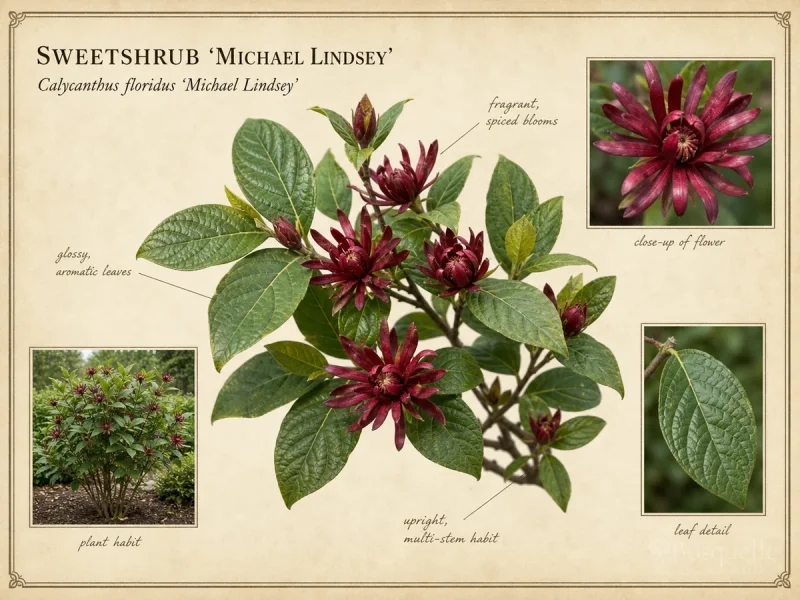
A large pot can hold a compact sweetshrub on a patio. The mix must drain, because a soggy pot is where root rot starts. Michael Lindsey is the compact eastern form if you need a smaller plant.
- Use a large pot with a drainage hole. A small cup dries too fast and then stays wet at the bottom.
- Fill it with potting mix, not garden soil. Set the root ball even with the mix.
- Water when the top inch is dry. Pots dry faster than a bed, so check more often in heat.
- Repot every two or three years, or plant the shrub out when the pot is packed with roots. See Planting Sweetshrub for the in-ground hole.
Can I grow sweetshrub in a pot?
Yes, in a large pot with a drainage hole and a mix that drains. Water when the top inch is dry. A compact kind is easier to keep in a pot than a 15-foot hybrid.
Lift a rooted sucker if you want more plants
The sure home method is a rooted sucker. Seedlings vary in fragrance, so a named plant is better cloned from a sucker or a cutting than from seed.
- Dig a sucker that already has its own roots at the edge of the clump.
- Cut it from the parent and keep those fibrous roots intact.
- Replant it at the same depth and keep the soil moist through the first season.
- If you have no sucker, take a firm July cutting, scrape one side, dip it in rooting hormone, and stick it in sand. Keep the sand moist until roots form.
How do I propagate sweetshrub?
Lift a rooted sucker in spring or early summer and replant it. A July cutting can clone a named plant if it roots. Seedlings often differ in fragrance from the parent.
Not spicebush — and not wintersweet
Sweetshrub is Calycanthus. Spicebush is Lindera benzoin. Wintersweet is Chimonanthus. Summersweet is Clethra. They are not the same plant and they do not take the same care.
- Sweetshrub (Calycanthus) — large maroon or white strap-tepal flowers in late spring, urn-shaped seed pods, and spicy bark when you scratch it. Carolina allspice is this shrub, not a cooking spice.
- Spicebush (Lindera benzoin) — small yellow flowers before the leaves, red berries in fall, and a different family. A spicebush tag is not sweetshrub.
- Wintersweet (Chimonanthus) — winter flowers on bare wood. See How to Grow Wintersweet if that is the tag you have.
- Summersweet (Clethra alnifolia) — midsummer bottlebrush spikes and wetter acid ground. Strawberry bush on a tag can also mean Euonymus americanus, which is not this genus.
Is sweetshrub the same as spicebush?
No. Sweetshrub is Calycanthus. Spicebush is Lindera benzoin. Both are fragrant native shrubs, but they have different flowers and fruit.
If a new shrub flags in a dry week, soak the root zone once, then check a few inches down before you water again.
FAQ
Does sweetshrub bloom in deep shade?
It survives deep shade, but flowering drops off. Part shade is the setting for a full flush.
Are sweetshrub seeds poisonous?
The seeds contain calycanthin and related alkaloids. They are a low-severity poison if eaten in quantity. Keep seed pods away from children and pets that might chew them.
Is Carolina allspice a cooking spice?
No. Carolina allspice is this ornamental shrub, named for its spicy scent. Culinary allspice is the dried berry of Pimenta dioica, a tropical tree.
What pests hit sweetshrub?
It has few insect problems. Wet, poorly drained soil can lead to root rot. If you see a warty gall at the soil line, remove the plant and do not replant sweetshrub in that hole.
Related guides


Recommended plants

References
- [1] Clemson Cooperative Extension HGIC -
https://hgic.clemson.edu/factsheet/sweetshrub/ - [2] North Carolina Extension Gardener Plant Toolbox -
https://plants.ces.ncsu.edu/plants/calycanthus-floridus/ - [3] UF/IFAS Extension -
https://ask.ifas.ufl.edu/publication/FP095 - [4] The Morton Arboretum -
https://mortonarb.org/plant-and-protect/trees-and-plants/carolina-allspice/
This note is part of Calycanthus Guides.
More first-season notes by plant are gathered in How to Grow Guides.
Updated: Reviewed by Bosquelle Editors