
Grow water lettuce in a still aquarium under strong light, and keep filter current off the crown. Water lettuce is Pistia.

Give it still tank water and strong light
| Factor | Recommended | Avoid |
|---|---|---|
| Light | Strong light for most of the day; raise it slowly if the plant came from shade | Do not blast a newly shipped rosette with full sun through glass on day one |
| Water | Warm, still freshwater, with the crown sitting on the surface | Do not keep the leaves constantly wet from splash |
| Air | If the room is dry, use a lid with a gap so the air above the tank stays humid | Do not seal a tight lid with no gap for air |
| Room | A tank large enough that hanging roots and daughters have space, often ten gallons or more for a small start | Do not jam a full pond-size mat into a tiny bowl |
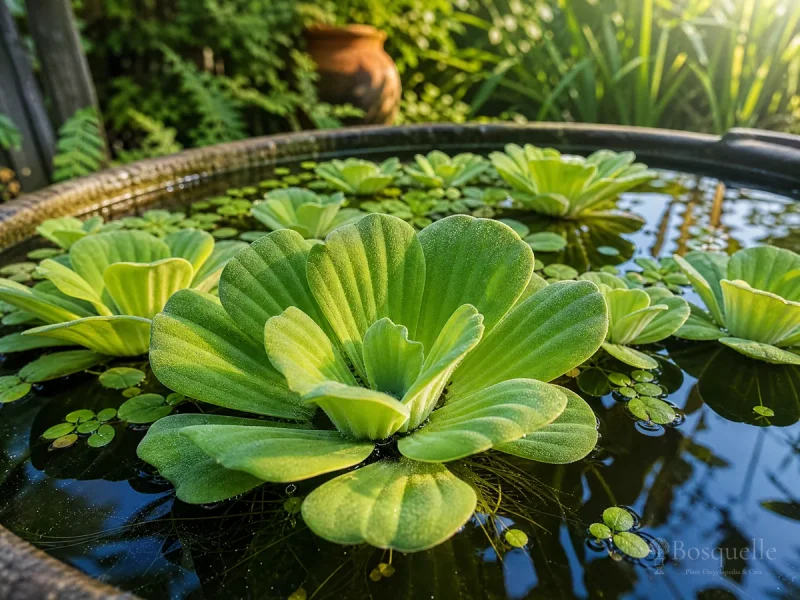
In a tank, water lettuce still needs still water and enough light that the rosette stays tight and green. Weak light keeps it small; a sudden blast of sun through a window can bleach new leaves. [1] water lettuce is Pistia stratiotes in the tank the same as in a pond: a fuzzy, ribbed rosette with hanging roots. Pond sun and frost are on How to Grow Water Lettuce.
Does water lettuce need a special fertilizer?
Fish waste is usually enough. If the rosettes yellow and stay small under strong light, the water is short of nutrients. Do not dose a dry-bed plant food on the leaves.
Keep filter current off the crown
A strong filter outflow shoves the rosette under, wets the velvety leaves, and tangles the roots in the intake. The plant needs the crown dry and the roots hanging, so the current has to miss it.
- Point the outflow along the glass or baffle it so the surface in one corner stays still.
- Keep the rosettes out of that flow with a floating ring of airline tubing, or tuck them behind a barrier.
- Check the intake so hanging roots cannot jam the filter. [2]
- If a leaf stays wet and turns mushy, move that plant out of the splash and pick off the rotten leaf.
Can I keep it under a tight lid?
A lid helps in a dry room, but leave a gap so air can move. A sealed lid with no gap traps stale air and soaks the leaves with condensate.
Leave open water, and bag extras
Daughters form on short runners. If they close the whole surface, the tank cannot breathe and plants below lose light. Scoop extras before the mat seals, and bag them. Never pour them into a creek, a ditch, or a storm drain. [3] [4]
- Leave open water so gas can move and light can reach plants below.
- Pinch daughters off the runner when the mat gets crowded.
- Bag extras for the trash. Do not pour them into a creek or a lake.
- If roots reach the gravel and snag, trim them back a few inches; new roots grow.
Is dwarf water lettuce a different plant?
No. Dwarf water lettuce is the same species kept smaller by tank light and nutrients. Give it pond sun and it can size up.
Float water lettuce on still tank water under strong light, keep the filter off the crown, and bag extras so the surface never seals.
FAQ
Will it survive in a cold room?
It wants warm water. If the tank sits in a cold room, growth stalls and the leaves yellow. Keep it out of a freeze.
Can I mix it with other floaters?
You can, but water lettuce spreads fast and will shade the others. Skim so each kind still has open water.
Related guides
Recommended plants

References
- [1] Modest Fish -
https://modestfish.com/water-lettuce/ - [2] NC State Extension Gardener -
https://plants.ces.ncsu.edu/plants/pistia-stratiotes/ - [3] Michigan Sea Grant -
https://www.canr.msu.edu/news/pretty-but-problematic-aquatic-plants-to-avoid-msg23-sturtevant23 - [4] Wisconsin Department of Natural Resources -
https://dnr.wisconsin.gov/topic/Invasives/fact/WaterLettuce.html
This note is part of Pistia Guides.
More container notes by plant live in Container Growing Guides.
Updated: Reviewed by Bosquelle Editors