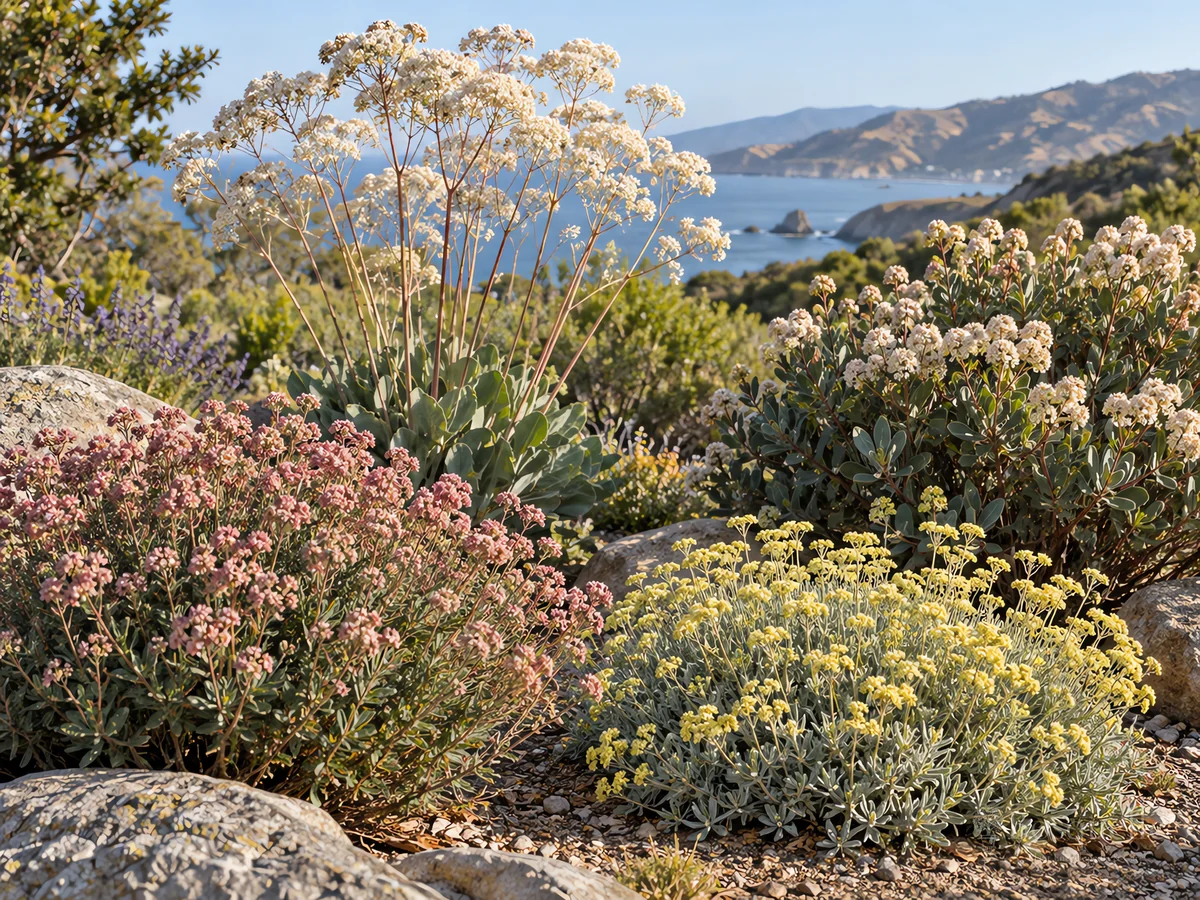
Choose a chaparral shrub, a yellow inland mat, or an island kind first.

Choose California buckwheat, sulphur-flower, or an island kind first
| Factor | Recommended | Avoid |
|---|---|---|
| California buckwheat | Fasciculatum. The usual two-to-four-foot chaparral shrub | Do not buy a packet labeled only buckwheat and expect this shrub |
| Sulphur-flower | Umbellatum. Low yellow mat for inland and mountain gardens | Do not plant it as an eight-foot island lace and expect the same outline |
| Island kinds | St. Catherine's lace, Santa Cruz Island, or San Miguel red | Do not plant the giant lace where winters stay hard |
| Coastal and naked | Seaside mound, or naked buckwheat with leafless bloom stems | Do not treat naked buckwheat as a dense four-foot shrub |
Know your USDA hardiness zone before you pick a type of eriogonum that will take your winter. Type your ZIP below.
2023 USDA ZIP listings (PRISM / USDA-ARS). Find Your USDA Hardiness Zone · Official USDA map.
The first choice is habit, then climate. A two-to-four-foot chaparral shrub is California buckwheat. A low yellow mat is sulphur-flower. A four-to-eight-foot lace is St. Catherine's lace. [1] Pick California buckwheat for a dry California slope. Pick sulphur-flower for an inland or mountain bed. Pick an island kind only where winters stay mild. [2] Sun, water, and planting stay on How to Grow Wild Buckwheat.
What are types of wild buckwheat?
Garden jobs split by habit: California buckwheat, sulphur-flower, island kinds, and coastal or naked buckwheat.
Is sulphur-flower the same as California buckwheat?
No. Sulphur-flower is a low yellow mat, hardy inland. California buckwheat is the usual chaparral shrub.
Browse by kind
Match the outline and the winter, then pick that kind. Care for the shrub you already have on How to Grow Wild Buckwheat.
California buckwheat
California buckwheat is the usual chaparral shrub, about two to four feet, with creamy heads that age rust. Buy it for a dry slope or a mixed native border.
Sulphur-flower
sulphur-flower is a low yellow mat for inland and mountain gardens. It is hardier than the island kinds, and it is not a Channel Islands giant.[3]
Island buckwheat
St. Catherine's lace is the giant, four to eight feet, with lacy cream heads. Santa Cruz Island buckwheat is a silvery island shrub. San Miguel red buckwheat is a low rosy mound from the Channel Islands. All three want a mild winter.[4]
Coastal and naked buckwheat
seaside buckwheat is a coastal mound, lower than California buckwheat. naked buckwheat holds pale heads on tall leafless stems — a different outline, still this genus.
Match California buckwheat, sulphur-flower, or an island kind before you plant. A chaparral shrub and a Channel Islands giant are not the same bed.
FAQ
Do you list Warriner Lytle or Dana Point?
Those are low California-buckwheat shop names. We do not list them as cards. Treat them as California buckwheat, not a new group.
Does naked buckwheat want the same shrub space?
Give it sun and drain, but expect a different outline: tall leafless bloom stems, not a dense four-foot shrub.
Do you list Ella Nelson's Yellow?
That is a naked-buckwheat shop name. We do not list it as a card. Treat it as naked buckwheat.
Related guides


References
- [1] Tree of Life Nursery -
https://californianativeplants.com/blog/garden-planning-tools/eriogonum/ - [2] UC Master Gardeners of Sonoma County -
https://ucanr.edu/site/mg-sonoma/eriogonum-buckwheat - [3] Lady Bird Johnson Wildflower Center -
https://www.wildflower.org/plants/result.php?id_plant=ERUM - [4] Gardenia -
https://www.gardenia.net/plant/eriogonum-giganteum
This note is part of Eriogonum Guides.
More type comparisons by plant are gathered in Types of Plants Guides.
Updated: Reviewed by Bosquelle Editors