
Shop “vanda orchid” and you will meet moth orchids, terete lookalikes, and named hybrids this catalog does not hold. We cover all 5: blue V. coerulea, sky-blue V. coerulescens, waling-waling V. sanderiana, fragrant V. tricolor, and V. denisoniana. Care stays on How to Grow Vanda.

Choose by night temperature and leaf
North Carolina Extension flags two plants that actually sit in this shortlist: V. coerulea with blue-reticulate flowers, and V. sanderiana with pinkish-tan petals and darker lateral sepals — a parent of many large hybrids. Gardeners Path adds the leaf fork: strap-leaf Vanda versus pencil-like terete leaves. Terete plants sold as “Vanda” are often Papilionanthe now — not extra cards here.
- Cooler-leaning blue — V. coerulea and V. coerulescens. Still bright light and open roots; nights can run a notch cooler than lowland heat vandas. Not frost plants.
- Warm show plants — V. sanderiana, V. tricolor, V. denisoniana. Heat, humidity, and a hang they will not forgive if you copy a dry windowsill moth orchid.
- Strap leaf — the five we hold. Linear, folded, leathery leaves on an upright monopodial stem.
At the nursery, strap-leaf Vanda looks like an upright cane with stiff, folded leaves in two ranks. Moth orchid leaves are broader and softer, usually in a bark pot. Pencil leaves are terete — look up Papilionanthe, not this shortlist. Read the genus on the tag before the color. “Blue” on a grocery moth orchid is usually dye.
Former names you will still see: Ascocentrum, Euanthe, Neofinetia, and ×Ascocenda. North Carolina Extension treats several of those as Vanda now. That does not add dwarf ampullacea or Neofinetia cards to this page — we do not hold them. An unlabeled compact vandaceous hybrid still wants open roots; it is not a sixth species card here.
Once you know the species, soak rhythm and the 55°F move live on How to Grow Vanda. Keiki and top-cut live on How to Propagate Vanda. Nesting a tight mesh basket lives on How to Repot Vanda.
Blue and sky-blue we hold
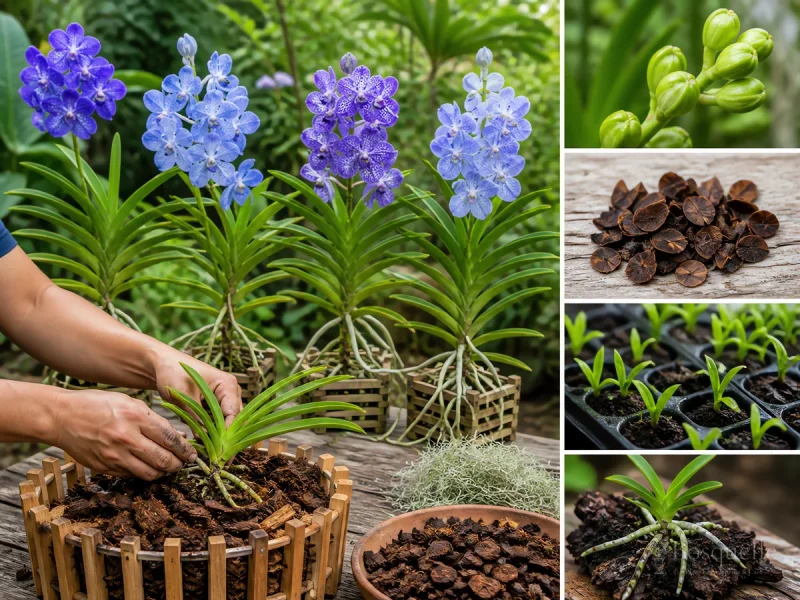
V. coerulea is the blue Vanda collectors chase — tessellated blue to lavender, used in hybridizing for color and a bit more cool tolerance. North Carolina Extension lists it; Gardeners Path notes highland types run cooler. V. coerulescens is the smaller sky-blue plant in this catalog. Same hang-and-soak culture. Do not park them on a heat-only patio next to a lowland sanderiana hybrid and expect one night temperature to serve both.
Live titles: blue-vanda and sky-blue-vanda. If a shop sold you a dyed “blue moth orchid,” that is not this group. Dyed Phalaenopsis is a different genus and a different pot. Color on a hybrid is not a sixth species. A blue-lavender shop plant with a Vanda tag still wants open roots. It is not automatically V. coerulea unless the label says so.
If two plants in one basket are different species, they still share hang-and-soak, but they may not share night temperature. Split the hang if nights disagree. A plant labeled only “blue vanda” with no Latin is a shop shortcut — treat it as open-root Vanda, then match nights once you know whether it is highland blue or a warm hybrid.
Buying checklist: Vanda on the tag, a basket you can hang, a humidity plan, and nights you can keep above a cold snap. Skip the plant if you need a low-water desk orchid. Iowa State University Extension already told you which orchid that is, and it is not this genus.
Sanderiana, tricolor, and denisoniana
V. sanderiana is waling-waling, the large Philippine show flower North Carolina Extension notes as much used in hybridizing. Some botanists still split it as Euanthe; horticulture tags it Vanda. Treat it as a warm, bright basket plant, not a moth orchid. V. tricolor is the fragrant upright plant in this catalog. V. denisoniana is Lady Denison-Londesborough’s Vanda — yellow-leaning, same open-root refusal of closed soil.
Trade hybrids Gardeners Path names — Brighton Sunset, Pachara Delight, Xena — are real plants in the wider market. They are not extra groups here. If a tag matches one of those names, still hang-and-soak it as Vanda, then come back to this shortlist for the five we link. Fragrance is a species hint, not a care change. Size on the tag is also not a type. A compact vandaceous hybrid may be former Ascocenda breeding. We still do not add a dwarf card.
Waling-waling on a tourist gift tag is V. sanderiana if the Latin agrees. Read the genus first, then the species. A compact plant with a Vanda tag and bright flat flowers may be former Ascocenda breeding — still hang-and-soak it; do not invent a dwarf card. Fragrance on V. tricolor is a hint at the bench, not a reason to copy moth-orchid ice cubes.
Wrong Vanda buys
- Phalaenopsis / moth orchid — bark cup, often ice-cube advice, lower light. Iowa State University Extension’s easy indoor orchid. Not Vanda.
- Papilionanthe / terete “Vanda” — pencil leaves, often more sun. North Carolina Extension moved them out of Vanda. We do not hold them.
- Cattleya / Dendrobium / Paphiopedilum — other genera on the same garden-center bench. Wrong care if you copy this page.
- Mokara / Aranda bedding “vanda” — intergeneric tropics bedding. Not a card in this catalog.
If a nursery sold a mixed “tropical orchid” with no Latin, use the root test before you copy a neighbor’s bark cup. Thick, hanging aerial roots on a slatted basket = this genus. Flat fleshy roots packed in fine bark with a moth-orchid leaf = Phalaenopsis. Pencil terete leaves = look up Papilionanthe, not this shortlist. When the Latin matches one of the five, stop shopping for a sixth invented kind. Hang it. Soak it. Then pick the night temperature that fits blue versus sanderiana — not a moth-orchid windowsill copied from a grocery tag. A Vanda tag with no species still wants open roots; it is not a moth orchid because the flower is large.
FAQ
What is waling-waling?
Vanda sanderiana, the large Philippine show species in this catalog. Warm, bright, open-root — not a moth orchid.
Is Ascocenda a different type?
North Carolina Extension treats former Ascocenda as Vanda now. We do not hold extra dwarf Ascocentrum cards. Grow unlabeled compact vandaceous plants as open-root Vanda, then use the five species we link.
Do blue Vanda need cooler care?
V. coerulea and V. coerulescens are often grown a notch cooler than heat-only lowland vandas, still with bright light and open roots — not frost culture.
Is Euanthe sanderiana the same plant?
Many botanists split it; horticulture tags it Vanda sanderiana. In this catalog it is the waling-waling card.
Do you cover terete Vanda?
No. Pencil-leaf types are often Papilionanthe now. We do not invent them from a garden-center spike.
Which Vanda should a beginner start with?
None of these is a low-light desk orchid. If you can hang a basket and soak daily in heat, any of the five works — match night temperature to blue vs sanderiana.
Are Brighton Sunset or Pachara Delight here?
No. They are real hybrids in the wider trade. We do not invent extra groups.
Is a dyed blue moth orchid a Vanda?
No. That is usually Phalaenopsis. Check the genus on the tag and the pot style.
Will all five bloom in a dark apartment?
No. Weak light makes dark soft leaves and no spikes. This is a bright-hang genus.
Is Neofinetia a type of Vanda we sell?
North Carolina Extension lists it among former names now in Vanda. We do not hold a Neofinetia card. Do not invent one.
Related guides



This note is part of Vanda Guides.
More type comparisons by plant are gathered in Types of Plants Guides.
Updated: Reviewed by Bosquelle Editors