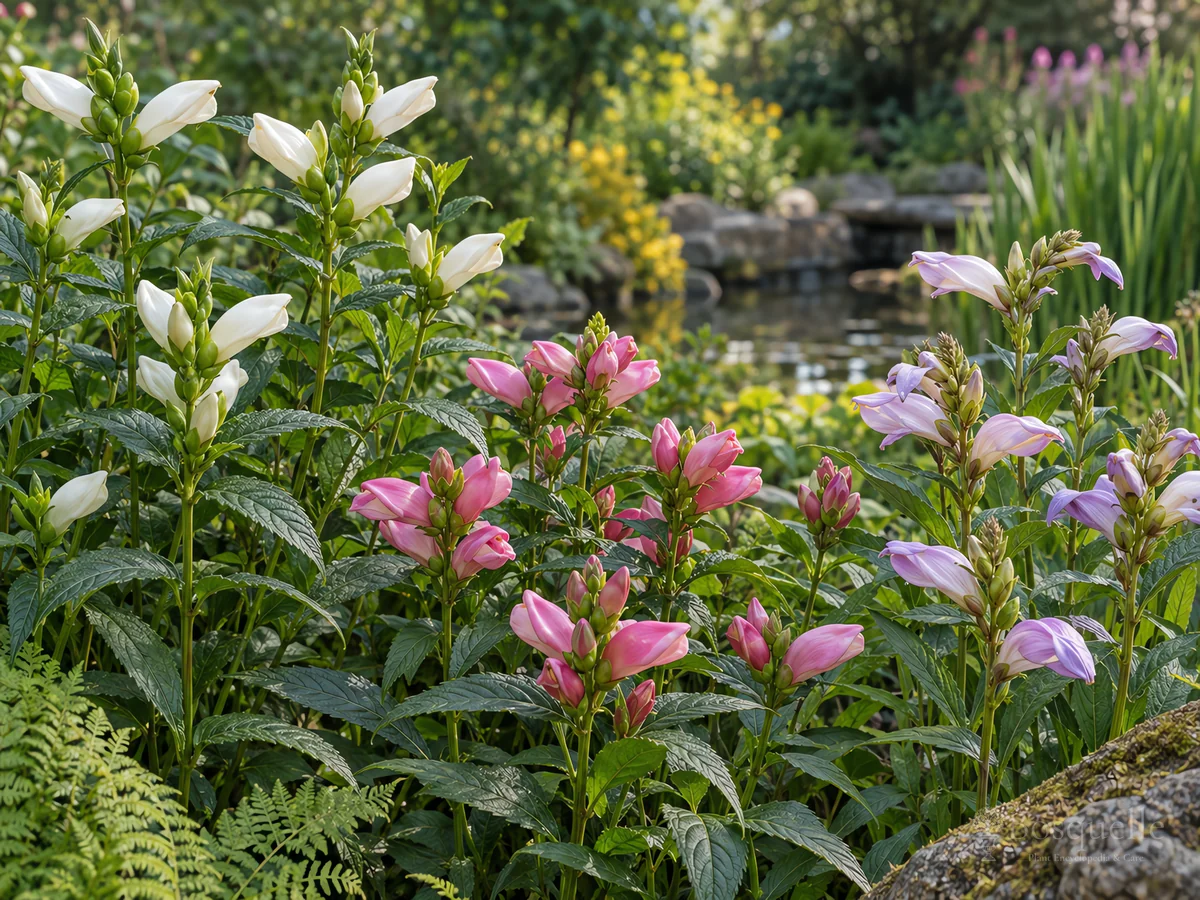
Choose turtlehead by flower color: white, pink, or rose. We list three kinds.
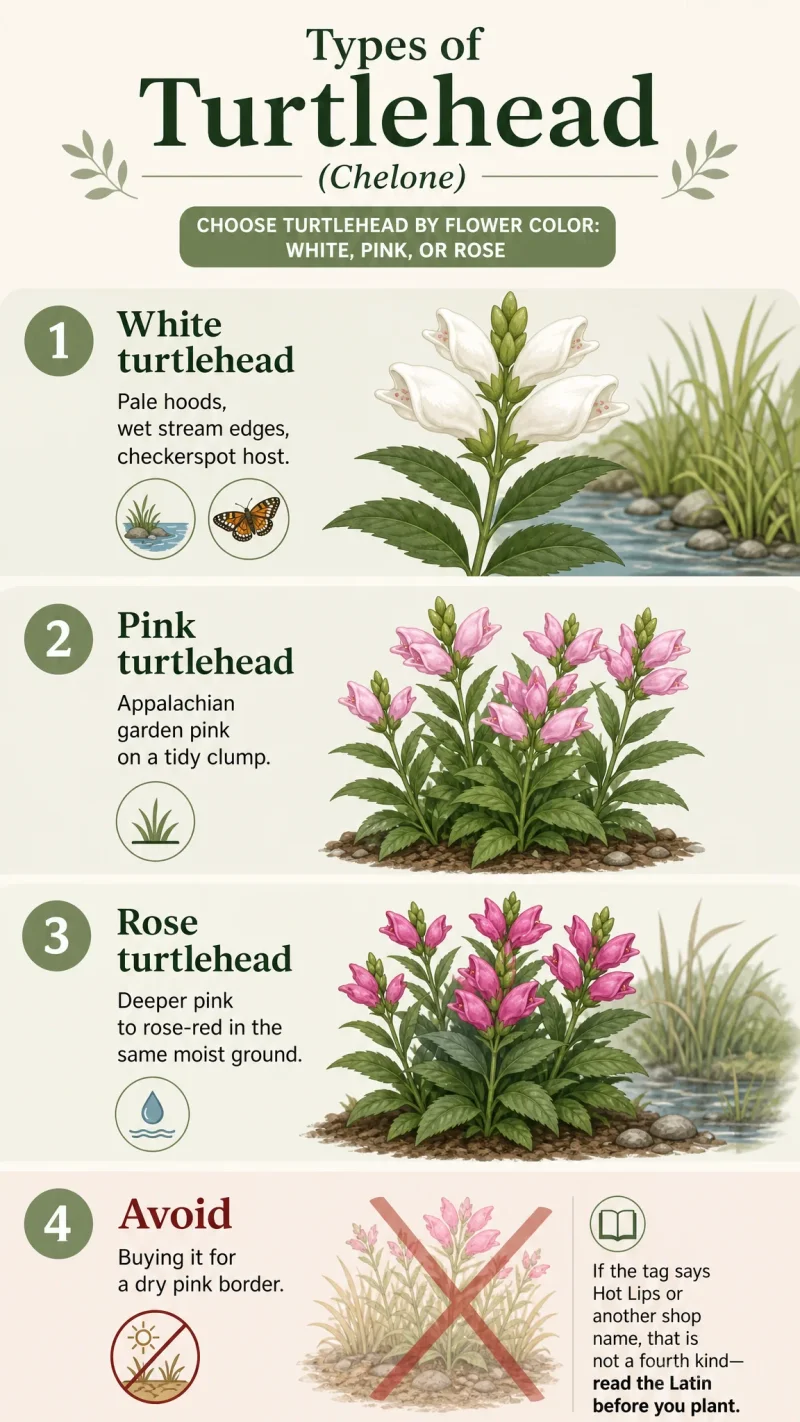
Choose white, pink, or rose turtlehead
| Factor | Recommended | Avoid |
|---|---|---|
| White turtlehead | Pale hoods, wet stream edges, checkerspot host | Buying it for a dry pink border |
| Pink turtlehead | Appalachian garden pink on a tidy clump | Treating a shop nickname as a fourth species |
| Rose turtlehead | Deeper pink to rose-red in the same moist ground | Assuming red means a different watering plan |
Know your USDA hardiness zone before you pick a type of chelone that will take your winter. Type your ZIP below.
2023 USDA ZIP listings (PRISM / USDA-ARS). Find Your USDA Hardiness Zone · Official USDA map.
Read the flower. The three we list are C. glabra, C. lyonii, and C. obliqua. [1] Culture is the same moist-wet ground. Color and native range are the choice. [2]
What is the difference between white and pink turtlehead?
White turtlehead is usually pale, sometimes pink-tinged. Pink turtlehead is the Appalachian garden pink. Rose turtlehead runs warmer still. All three want moisture.
Does pink turtlehead spread?
Slowly, like the others — a clump, not a runaway patch. Color on the tag is not a containment fix.
Browse by kind
White turtlehead
C. glabra is white turtlehead — pale hooded spikes, sometimes pink-tinged, for wet woods and stream edges. It is the checkerspot host in this list, and the broadest eastern native range of the three.
Pink turtlehead
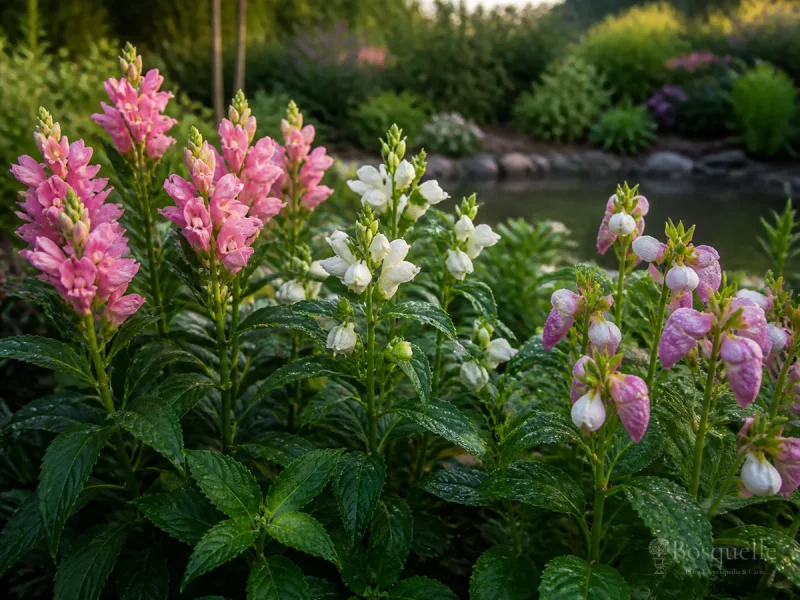
C. lyonii is pink turtlehead from the southern Appalachians. It is the usual garden pink: tidy clumps and deep pink spikes when moisture holds, with afternoon shade in heat.
Rose turtlehead
C. obliqua is rose turtlehead — pink to nearly red hoods in the same moist niche, and the warmer flower tone if you want it. Moisture stays the same contract as white and pink.
All three share moist-wet Chelone habits: rich soil, sun to part shade, and a late spike. Pick by flower color, not by a shop list of extra names. [3] [4]
Not extra shop names
Nursery names such as Hot Lips, Tiny Tortuga, Black Ace, and Pink Temptation are still these three habits — not extra kinds in this list. A fourth wild species you cannot buy is not a catalog card. Read the Latin so the tag is Chelone, not obedient plant or bee balm. Color on a shop tag does not change the moist-ground job.
What is Hot Lips turtlehead?
A pink-turtlehead garden selection with deeper rose blooms. It is not a fourth species in this list.
If the tag says Hot Lips or another shop name, that is not a fourth kind — read the Latin before you plant.
FAQ
Is Hot Lips a plant we hold?
No. That pink-turtlehead selection is not in this catalog. Same moist ground if you bought one elsewhere.
Is Tiny Tortuga a plant we hold?
No. That compact nursery name is not in this catalog. Same wet niche and late bloom.
Is shellflower a different plant?
Shellflower is another common name for turtlehead, not a second genus.
Is red turtlehead a different species?
Red or rose turtlehead is Chelone obliqua in this list — deeper pink to nearly red, same moist ground as the others.
Related guides

References
- [1] University of Wisconsin–Madison Division of Extension -
https://hort.extension.wisc.edu/articles/turtlehead-chelone-spp/ - [2] Piedmont Master Gardeners -
https://www.piedmontmastergardeners.org/article/chelone-a-funny-name-but-a-sweet-flower/ - [3] NC State Extension -
https://plants.ces.ncsu.edu/plants/chelone-lyonii/ - [4] NC State Extension -
https://plants.ces.ncsu.edu/plants/chelone-obliqua/
This note is part of Chelone Guides.
More type comparisons by plant are gathered in Types of Plants Guides.
Updated: Reviewed by Bosquelle Editors