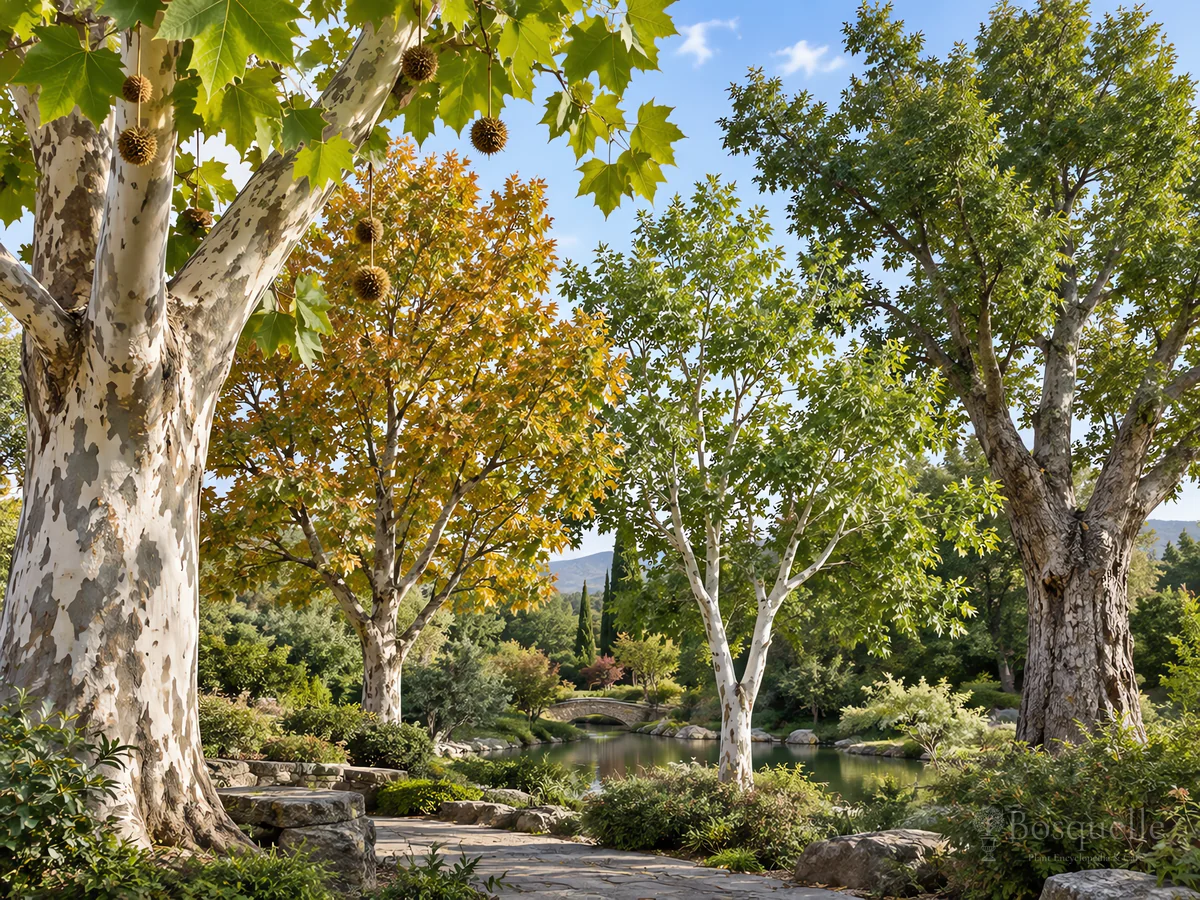
Choose a sycamore by the job first: an American sycamore for a wet opening, a London plane for a street, or a California sycamore in the West. All are Platanus with peeling bark and hanging seed balls.
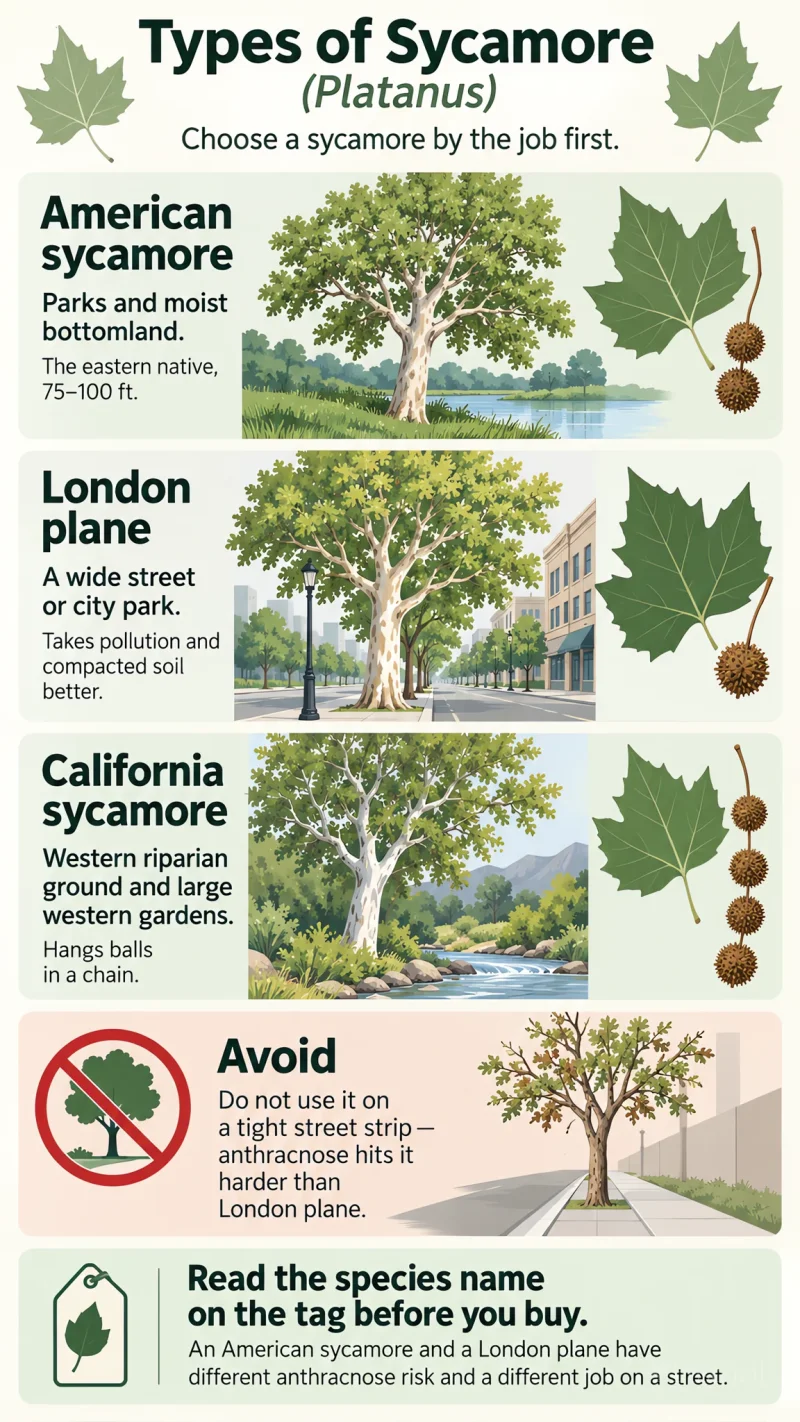
Choose an American sycamore for wet ground, a London plane for a street, or a California sycamore in the West
| Kind | Best for | Not for |
|---|---|---|
| American | Parks and moist bottomland; American sycamore is the eastern native, 75–100 ft | Do not use it on a tight street strip — anthracnose hits it harder than London plane |
| London plane | A wide street or city park; London plane takes pollution and compacted soil better | Do not squeeze it into a tiny courtyard — it still reaches 70–100 ft |
| California | Western riparian ground and large western gardens; California sycamore hangs balls in a chain | Do not treat it as a desert tree, or water only with a sprinkler on the leaves |
Know your USDA hardiness zone before you pick a type of platanus that will take your winter. Type your ZIP below.
2023 USDA ZIP listings (PRISM / USDA-ARS). Find Your USDA Hardiness Zone · Official USDA map.
London plane is the usual nursery street form. Count the seed balls: London plane usually hangs two per stalk, and the inner bark is more olive than chalk-white. [1] American sycamore is the large eastern native. It usually hangs one ball per stalk, and the upper trunk peels to white. [2] California sycamore is the western native. Give it a deep soak that sends roots down, not frequent shallow sprinkling. [3] Site, watering, and the first-year plant-out stay on How to Grow Sycamore.
American vs London plane vs California?
American sycamore is the eastern native for wet openings, usually one ball per stalk. London plane is the street hybrid, usually two balls. California sycamore is the western native, with several balls in a chain.
Which sycamore for a city street?
London plane, on a wide median or a wide tree lawn. American sycamore is a better park and bottomland tree than a tight paved strip.
Browse by kind
American sycamore
American sycamore. Eastern native of moist bottomlands; usually one seed ball per stalk and white bark high in the crown.
London plane
London plane. Street hybrid of American and Oriental plane; usually two balls per stalk; anthracnose is usually milder.
California sycamore
California sycamore. Western riparian native; seed balls hang in a chain of several.
Oriental plane
Oriental plane. Old World parent of London plane; more drought once established.
Oriental plane is the Old World parent of London plane. It shares the same large shade habit; it handles drought better once it is established than American sycamore. Named street forms such as Bloodgood sit inside London plane; they are not a separate species. [4]
Read the species name on the tag before you buy — an American sycamore and a London plane have different anthracnose risk and a different job on a street.
FAQ
Is Bloodgood a different species?
No. Bloodgood, Columbia, Liberty, and Exclamation are named selections of London plane, sold for stronger anthracnose resistance. Read the tag for Platanus × acerifolia.
Is Oriental plane the same as London plane?
No. Oriental plane is Platanus orientalis. London plane is the hybrid of Oriental plane and American sycamore. Both are large shade trees; London plane is the one nurseries sell for streets.
Do you list Mexican sycamore?
Mexican sycamore is not in this catalog. The four kinds here are American, London plane, California, and Oriental. Do not treat a maple labeled sycamore as a fifth plane tree.
Related guides

References
- [1] North Carolina Extension Gardener Plant Toolbox -
https://plants.ces.ncsu.edu/plants/platanus-x-acerifolia/ - [2] North Carolina Extension Gardener Plant Toolbox -
https://plants.ces.ncsu.edu/plants/platanus-occidentalis/ - [3] UC Agriculture and Natural Resources -
https://ucanr.edu/blog/under-solano-sun/article/sycamores - [4] Cornell University Woody Plants Database -
https://woodyplants.cals.cornell.edu/plant/print/184
This note is part of Platanus Guides.
More type comparisons by plant are gathered in Types of Plants Guides.
Updated: Reviewed by Bosquelle Editors