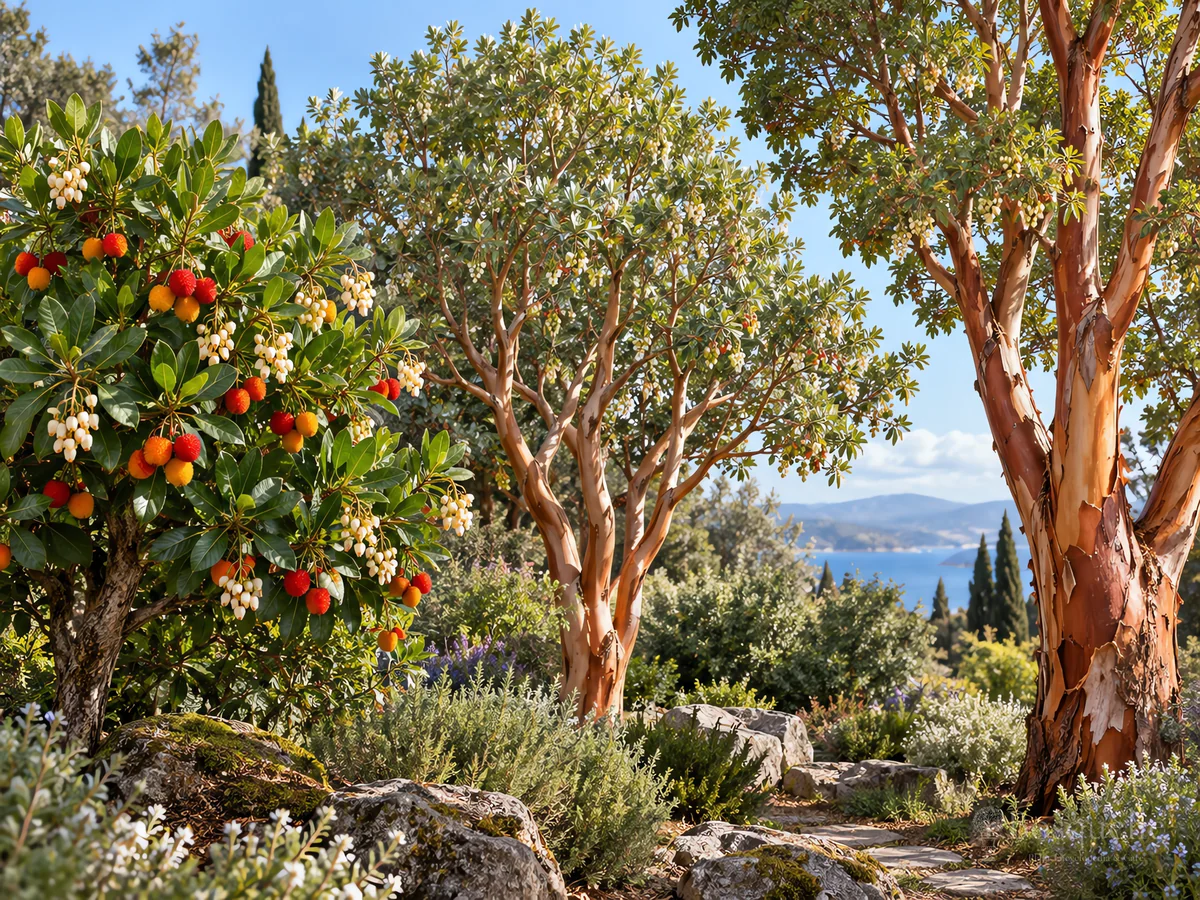
Choose strawberry tree by temperament first: an easy Mediterranean evergreen, a Greek collector cousin, or Pacific madrone on a native site. We list three kinds.

Choose a strawberry tree, Greek strawberry tree, or Pacific madrone
| Factor | Recommended | Avoid |
|---|---|---|
| Ordinary drained garden | Strawberry tree (A. unedo) | Buying Pacific madrone because the bark looks similar |
| Collector Mediterranean evergreen | Greek strawberry tree (A. andrachne) | Expecting unedo fruit size on andrachne |
| Rocky West Coast native site | Pacific madrone, smallest stock, little summer water | A manicured irrigated lawn |
Know your USDA hardiness zone before you pick a type of arbutus that will take your winter. Type your ZIP below.
2023 USDA ZIP listings (PRISM / USDA-ARS). Find Your USDA Hardiness Zone · Official USDA map.
Greek strawberry tree resembles Pacific madrone but stays smaller. [1] Compact shop forms of unedo stay denser and shorter for years; they are still woody shrubs, not patio strawberries. [2]
Strawberry tree vs Pacific madrone?
Both are Arbutus. Unedo is the easier Mediterranean landscape tree. Pacific madrone is a native that often fails after a big transplant or extra summer water.
Browse by kind
Strawberry tree
Strawberry tree (A. unedo) is the landscape default: peeling bark, fall flowers, and bland red fruit that often hangs with new bloom.
Greek strawberry tree
Greek strawberry tree (A. andrachne) is the collector Mediterranean cousin. It looks more like Pacific madrone than like a fruiting unedo, and it stays smaller than a forest madrone.
Pacific madrone
Pacific madrone (A. menziesii) is the West Coast native. Buy the smallest plant you can, keep extra summer water off it, and do not treat it as a beginner unedo.
Not strawberry tree — garden strawberries, Chinese strawberry tree, and other names
- Garden strawberry is Fragaria, a low fruit crop. The red fruits on this tree only look vaguely similar.
- Chinese strawberry tree is usually Myrica rubra (red bayberry / yangmei), not Arbutus. Confirm the Latin.
- Hydrangea Vanilla Strawberry is a hydrangea panicle. It is not a tree in the heath family.
- Pacific madrone in a wet lawn fails for cultural reasons, not because you bought the wrong fruit. Smallest stock, undisturbed roots, little extra water. [3]
- Marina is a shop hybrid you may see in California. We do not list it as a card. [4] Match bark and size at the nursery; do not assume it is unedo or Pacific madrone.
Is it related to garden strawberries?
No. Garden strawberries are Fragaria. Strawberry tree is Arbutus. The fruit is edible but bland; it is not a dessert berry patch.
If you want an easy evergreen, start with unedo — do not force Pacific madrone to do that job in a wet bed.
FAQ
Do we list Compacta, Elfin King, or Marina?
No. Compact and dwarf forms of unedo stay shorter; Marina is a shop hybrid. The three kinds here are unedo, andrachne, and Pacific madrone.
How big does a strawberry tree get?
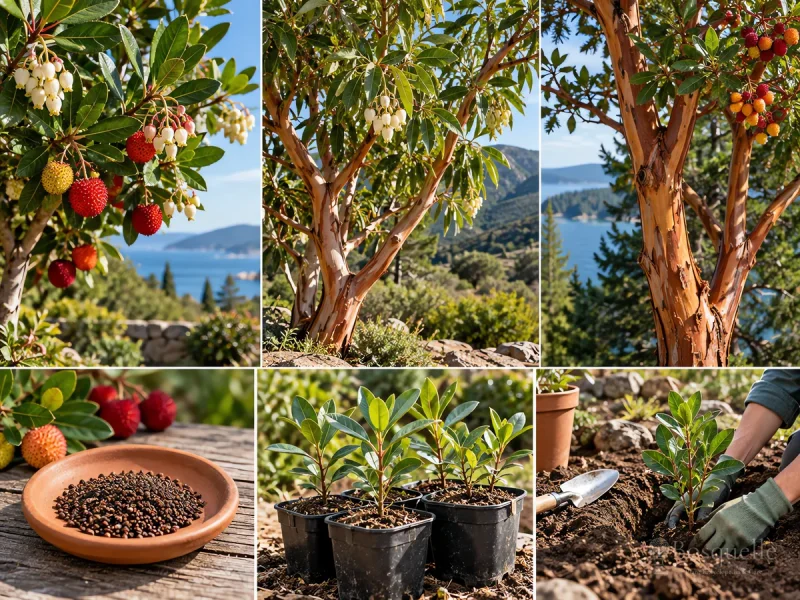
Often 10 to 15 feet as a large shrub or small tree; old plants can push much taller. Compact selections stay denser and shorter for years, but they are still woody, not a berry patch.
Is strawberry madrone Pacific madrone?
Not usually. In California, strawberry madrone often means unedo. Pacific madrone is A. menziesii, the West Coast native.
Related guides


References
- [1] Oregon State University Landscape Plants -
https://landscapeplants.oregonstate.edu/plants/arbutus-unedo - [2] NC State Extension Gardener -
https://plants.ces.ncsu.edu/plants/arbutus-unedo/ - [3] Oregon State University Extension -
https://extension.oregonstate.edu/news/grow-oregons-iconic-madrone-care-patience - [4] San Marcos Growers -
https://www.smgrowers.com/products/plants/plantdisplay.asp?plant_id=159
This note is part of Arbutus Guides.
More type comparisons by plant are gathered in Types of Plants Guides.
Updated: Reviewed by Bosquelle Editors