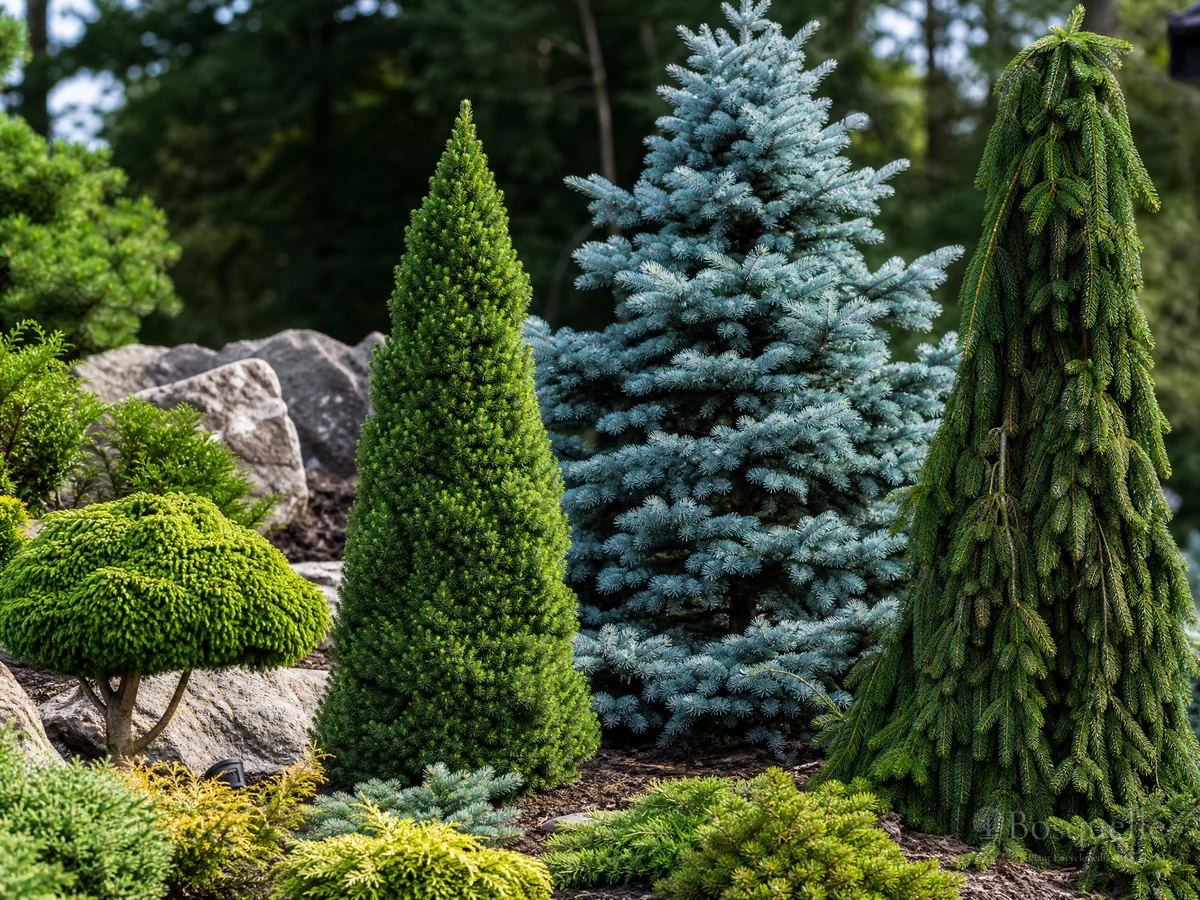
Choose spruce by habit: a dwarf nest, a dwarf cone, a landscape tree, or a weeping or narrow column. Match the habit on the tag to one of those groups.
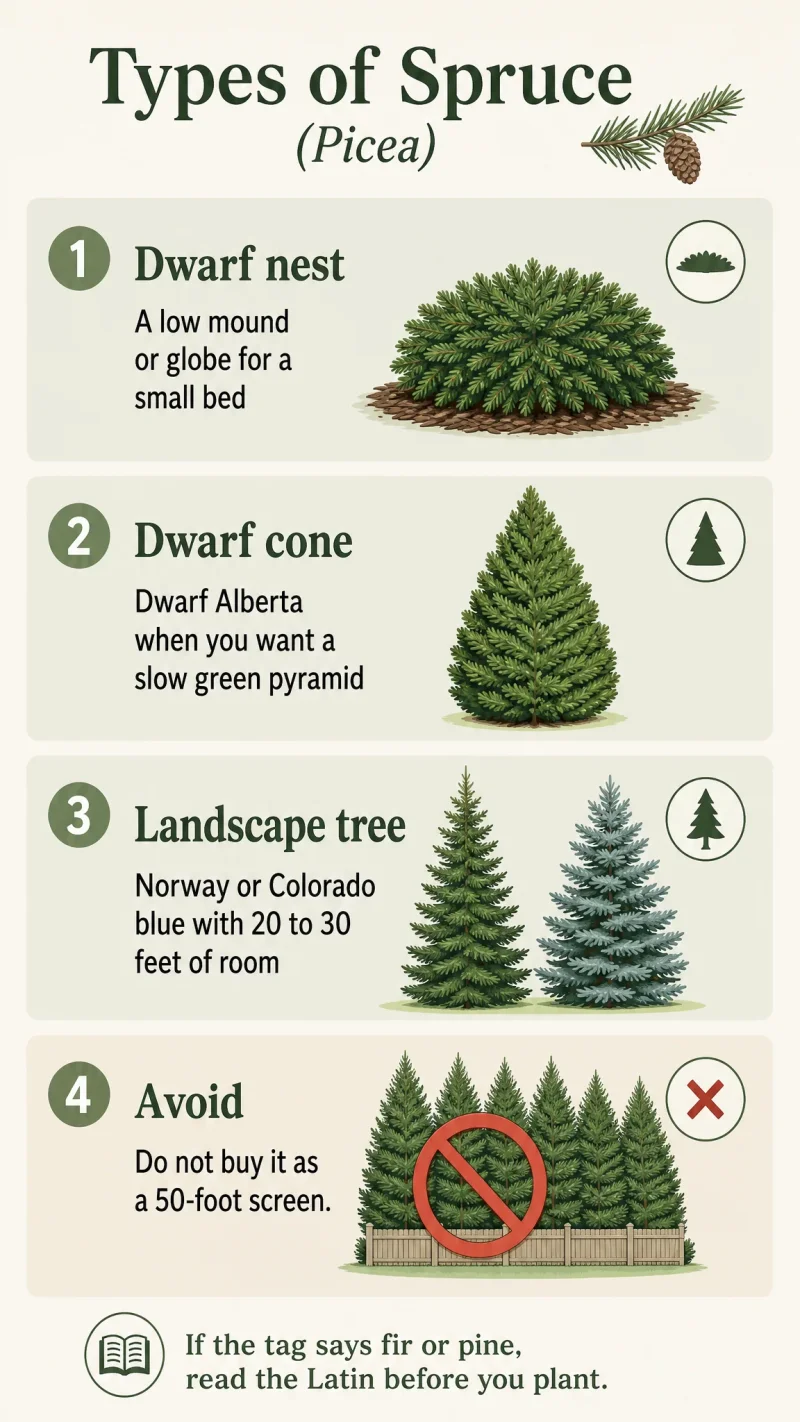
Choose a dwarf nest, a dwarf cone, or a landscape tree
| Factor | Recommended | Avoid |
|---|---|---|
| Dwarf nest | A low mound or globe for a small bed | Do not buy it as a 50-foot screen |
| Dwarf cone | Dwarf Alberta when you want a slow green pyramid | Do not site it in a hot humid corner with no air |
| Landscape tree | Norway or Colorado blue with 20 to 30 feet of room | Do not treat a 6-inch pot photo as the mature size |
| Weeping or column | Inversa or Cupressina when you want a specimen outline | Do not plant it as a bird's-nest mound |
Know your USDA hardiness zone before you pick a type of picea that will take your winter. Type your ZIP below.
2023 USDA ZIP listings (PRISM / USDA-ARS). Find Your USDA Hardiness Zone · Official USDA map.
Read the habit on the tag. Spruces share cool sun and moist drain. The choice is how tall and how wide it will be. [1] [2] A one-gallon nursery plant can still become a 40-foot tree or stay a three-foot nest. Size on the pot is not the mature size.
What is the difference between a dwarf nest, a dwarf cone, and a landscape spruce?
Nests and globes stay low and wide. Dwarf Alberta is a slow cone. Landscape Norway and Colorado blue become large trees.
Browse by kind
Dwarf nests and globes
Nidiformis is the classic bird's-nest mound. Little Gem is a tighter dwarf. Globosa is a blue globe of Colorado spruce. Space them for the mature spread, not the nursery pot, on Planting Spruce.
Dwarf Alberta cones
Conica is dwarf Alberta spruce — a slow green cone of white spruce, not a 50-foot Norway. Related Alberta forms sit here too.
Landscape trees
Norway spruce is the fast European tree with drooping branchlets. Colorado blue spruce is the stiff blue Rocky Mountain tree. Sitka, Engelmann, black, and red spruce are species trees in this group.
Weeping and narrow columns
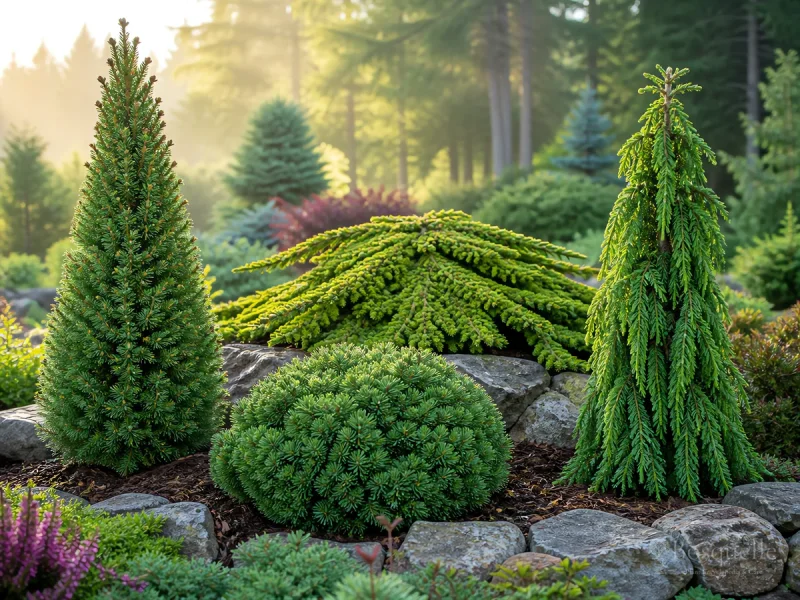
Inversa weeps. Cupressina is a narrow Norway column for a tight screen. Neither is a nest, and neither is a 30-foot-wide windbreak.
Culture stays the same cool sun and drain. Pick by outline, not by a shop list of extra names. [3]
Not fir — and not pine
Spruce needles are square in cross-section, so they roll between your fingers, and each needle sits on a small woody peg. Cones hang. Fir needles are flat and do not roll; fir cones stand up and shatter on the tree. Pine needles come in bundles of two to five. [4] A tag that says only “evergreen” is not enough; read the Latin.
How do I tell spruce from fir or pine?
Roll a needle: spruce is square. Fir is flat. Pine needles come in bundles. Spruce and pine cones hang; fir cones stand up and fall apart on the tree.
If the tag says fir or pine, read the Latin before you plant.
FAQ
Is Fat Albert or Black Hills spruce in this catalog?
No. Those nursery names are not in this catalog. They still want the same cool sun and drain as Colorado blue or white spruce.
Is dwarf Alberta a separate species?
No. Dwarf Alberta spruce is Picea glauca var. albertiana ‘Conica’ — a slow cone of white spruce, not a second genus.
Is Globosa a separate species?
No. Globosa is a dwarf globe of Colorado spruce (Picea pungens), not a different genus.
Related guides



References
- [1] The Morton Arboretum -
https://mortonarb.org/plant-and-protect/trees-and-plants/norway-spruce/ - [2] NC State Extension Gardener -
https://plants.ces.ncsu.edu/plants/picea-abies/ - [3] NC State Extension Gardener -
https://plants.ces.ncsu.edu/plants/picea-pungens/ - [4] Ohio State University Extension -
https://cfaes.osu.edu/fact-sheet/it-pine-spruce-or-fir
This note is part of Picea Guides.
More type comparisons by plant are gathered in Types of Plants Guides.
Updated: Reviewed by Bosquelle Editors