
Choose a garden hybrid, common sneezeweed, or bitterweed first.
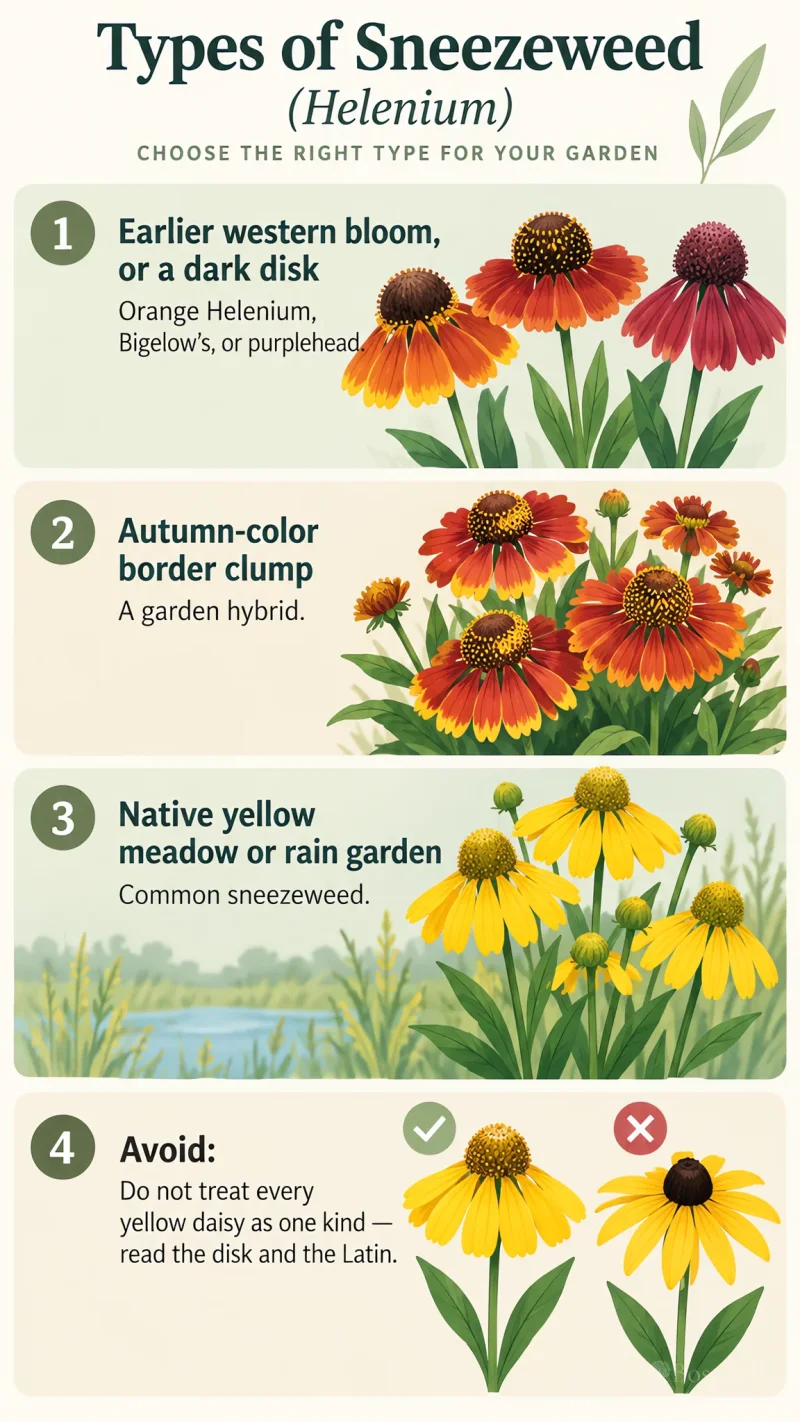
Choose a garden hybrid, common sneezeweed, or bitterweed first
| Factor | Recommended | Avoid |
|---|---|---|
| Autumn-color border clump | A garden hybrid | Do not buy the wild yellow if you wanted copper rays |
| Native yellow meadow or rain garden | Common sneezeweed | Do not buy a named hybrid when you wanted the species |
| Earlier western bloom, or a dark disk | Orange Helenium, Bigelow's, or purplehead | Do not treat every yellow daisy as one kind — read the disk and the Latin |
| A short annual in dry ground | Skip it for a moist border | Do not plant bitterweed as a perennial clump |
Know your USDA hardiness zone before you pick a type of helenium that will take your winter. Type your ZIP below.
2023 USDA ZIP listings (PRISM / USDA-ARS). Find Your USDA Hardiness Zone · Official USDA map.
Read the Latin on the tag, then pick the group that matches the job. [1] [2] Wild yellow forms suit a native planting; refined hybrids carry the copper, red, and gold border job. [3] Orange Helenium grows from a taproot, so it is a different plant from a fibrous hybrid clump. Purplehead is the yellow daisy with a dark disk — confirm that if the tag only says sneezeweed. [4] Sun and watering stay on How to Grow Sneezeweed.
Which sneezeweed should I plant?
Pick habit first: a garden hybrid for autumn color, common sneezeweed for a native yellow meadow, or skip bitterweed in a moist border.
Is bitterweed a garden helenium?
Helenium amarum is a short annual of dry pasture. It is not the moist-border perennial sold as Moerheim Beauty or Mardi Gras.
Browse by kind
Garden hybrids
Moerheim Beauty is the classic copper-red border clump. Mardi Gras is the orange-and-gold class that starts earlier. Most named tags in a U.S. garden center sit here.
Common sneezeweed
common sneezeweed is the wild yellow meadow form. Buy it for a rain garden or a native strip, not if you want mahogany rays.
Western and orange sneezeweed
orange Helenium is mountain / orange sneezeweed, a western species. Bigelow's sneezeweed is the California–Oregon yellow. Both bloom earlier than most fall hybrids.
Purplehead sneezeweed
purplehead sneezeweed has drooping yellow rays around a dark disk. Confirm the disk color if the tag only says sneezeweed.
Bitterweed
yellow sneezeweed is Helenium amarum, a short annual of dry, disturbed ground. It is the pasture bitterweed, not a moist border perennial.
Pick the group, then the cultivar. Extra shop names are not extra kinds. Ruby Tuesday, Short 'n' Sassy, and the Mariachi series are compact hybrids; treat them as garden hybrids if you grow one.
If you want copper-red rays, buy a garden hybrid — common sneezeweed is the yellow meadow form.
FAQ
Is Inula helenium this plant?
No. Inula helenium is elecampane. Sneezeweed is Helenium. Confirm the genus on the tag.
Does orange Helenium want a dry bed?
No. It is a western species with a taproot, and it still wants sun and moisture in the garden. Do not site it on a drought bank.
Is Rubinzwerg a different species?
No. It is a shorter garden hybrid. Use it at the front of a moist border. Care stays the same as the taller hybrids.
Related guides


References
- [1] Piedmont Master Gardeners -
https://www.piedmontmastergardeners.org/article/helenium-a-great-choice-for-the-late-summer-garden/ - [2] NC State Extension Gardener -
https://plants.ces.ncsu.edu/plants/helenium/ - [3] Wisconsin Horticulture -
https://hort.extension.wisc.edu/articles/helenium-helenium-autumnale/ - [4] Lady Bird Johnson Wildflower Center -
https://www.wildflower.org/plants/result.php?id_plant=heau
This note is part of Helenium Guides.
More type comparisons by plant are gathered in Types of Plants Guides.
Updated: Reviewed by Bosquelle Editors