
Choose smoke bush by foliage color first — purple, gold, or green — or pick the native American smoke tree if you want a larger specimen with intense fall color.
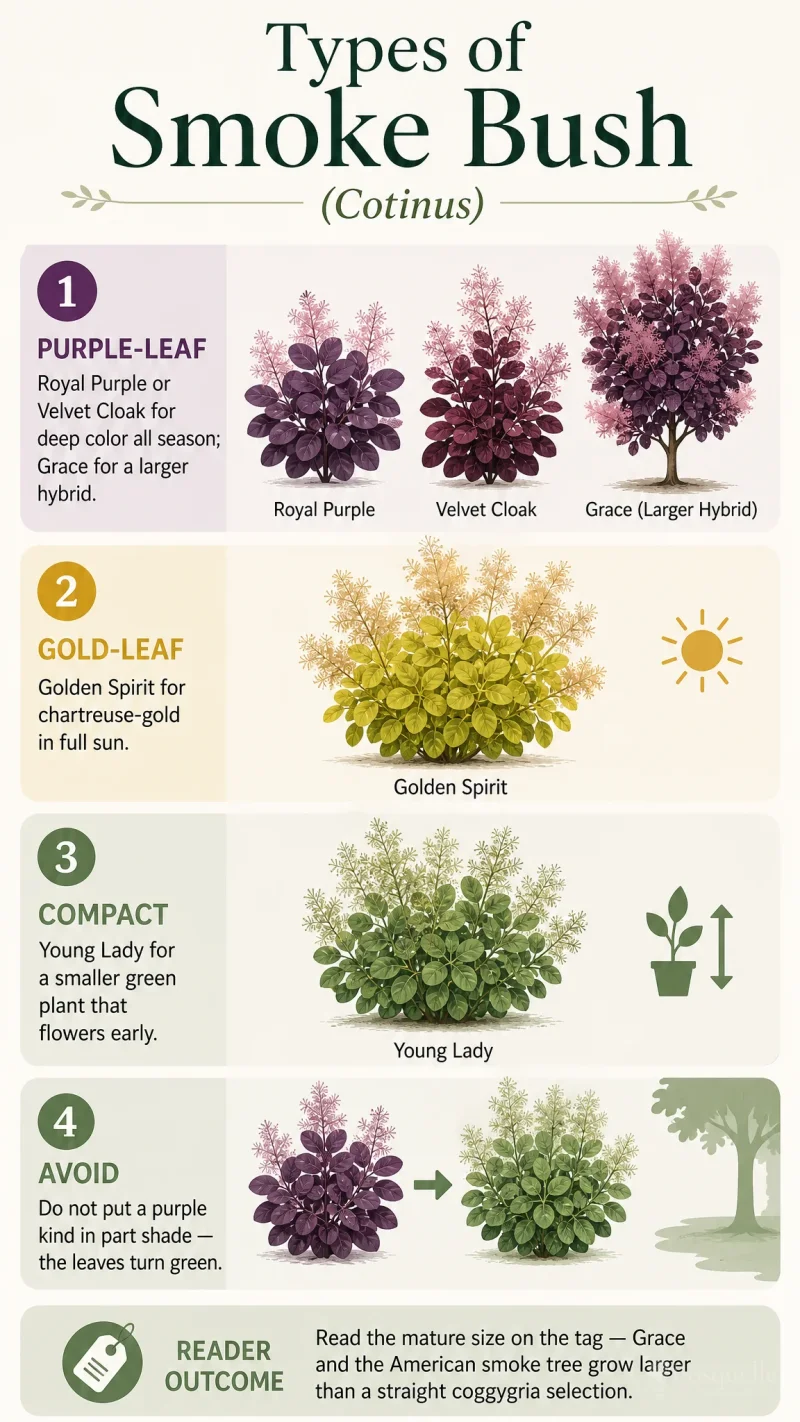
Choose purple, gold, or the native American tree first
| Factor | Recommended | Avoid |
|---|---|---|
| Purple-leaf | Royal Purple or Velvet Cloak for deep color all season; Grace for a larger hybrid | Do not put a purple kind in part shade — the leaves turn green |
| Gold-leaf | Golden Spirit for chartreuse-gold in full sun | Do not expect plumes to outrank the gold leaf on this kind |
| Compact | Young Lady for a smaller green plant that flowers early | Do not buy a full-size coggygria where space is tight |
| Native tree | Cotinus obovatus for a larger American specimen and intense fall color | Do not treat obovatus as a 10-foot purple shrub — it grows into a small tree |
Know your USDA hardiness zone before you pick a type of cotinus that will take your winter. Type your ZIP below.
2023 USDA ZIP listings (PRISM / USDA-ARS). Find Your USDA Hardiness Zone · Official USDA map.
Start with the leaf color you want, then check mature size on the tag. [1] [2] European smoke bush is the usual 10-to-15-foot shrub with showy plumes. The American smoke tree is a native specimen with smaller plumes and stronger fall color. [3] [4] All kinds share the same sun and drain. Site the one you choose on How to Grow Smoke Bush.
Which smoke bush should I plant?
Start with foliage color: purple, gold, or green. Then check mature size. Royal Purple is the usual purple-leaf. Pick American smoke tree if you want a larger native specimen.
What is the difference between smoke bush and smoke tree?
Smoke bush usually means Cotinus coggygria, a large shrub. American smoke tree is Cotinus obovatus — native, taller, with intense fall color and smaller plumes.
Browse by kind
Purple-leaf selections
Royal Purple is the usual purple-leaf selection — deep purple-black foliage through the growing season, then red-orange in fall. Velvet Cloak is similar in outline. Grace is a hybrid between Cotinus coggygria and Cotinus obovatus, so it grows larger than a straight coggygria cultivar; the leaf is reddish-purple and the fall color is outstanding. All purple-leaf kinds need full sun to keep color.
Gold-leaf selections
Golden Spirit (sold as Golden Spirit or ANCOT) has chartreuse to gold leaves in full sun and orange-red fall color.
Compact green-leaf
Young Lady is a compact green-leaf selection that starts flowering while it is still young, so you see plumes on a smaller plant.
Species plants
Cotinus coggygria is the European smoke bush — blue-green leaves, smoky pink plumes in summer, and yellow to red fall color. Cotinus obovatus, the American smoke tree, is native to limestone bluffs in the eastern United States. It grows larger than Cotinus coggygria and puts on some of the most intense orange-red fall color of any deciduous shrub. The plumes are smaller than on coggygria.
Read the mature size on the tag — Grace and the American smoke tree grow larger than a straight coggygria selection.
FAQ
Are Winecraft Black or Lilla in this catalog?
No. Winecraft Black, Lilla, and Velveteeny are compact selections we do not currently hold. The catalog includes Royal Purple, Velvet Cloak, Grace, Golden Spirit, Young Lady, and both species.
Is Golden Spirit the same as ANCOT?
Yes. ANCOT is the trade name. Golden Spirit is the same plant.
Related guides


References
- [1] Fine Gardening -
https://www.finegardening.com/genus/cotinus - [2] University of Missouri IPM -
https://ipm.missouri.edu/meg/2023/8/smokeTree-MW/ - [3] NC State Extension Gardener -
https://plants.ces.ncsu.edu/plants/cotinus-obovatus/ - [4] Portland Nursery -
https://www.portlandnursery.com/shrubs/cotinus
This note is part of Cotinus Guides.
More type comparisons by plant are gathered in Types of Plants Guides.
Updated: Reviewed by Bosquelle Editors