
Choose a cabbage palm tree or a dwarf palmetto first. Both are Sabal. Saw palmetto is a different plant.
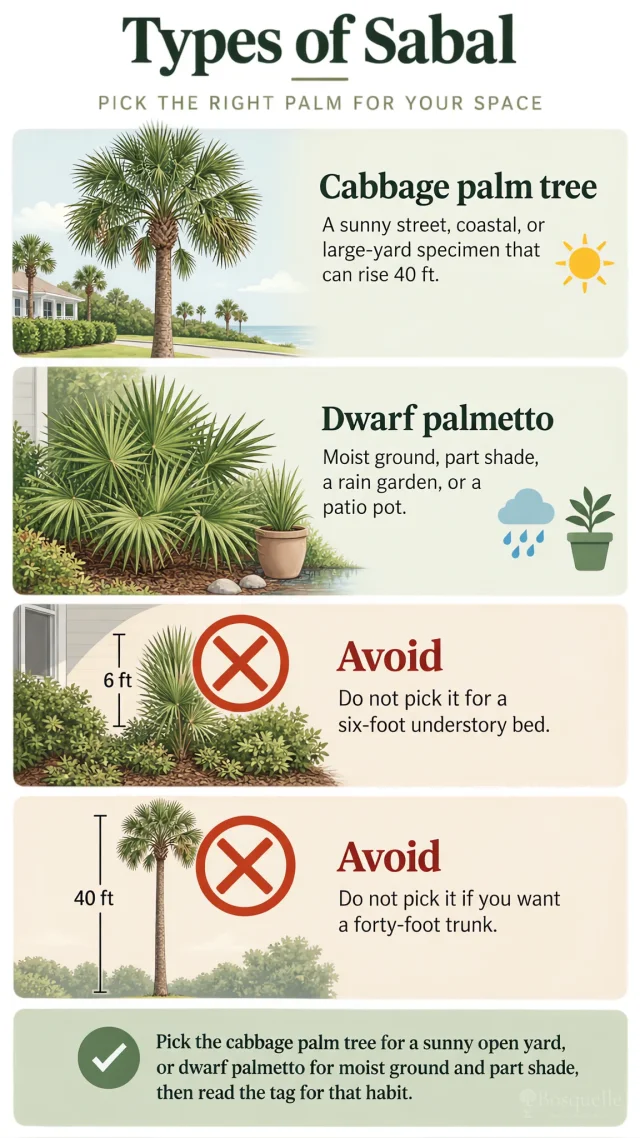
Choose a cabbage palm tree or a dwarf palmetto first
| Factor | Recommended | Avoid |
|---|---|---|
| Cabbage palm tree | A sunny street, coastal, or large-yard specimen that can rise 40 ft | Do not pick it for a six-foot understory bed |
| Dwarf palmetto | Moist ground, part shade, a rain garden, or a patio pot | Do not pick it if you want a forty-foot trunk |
Know your USDA hardiness zone before you pick a type of sabal that will take your winter. Type your ZIP below.
2023 USDA ZIP listings (PRISM / USDA-ARS). Find Your USDA Hardiness Zone · Official USDA map.
cabbage palm is the tree. It keeps a long arched costa in the fan and thread-like fibers between the segments. Flower stalks come from the top after an aboveground trunk has formed. [1] dwarf palmetto stays a shrub. The costa is weak, the fans have no marginal fibers, and the flower stalk rises from the base while the plant is still short — often under five feet. That bloom at a short height is the practical way to tell a true dwarf palmetto from a young cabbage palm that has not made a trunk yet. Cabbage palm is the coastal street tree. Dwarf palmetto is the floodplain understory plant you buy when the bed stays moist and you do not want a trunk. [2] [3] Saw palmetto is Serenoa. Its petioles have saw-like teeth. Sabal petioles are smooth. Scrub palmetto is a Florida sandhill plant that is not in this catalog. Site and watering stay on How to Grow Cabbage Palm. [4]
Which sabal should I plant?
Pick by mature habit. Cabbage palm is the street tree. Dwarf palmetto is the trunkless understory palm for moist ground and part shade.
Is saw palmetto a type of sabal?
No. Saw palmetto is Serenoa. The leaf stalk has teeth. Sabal stalks are smooth.
Browse by kind
Cabbage palm trees
Cabbage palm, also sold as cabbage palmetto or palmetto tree. A solitary fan-palm tree for a sunny coastal or street yard, not a six-foot understory clump.
Dwarf palmetto
Dwarf palmetto. A trunkless understory palm for moist ground and part shade, not a forty-foot street tree.
Read the tag for the habit that changes the job, then pick that kind. A young cabbage palm can look trunkless for years, so check the arched costa and the fibers, not only height.
Pick the cabbage palm tree for a sunny open yard, or dwarf palmetto for moist ground and part shade, then read the tag for that habit.
FAQ
Is blue palmetto a third species?
Blue palmetto is a shop name for cabbage palm. This catalog holds cabbage palm and dwarf palmetto.
Do you list Savannah Silver?
No. Savannah Silver, McCurtain, and Louisiana are extra shop names on dwarf palmetto, not extra cards here. Read the species on the tag.
What about scrub palmetto?
Scrub palmetto is Sabal etonia, a Florida sandhill palm. It is not in this catalog. Do not treat it as a third shop card.
Related guides



References
- [1] Clemson Home & Garden Information Center -
https://hgic.clemson.edu/identifying-volunteer-native-palms-in-the-landscape/ - [2] UF/IFAS Extension -
https://ask.ifas.ufl.edu/publication/FR357 - [3] UF/IFAS Gardening Solutions -
https://gardeningsolutions.ifas.ufl.edu/plants/trees-and-shrubs/palms-and-cycads/sabal-palmetto/ - [4] North Carolina Extension Gardener Plant Toolbox -
https://plants.ces.ncsu.edu/plants/sabal-palmetto/
This note is part of Sabal Guides.
More type comparisons by plant are gathered in Types of Plants Guides.
Updated: Reviewed by Bosquelle Editors