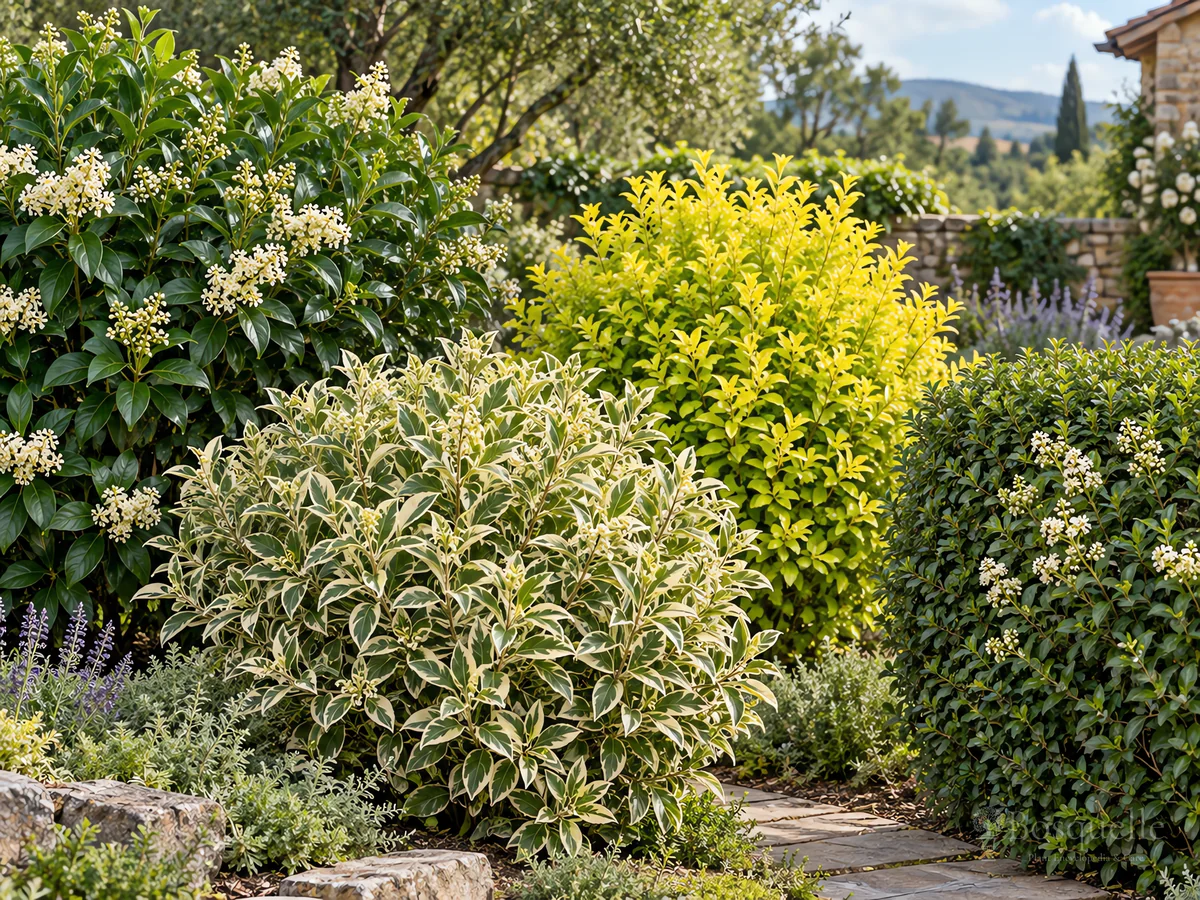
Choose Japanese wax-leaf if you want a thick evergreen screen, a compact golden kind if you want a small gold hedge, common privet if you already own the European hedge plant, or a sterile Golden Ticket if you need a hybrid that sets little fruit.

Choose Japanese wax-leaf, a compact golden kind, common privet, or a sterile Golden Ticket
| Factor | Recommended | Avoid |
|---|---|---|
| Evergreen screen | Japanese wax-leaf with thick glossy leaves | Do not expect year-round leaves from common privet in a cold winter |
| Compact gold | Sunshine or Golden Ticket for a small golden hedge | Do not treat a gold tag as proof it is legal to plant |
| Sterile hedge | Golden Ticket when you need a sterile hybrid | Do not plant common or Japanese seeders where they are listed invasive |
Know your USDA hardiness zone before you pick a type of ligustrum that will take your winter. Type your ZIP below.
2023 USDA ZIP listings (PRISM / USDA-ARS). Find Your USDA Hardiness Zone · Official USDA map.
Read the tag and match the job: an evergreen Japanese screen, a compact gold mound, weedy common privet, or a sterile hybrid. [1] Japanese wax-leaf has larger, thicker leaves than Chinese privet. [2] Golden Ticket is considered sterile. [3] Some states still regulate all cultivars of a listed species unless that cultivar is exempted. [4] Site and water stay on How to Grow Privet. Shear on Pruning Privet.
Which privet should I buy?
Start with Japanese wax-leaf for an evergreen screen. Choose Sunshine or Golden Ticket for compact gold. Skip common privet where it is listed invasive.
Is Sunshine the same as Golden Ticket?
No. Sunshine is compact golden Chinese privet. Golden Ticket is a sterile hybrid. Check your local list for both.
Browse by kind
These are the kinds in this catalog. Match the job first: evergreen Japanese screen, compact gold, common privet, or a sterile hybrid. Do not buy on leaf color alone when invasiveness also changes what you get.
Japanese wax-leaf evergreen
Japanese privet is the classic evergreen screen with thick, glossy leaves. variegated Japanese privet is the same species with cream-edged leaves. Rotundifolium is a stiff, compact Japanese kind with rounded foliage, about three to four feet, not a ten-foot wall.
Compact golden Chinese privet
Sunshine is a small golden hedge. It is still Chinese privet. Check your local list before you plant it, even if the tag says compact gold.
Common European privet
common privet is the European hedge plant: semi-evergreen, fast, and weedy where birds drop the berries. Do not plant it where it is listed invasive.
Sterile Golden Ticket
Golden Ticket is a compact golden hybrid bred to set little or no fruit. Use it when you want gold and a sterile tag, not a seeding Japanese or common hedge. The gold is strongest in sun, and it holds better with a light tidy than with a hard green-hedge shear.
If the tag says only privet, read the Latin before you buy — Japanese is not Golden Ticket.
FAQ
Is California privet in this list?
No. California privet is Ligustrum ovalifolium, a different species. Sort a shop plant with Japanese wax-leaf if the leaves are thick and evergreen, or ask for the Latin name.
Is glossy tree privet the same as wax-leaf?
No. Glossy privet is Ligustrum lucidum, a larger tree. Wax-leaf in this catalog is Japanese privet, a shrub or small screen.
Related guides


References
- [1] Clemson HGIC -
https://hgic.clemson.edu/factsheet/ligustrum/ - [2] Mississippi State University Extension -
https://extension.msstate.edu/publications/chinese-privet - [3] North Carolina Extension Gardener Toolbox -
https://plants.ces.ncsu.edu/plants/ligustrum-golden-ticket-nclx1/ - [4] University of Maryland Extension -
https://extension.umd.edu/resource/privet
This note is part of Ligustrum Guides.
More type comparisons by plant are gathered in Types of Plants Guides.
Updated: Reviewed by Bosquelle Editors