
Choose oregano by kind: a kitchen mound, sweet marjoram, ornamental hop-bract types, or a tender Mediterranean kind.
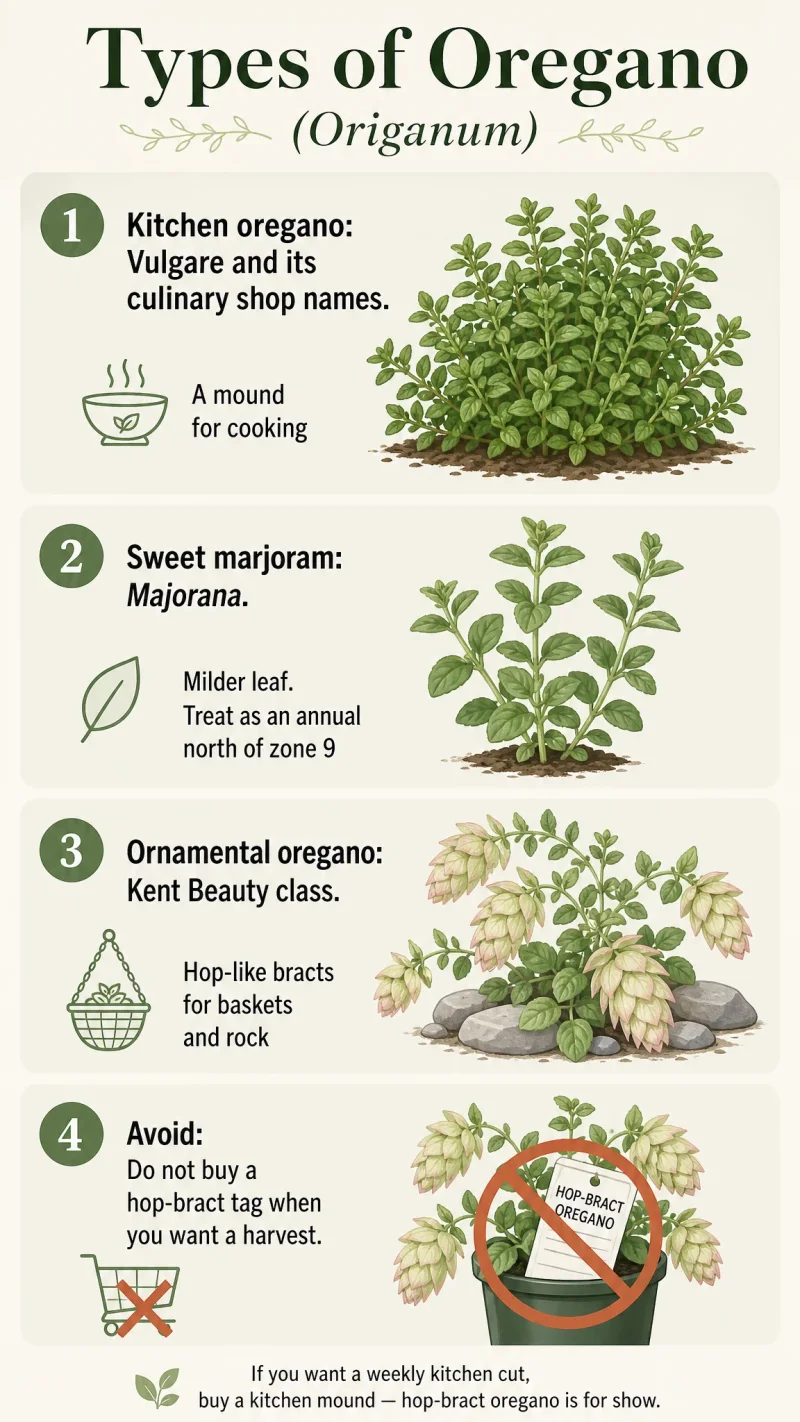
Choose kitchen oregano, sweet marjoram, ornamental oregano, or a tender kind
| Factor | Recommended | Avoid |
|---|---|---|
| Kitchen oregano | Vulgare and its culinary shop names. A mound for cooking | Do not buy a hop-bract tag when you want a harvest |
| Sweet marjoram | Majorana. Milder leaf. Treat as an annual north of zone 9 | Do not expect it to overwinter like hardy kitchen oregano |
| Ornamental oregano | Kent Beauty class. Hop-like bracts for baskets and rock | Do not expect a strong kitchen flavor from the bracts |
| Tender kinds | Dittany and Syrian oregano. Gray or Syrian leaf for a warm winter | Do not plant them as hardy kitchen oregano in a cold bed |
Know your USDA hardiness zone before you pick a type of origanum that will take your winter. Type your ZIP below.
2023 USDA ZIP listings (PRISM / USDA-ARS). Find Your USDA Hardiness Zone · Official USDA map.
Read the tag for kind first, then the Latin. [1] Kitchen oregano is the cooking mound. Greek shop names are the same culinary class, even when the packet says hirtum. [2] Sweet marjoram is a different species, milder and tender. [3] Sun and water stay on How to Grow Oregano. Kind and use are the choice here. [4]
What is the difference between oregano and marjoram?
Kitchen oregano is Origanum vulgare. Sweet marjoram is Origanum majorana. Marjoram is milder and tender. Both are this genus, not the same purchase.
Is Greek oregano a different species?
Greek oregano is usually Origanum vulgare subsp. hirtum, the strong culinary form. We do not list it as a separate card. Treat a Greek tag as the kitchen class.
Browse by kind
Match the harvest you want, then pick that kind. Kitchen oregano is the cooking mound. Sweet marjoram is the milder tender leaf. Hop-bract types are for show. Care for the plant you already have on How to Grow Oregano.
Kitchen oregano
common oregano is the kitchen mound. Compactum is a low culinary form. golden oregano, Country Cream, and Variegata are leaf-color forms of the same class, not hop-bract ornamentals.
Sweet marjoram
sweet marjoram is sweet marjoram. It is milder than kitchen oregano and tender north of zone 9. Grow it as a summer annual there.
Ornamental oregano
Kent Beauty is the usual hop-bract ornamental. Kirigami and Buckland are the same show class. Rosenkuppel is grown for flower, not a weekly kitchen cut.
Tender Mediterranean kinds
dittany of Crete is dittany of Crete — a gray, woolly dwarf. Cleopatra is Syrian oregano. Both are winter-tender. Do not treat them as hardy kitchen oregano.
Sweet marjoram is not kitchen oregano
Sweet marjoram is still Origanum. It is not thyme and not a second genus. Use it for a milder leaf, and treat it as an annual north of zone 9. Do not buy Kent Beauty when you want a weekly kitchen harvest. dittany of Crete is even less a cooking herb — grow it for the gray mat in a warm winter.
Is Kent Beauty good for cooking?
No. Kent Beauty is grown for hop-like bracts. Use kitchen oregano or sweet marjoram for cooking.
If you want a weekly kitchen cut, buy a kitchen mound — hop-bract oregano is for show.
FAQ
Is Italian oregano a different plant?
Italian oregano is often Origanum × majoricum, a hybrid we do not list as an extra card. Treat a kitchen tag as the culinary class.
Do you list Hot and Spicy oregano?
Hot and Spicy is a shop name in the culinary class. We do not list it as an extra card.
Related guides



References
- [1] North Carolina Extension Gardener Plant Toolbox -
https://plants.ces.ncsu.edu/plants/origanum/ - [2] North Carolina Extension Gardener Plant Toolbox -
https://plants.ces.ncsu.edu/plants/origanum-vulgare-subsp-hirtum/ - [3] North Carolina Extension Gardener Plant Toolbox -
https://plants.ces.ncsu.edu/plants/origanum-majorana/ - [4] Old Farmer's Almanac -
https://www.almanac.com/plant/oregano
This note is part of Origanum Guides.
More type comparisons by plant are gathered in Types of Plants Guides.
Updated: Reviewed by Bosquelle Editors