
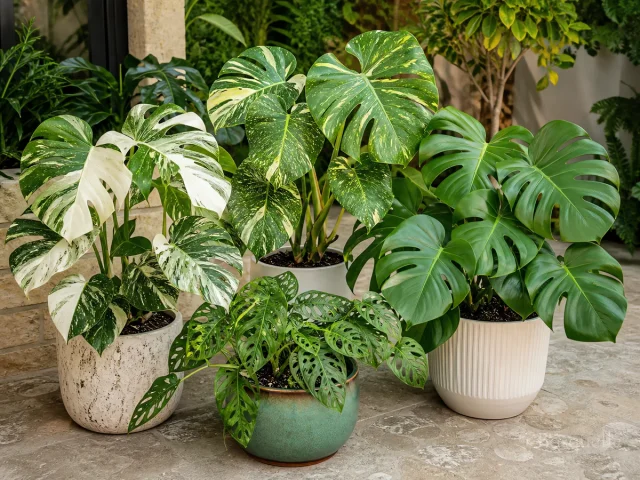
Choose Monstera by the leaf and the habit: a large floor climber whose splits reach the edge, a smaller trailing vine with oval windows inside the blade, or a variegated kind that needs extra filtered light. Mini monstera on a tag is not a type here.

Choose a floor climber, a trailing vine, or a variegated kind first
| Factor | Recommended | Avoid |
|---|---|---|
| Large leaves, splits that reach the margin | Floor climber — M. deliciosa | A hanging basket with no pole if you wanted a six-foot statement |
| Smaller blades, oval holes fully inside the leaf | Trailing vine — M. adansonii | Paying deliciosa prices for a thin vine |
| White or cream sectors | Albo or Thai Constellation, in a brighter filtered window | A dark corner “to protect” white tissue |
| Puckered leaf with almost no holes | Peru (M. karstenianum) | Waiting for swiss-cheese splits on this kind |
Know your USDA hardiness zone before you pick a type of monstera that will take your winter. Type your ZIP below.
2023 USDA ZIP listings (PRISM / USDA-ARS). Find Your USDA Hardiness Zone · Official USDA map.
Write the hole type and the footprint before you pay. A hanging basket and a six-foot floor pole are different plants even when both tags say swiss cheese. Care after you choose lives on How to Grow Monstera. [1]
- Splits that cut to the leaf edge on a large climber → M. deliciosa.
- Enclosed oval windows on a slimmer vine → M. adansonii.
- White sectors or cream speckles → M. deliciosa ‘Albo Borsigiana’ or M. deliciosa ‘Thai Constellation’, only if you can hold brighter filtered light.
- Corrugated leaf with almost no holes → M. karstenianum (Peru).
- Paper-thin, heavily windowed, slow, and expensive → true M. obliqua. Ordinary grocery “obliqua” is usually adansonii.
What is the difference between Monstera deliciosa and adansonii?
Deliciosa develops splits that reach the leaf edge on large climbing leaves. Adansonii keeps enclosed oval holes on a smaller trailing vine. Confirm the Latin; both get sold as swiss cheese.
Deliciosa, adansonii, Peru, and variegated kinds
Swiss cheese climber
M. deliciosa is the classic floor plant: heart-shaped juveniles that later split toward the margin. It wants a pole. This catalog holds six live plants — start here if you want the familiar scale. [2]
Swiss cheese vine
M. adansonii stays smaller, with oval windows that do not open to the edge the way deliciosa slots do. It trails or scrambles and fits a shelf or hanging pot. The thinner leaf scorches sooner in west glass.
Variegated kinds
M. deliciosa ‘Albo Borsigiana’ carries bold white sectors that can revert greener or push tissue so white it cannot feed itself. If a stem goes fully white, cut back to the last node that still has green. M. deliciosa ‘Thai Constellation’ is the cream-speckled form usually sold from tissue culture; the pattern is more stable, still slower than all-green deliciosa. Both want a brighter filtered seat than green deliciosa, without unfiltered midday glass.
Peru and obliqua
M. karstenianum, sold as Monstera Peru, is grown for corrugated texture, not holes. True M. obliqua is paper-thin, heavily windowed, and rare. [3] If the price is ordinary, believe adansonii.
What is the difference between Monstera Albo and Thai Constellation?
Albo has bold white sectors that can revert or go too white. Thai Constellation is cream-speckled and usually more stable. Both need brighter filtered light than green deliciosa.
Does Monstera Peru have holes?
Mature karstenianum (Peru) is grown for corrugated texture, not swiss-cheese fenestration. Missing holes are not a light failure on this kind.
Not monstera — mini monstera, split-leaf philodendron, and extra shop names
- Mini monstera — often Rhaphidophora tetrasperma, a different genus. Confirm Latin Monstera before you train it as swiss cheese. [4]
- Split-leaf philodendron — a nickname. Many plants sold under that name are M. deliciosa. Tree philodendron (selloum) has deep lobes and no holes in the blade.
- Pothos — grooved petiole, usually smaller heart leaves, no swiss-cheese windows. Not a type here.
- Dubia, siltepecana, and extra listicle names — we do not inventory them. Grow extras like these: bright indirect light, chunky mix, a climb if the stem wants one.
Clone after you choose on How to Propagate Monstera. A packed pot lives on How to Repot Monstera.
Pick a floor climber, a trailing vine, or a variegated kind, then grow it on How to Grow Monstera.
FAQ
Is mini monstera a type of Monstera?
Usually no. Shop “mini monstera” is often Rhaphidophora tetrasperma. Confirm the Latin Monstera.
Which Monstera should I buy first?
Start with green M. deliciosa for classic scale, or M. adansonii for a faster vine. Choose Albo or Thai Constellation only if you can hold brighter filtered light without scorch.
Why is Monstera albo expensive?
Bold white sectors are uncommon chimeric pattern, slower to grow, and easy to kill with low light or all-white stems. Price is not a care method.
Is split-leaf philodendron a Monstera type?
It is a nickname, not a type. Many plants sold under that name are M. deliciosa. Read the Latin.
Monstera obliqua vs adansonii — which do I have?
Adansonii is common and thicker-leaved. True obliqua is paper-thin, very holey, and slow. Most retail obliqua labels are adansonii.
Do I water types differently?
Not as a separate calendar. All six share chunky mix and a dry top between waterings. Variegates want more light, not a wetter pot. Full method is on How to Grow Monstera.
Related guides


References
- [1] Penn State Extension -
https://extension.psu.edu/monstera-as-a-houseplant - [2] NC State Extension -
https://plants.ces.ncsu.edu/plants/monstera-deliciosa/ - [3] Wisconsin Horticulture -
https://hort.extension.wisc.edu/articles/monstera-deliciosa/ - [4] Clemson HGIC -
https://hgic.clemson.edu/factsheet/philodendron-pothos-monstera/
This note is part of Monstera Guides.
More type comparisons by plant are gathered in Types of Plants Guides.
Updated: Reviewed by Bosquelle Editors