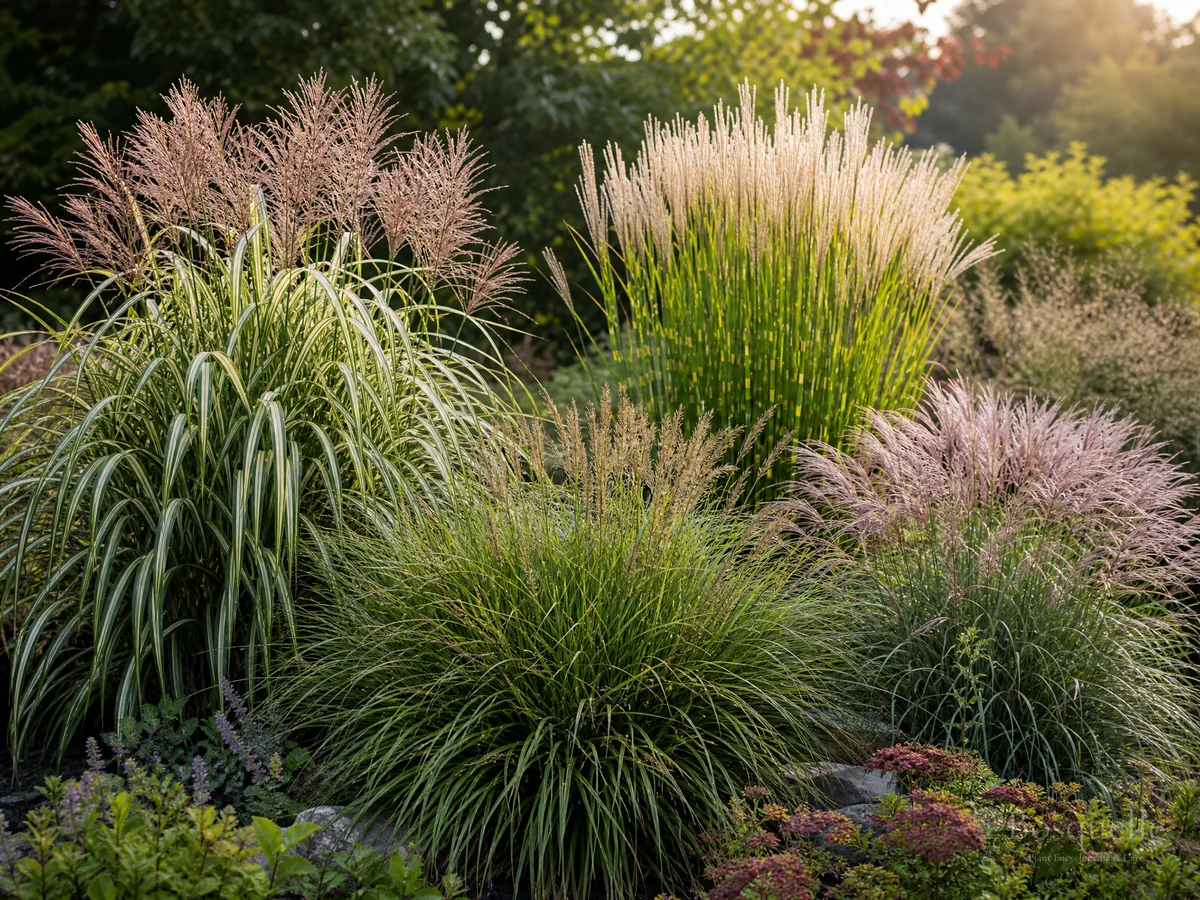
Choose a fine maiden grass, a banded zebra grass, or a dwarf clump first.
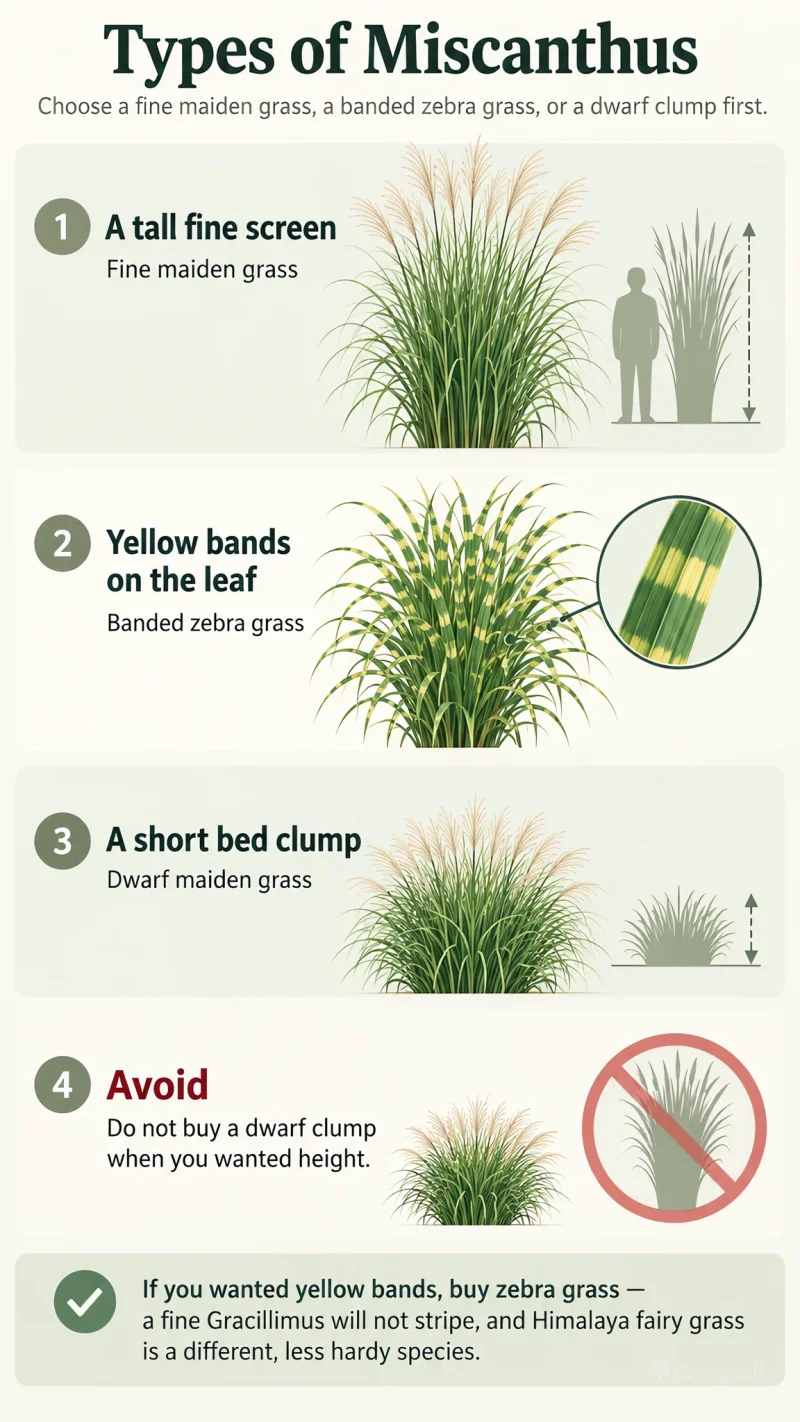
Choose a fine maiden grass, a banded zebra grass, or a dwarf clump first
| Factor | Recommended | Avoid |
|---|---|---|
| A tall fine screen | Fine maiden grass | Do not buy a dwarf clump when you wanted height |
| Yellow bands on the leaf | Banded zebra grass | Do not treat zebra grass as a second genus |
| A short bed clump | Dwarf maiden grass | Do not force a six-foot Gracillimus into a tight space |
| Wide cream-edged blades | Broad variegated maiden grass | Do not pick a fine thread-leaf when you wanted bold variegation |
| Golden Himalayan plumes | Himalaya fairy grass | Do not site it as a hardy sinensis maiden grass |
Know your USDA hardiness zone before you pick a type of miscanthus that will take your winter. Type your ZIP below.
2023 USDA ZIP listings (PRISM / USDA-ARS). Find Your USDA Hardiness Zone · Official USDA map.
Read the Latin. Height and leaf pattern are the choose, not the nursery pot size. [1] [2] Fine maiden grass is the usual screen. Zebra grass is the same species with banded leaves. Dwarf kinds stay short. Upright banded Strictus holds better than a flopping Zebrinus. [3] Near a meadow, prefer a low-seed or striped cultivar over a plain green species plant. [4] Sun, water, and the late-winter cut stay on How to Grow Miscanthus.
Which miscanthus should I plant?
Pick habit first: a fine maiden-grass screen, banded zebra grass, a dwarf clump, wide cream-edged Cosmopolitan, or Himalaya fairy grass if you can shelter it.
Is zebra grass a different plant?
No. Zebra grass is Miscanthus sinensis with horizontal yellow bands. It is maiden grass, not a second genus.
Browse by kind
Fine maiden grass
Gracillimus is the classic fine maiden grass. Morning Light has a thin white leaf edge. Flamingo, Ghana, Grosse Fontane, Kaskade, Kleine Fontane, Kleine Silberspinne, Malepartus, and Silberfeder sit in the same narrow-leaf class.
Banded zebra grass
Zebrinus is zebra grass — yellow bands across the blade, and it can flop with age. Strictus is the upright banded clump, sometimes sold as porcupine grass.
Dwarf maiden grass
Little Kitten and Yakushima Dwarf stay short. Use them where a six-foot screen would be too much. They are still maiden grass, not a different genus.
Broad variegated maiden grass
Cosmopolitan has wide blades with a cream edge. It is sinensis var. condensatus, not a fine Gracillimus thread. Striped forms like this set less seed than a plain green species plant.
Himalaya fairy grass
Himalaya fairy grass is Miscanthus nepalensis. It carries golden plumes and wants a sheltered, well-drained site. Treat it as less hardy than the sinensis maiden grasses.
Pick the group, then the plant. Extra shop names are not extra kinds. Graziella, purple maiden grass, Adagio, and giant miscanthus are not in this catalog; treat a fine green clump you already own as fine maiden grass, and skip a biofuel cane if you wanted a garden maiden grass.
If you wanted yellow bands, buy zebra grass — a fine Gracillimus will not stripe, and Himalaya fairy grass is a different, less hardy species.
FAQ
Is giant miscanthus in this catalog?
No. Giant miscanthus is usually Miscanthus × giganteus, a sterile biofuel cane we do not list. Garden kinds here are ornamental sinensis cultivars and Himalaya fairy grass.
Is purple maiden grass here?
No. Flame grass sold as Purpurascens is not in this catalog. Garden kinds here are green, silver-edged, banded, or cream-edged clumps.
Is Graziella here?
No. Graziella is a fine maiden grass we do not list. If you own one, treat it as the same class as Gracillimus.
Related guides


References
- [1] NC State Extension Gardener -
https://plants.ces.ncsu.edu/plants/miscanthus-sinensis/ - [2] University of Florida IFAS -
https://ask.ifas.ufl.edu/publication/FP405 - [3] Ohio State University Plantfacts -
https://plantfacts.osu.edu/pdf/0247-745.pdf - [4] University of Minnesota -
https://miscanthus.cfans.umn.edu/miscanthus-landscape-plant
This note is part of Miscanthus Guides.
More type comparisons by plant are gathered in Types of Plants Guides.
Updated: Reviewed by Bosquelle Editors