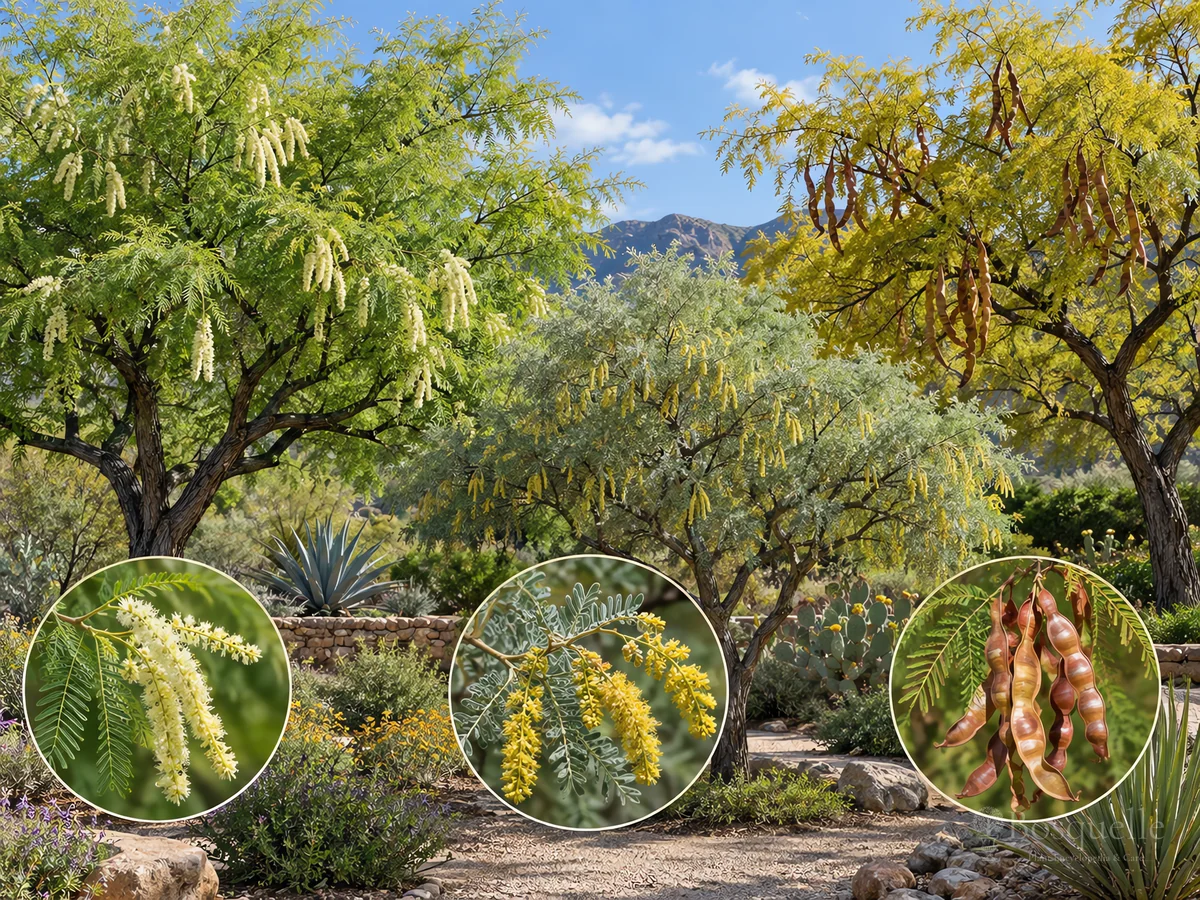
Choose honey mesquite, velvet mesquite, or screwbean mesquite first.

Choose honey mesquite, velvet mesquite, or screwbean mesquite first
| Factor | Recommended | Avoid |
|---|---|---|
| Weeping Texas tree | Honey mesquite — 15–30 ft, long straight pods | Do not buy it for a six-foot shrub slot |
| Arizona native | Velvet mesquite — fuzzy leaflets, dark bark | Do not buy a Chilean hybrid as velvet |
| Wash tree with coiled pods | Screwbean mesquite — smaller vase, tornillo on some tags | Do not plant it as a dry-ridge honey |
Know your USDA hardiness zone before you pick a type of prosopis that will take your winter. Type your ZIP below.
2023 USDA ZIP listings (PRISM / USDA-ARS). Find Your USDA Hardiness Zone · Official USDA map.
The first choice is habit. Honey mesquite is the weeping Texas tree with shiny leaflets and long pods. Velvet mesquite is the Arizona native with fuzzy leaflets and stronger wood than a South American nursery hybrid. Screwbean mesquite is the smaller vase with tightly coiled pods, often sold as tornillo. Read the Latin on the tag before you buy, because shop names mix mesquite with palo verde. [1] Honey is the long-pod weeping tree. Velvet is the fuzzy Arizona native. Screwbean is the coiled-pod wash tree. Do not buy a Chilean hybrid because the nursery sign said mesquite.
Which mesquite should I plant?
Buy honey mesquite for a weeping Texas tree, velvet mesquite for an Arizona native, or screwbean mesquite for a smaller wash tree with coiled pods.
Is velvet mesquite the same as honey mesquite?
No. Velvet mesquite is Prosopis velutina, with fuzzy leaflets. Honey mesquite is Prosopis glandulosa, with shiny leaflets and long pods.
Browse by kind
Match the habit, then pick that kind. Care for the tree you already have on How to Grow Mesquite.
Honey mesquite
honey mesquite is the weeping Texas tree, about fifteen to thirty feet, with shiny leaflets and long straight pods. Buy this group when you want that open, feathery shade, not a coiled-pod wash tree. [2]
Velvet mesquite
velvet mesquite is the Arizona native, often thirty to fifty feet with water, with fuzzy leaflets and dark bark. Shop tags also say Arizona mesquite. Native wood is stronger than a Chilean nursery hybrid, so keep the Latin on the tag in view. [3]
Screwbean mesquite
screwbean mesquite is the smaller vase, about twenty-five feet, with tightly coiled pods. Shop tags also say tornillo. It wants a wash or a bit more moisture, so it is a poor pick if you wanted a dry-ridge honey. [4]
If you wanted an Arizona native, buy velvet mesquite — Chilean nursery hybrids are a different tree.
FAQ
Is Chilean mesquite in this catalog?
No. Chilean mesquite is Prosopis chilensis, often sold as a fast thornless hybrid. If you own one, treat it as a mesquite, not as velvet.
Is tornillo the same as screwbean mesquite?
Yes. Garden tags still say Prosopis pubescens. Tornillo is the Spanish shop name for the coiled-pod kind.
Is Neltuma the same as Prosopis?
Some newer lists move New World mesquites into Neltuma. The plant is still a mesquite. This catalog keeps Prosopis on the tag.
Is Prosopis juliflora in this catalog?
No. That name is an old alias on velvet mesquite. If the tag says juliflora, treat the tree as velvet unless the leaflets are shiny honey.
Related guides



References
- [1] University of Arizona Cooperative Extension -
https://extension.arizona.edu/sites/default/files/2024-08/az1429.pdf - [2] Lady Bird Johnson Wildflower Center -
https://www.wildflower.org/plants/result.php?id_plant=prgl2 - [3] Desert Tropicals -
https://www.desert-tropicals.com/Plants/Fabaceae/Prosopis_velutina.html - [4] Lady Bird Johnson Wildflower Center -
https://www.wildflower.org/plants/result.php?id_plant=PRPU
This note is part of Prosopis Guides.
More type comparisons by plant are gathered in Types of Plants Guides.
Updated: Reviewed by Bosquelle Editors