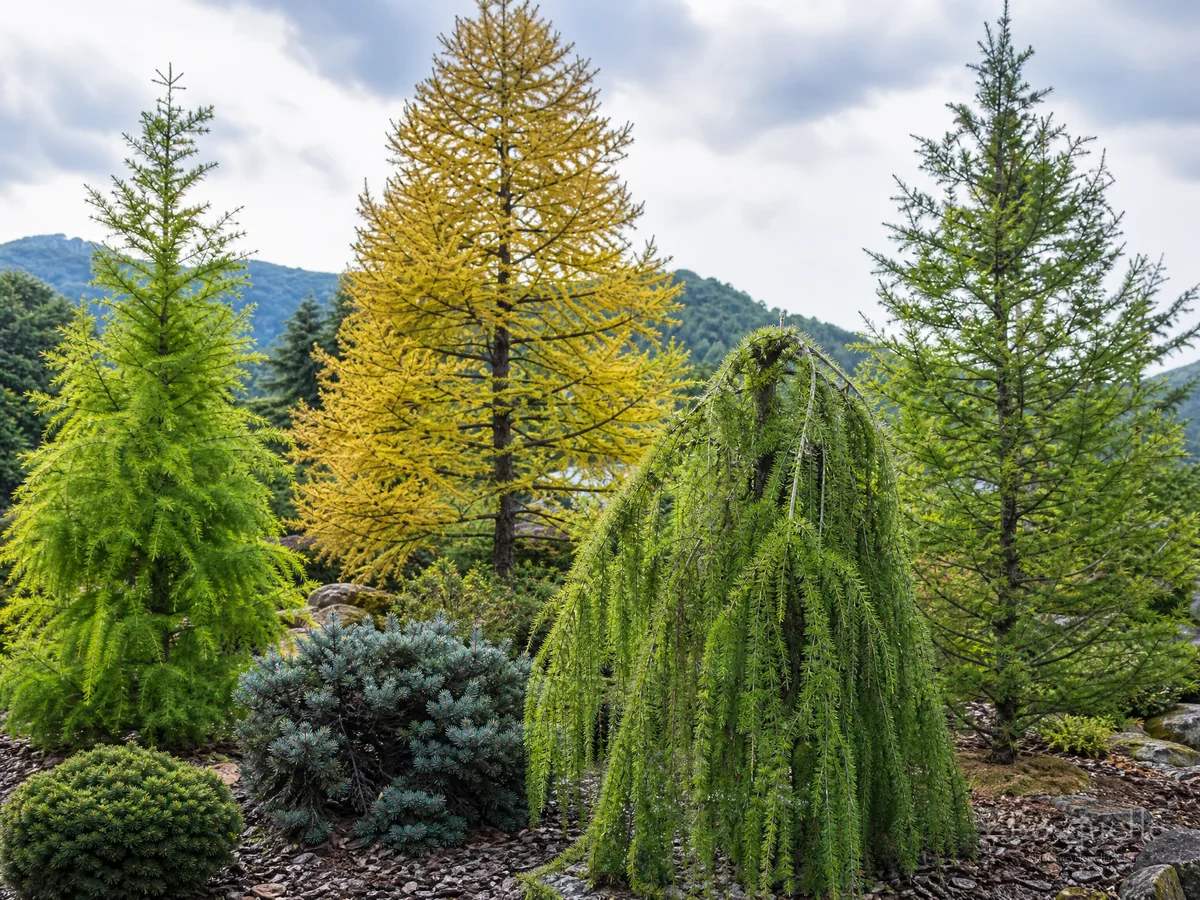
Choose larch by form first: a landscape tree, a tamarack for wet ground, or a weeping form. We list the catalog plants in those groups.
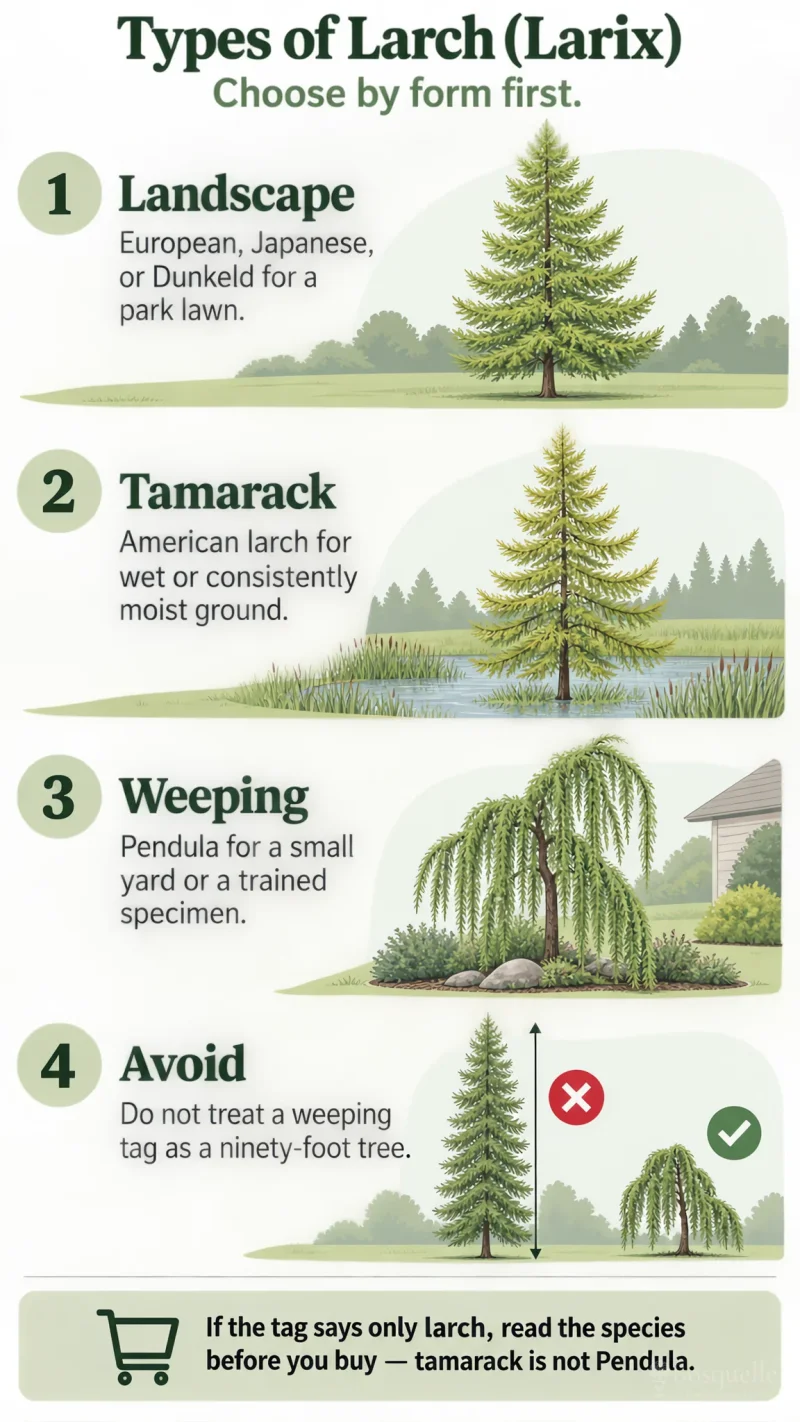
Choose a landscape tree, a tamarack, or a weeping form first
| Factor | Recommended | Avoid |
|---|---|---|
| Landscape | European, Japanese, or Dunkeld for a park lawn | Do not treat a weeping tag as a ninety-foot tree |
| Tamarack | American larch for wet or consistently moist ground | Do not plant it on dry, well-drained sand |
| Weeping | Pendula for a small yard or a trained specimen | Do not give it the spacing of a park giant |
| Tag | Read landscape, tamarack, or weeping before you buy | Do not buy a golden-larch tag without checking the genus |
Know your USDA hardiness zone before you pick a type of larix that will take your winter. Type your ZIP below.
2023 USDA ZIP listings (PRISM / USDA-ARS). Find Your USDA Hardiness Zone · Official USDA map.
Read the species on the tag. Larches share cool sun and even moisture; they do not share one mature size or one soil wetness. [1] [2] Tamarack is the wet-ground native. Japanese larch is a landscape pyramid. Pendula is the weeping form. [3] A golden-larch tag is often Pseudolarix, not Japanese larch. [4] Once you know the form, site it on How to Grow Larch.
Which kind of larch should I plant?
Start with the site. A park lawn takes a landscape tree. Wet ground takes tamarack. A small yard takes the weeping form.
Does tamarack want wet ground?
Yes. Tamarack is the American larch for bogs, rain gardens, and soil that stays moist. European and Japanese trees want moist drain, not standing wet.
Browse by kind
Landscape trees
European larch is the usual park pyramid — sixty to one hundred feet, drooping branchlets, cones with straight scales. Japanese larch is a similar landscape tree with broader, reflexed cones and a bit more heat edge. Dunkeld larch is the hybrid of those two; still a large tree, not a weeping mound.
Tamarack
tamarack is the native American larch. It stays smaller than a European park tree, with cones about a half inch long, and it wants wet or consistently moist ground — a bog edge or rain garden, not dry sand.
Weeping forms
Pendula is the weeping Japanese form in this catalog, about fifteen to thirty feet. Train a stake if you want a trunk; otherwise it mounds. It is not a ninety-foot park tree.
Culture stays cool sun and even moisture. Pick by mature size and how wet the ground stays, not by a shop list of extra names. Western larch, Siberian larch, Blue Dwarf, Nana, and Diana are other selections. They are not extra cards here.
If the tag says only larch, read the species before you buy — tamarack is not Pendula.
FAQ
Are Blue Dwarf, Nana, and Diana in this catalog?
No. Those are other Japanese-larch selections sold elsewhere. We list the five plants in the three groups above.
Is western larch in this catalog?
No. Western larch and Siberian larch are other species. This catalog holds European, Japanese, Dunkeld, tamarack, and Pendula.
Is Dunkeld a third species?
Dunkeld is a hybrid of European and Japanese larch. Treat it as a landscape tree, not as a tamarack or a weeping form.
Related guides

References
- [1] Wisconsin Horticulture -
https://hort.extension.wisc.edu/articles/european-larch-larix-decidua/ - [2] NC State Extension Gardener -
https://plants.ces.ncsu.edu/plants/larix-kaempferi/ - [3] Gardening Know How -
https://www.gardeningknowhow.com/ornamental/trees/larch/growing-a-larch-tree.htm - [4] NC State Extension Gardener -
https://plants.ces.ncsu.edu/plants/pseudolarix-amabilis/
This note is part of Larix Guides.
More type comparisons by plant are gathered in Types of Plants Guides.
Updated: Reviewed by Bosquelle Editors