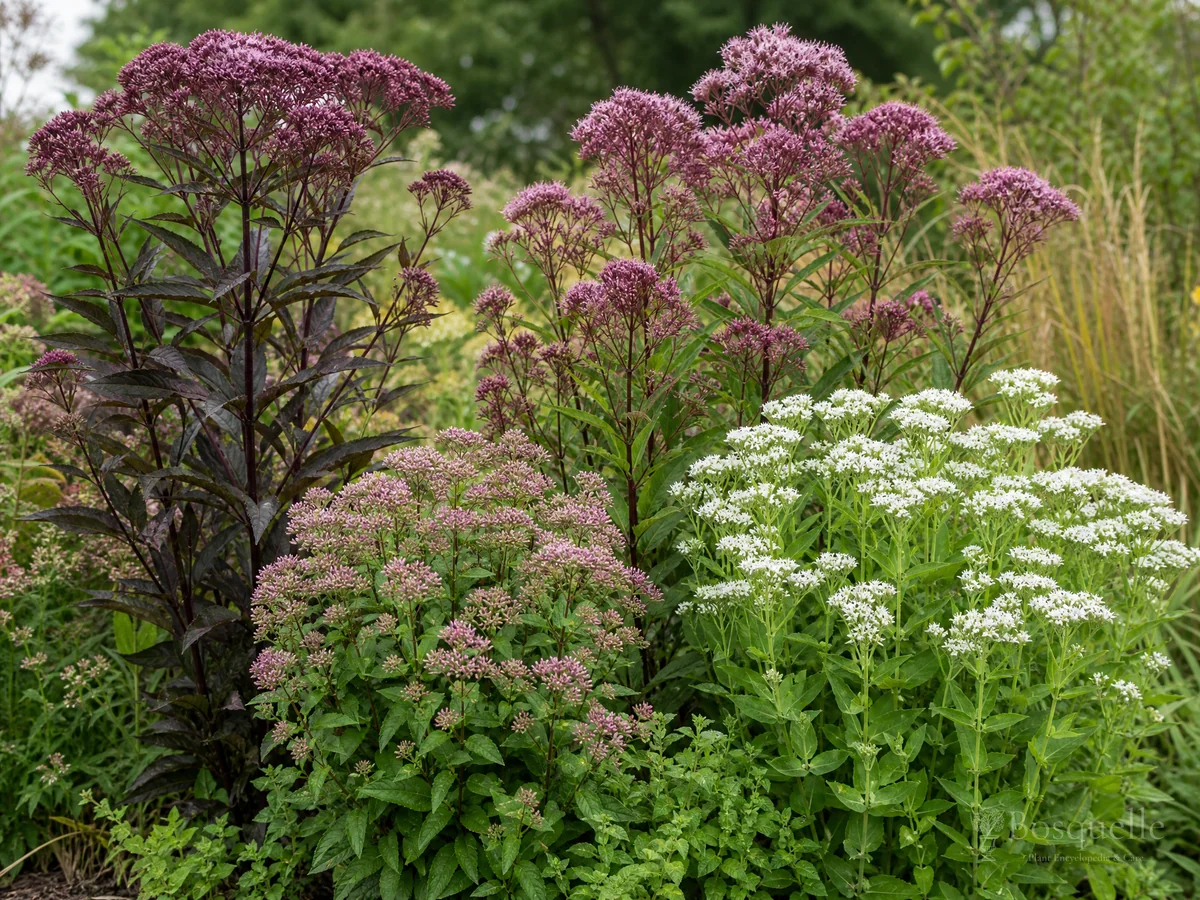
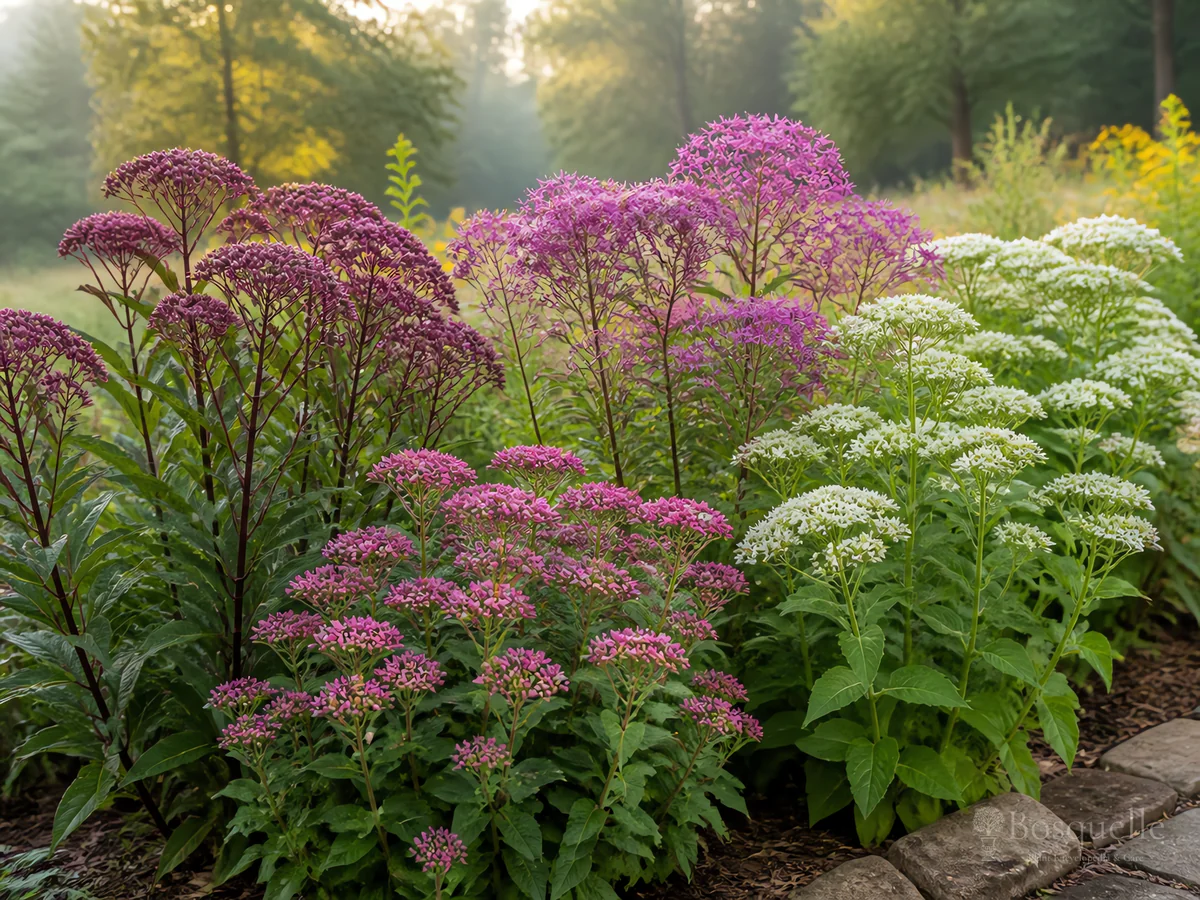
Pick spotted, sweet, hollow-stem, or a compact coastal Joe-Pye when you want mauve heads on whorled leaves. Boneset, mistflower, snakeroot, and dog fennel sit in the same nursery tag, and they are not that plant.

Choose spotted, sweet, hollow-stem, or a compact coastal Joe-Pye first
| Factor | Recommended | Avoid |
|---|---|---|
| Mauve border clump, spotted stems | Spotted Joe-Pye | Do not buy white boneset if you wanted mauve heads |
| Vanilla-scented dome, purple nodes | Sweet Joe-Pye | Do not treat every Joe-Pye tag as one species |
| The tallest hollow stems | Hollow-stem Joe-Pye | Do not pick a compact coastal kind when you wanted seven feet |
| A shorter mauve plant | Coastal / Baby Joe | Do not put a seven-foot hollow-stem in a small bed |
Know your USDA hardiness zone before you pick a type of eupatorium that will take your winter. Type your ZIP below.
2023 USDA ZIP listings (PRISM / USDA-ARS). Find Your USDA Hardiness Zone · Official USDA map.
Read the Latin on the tag, because the common name Joe-Pye is shared across several plants. [1] Spotted, sweet, hollow-stem, and coastal Joe-Pye share whorled leaves and mauve heads. Boneset is the white plant with leaves that wrap the stem. [2] Mistflower is a short blue spreader, not a tall Joe-Pye. [3] White snakeroot is a woodland plant that is toxic if eaten — not a garden Joe-Pye. [4] Sun and watering stay on How to Grow Joe-Pye Weed.
Which Joe-Pye should I plant?
Pick habit first: spotted or sweet for a tall mauve clump, hollow-stem for the tallest plant, or coastal / Baby Joe for a shorter bed.
Is boneset Joe-Pye weed?
No. Boneset is Eupatorium perfoliatum — white flowers and opposite leaves. Joe-Pye is Eutrochium, with mauve heads and whorled leaves.
Browse by kind
Spotted Joe-Pye
Gateway is the classic spotted border clump. spotted Joe-pye weed is the wild spotted form. Stems are spotted or purple, and the head is flatter than sweet Joe-Pye.
Sweet Joe-Pye
purple Joepyeweed is Eutrochium purpureum — green stems with purple nodes and a vanilla scent. Buy it when the tag says sweet or purple Joe-Pye.
Hollow-stem Joe-Pye
hollow-stem Joe-Pye has hollow, glaucous stems and is often the tallest plant in this catalog. Cut a stem near the base if you need to tell it from spotted Joe-Pye.
Coastal and compact Joe-Pye
Baby Joe is a compact coastal kind. Use it when you want mauve Joe-Pye without a seven-foot clump.
Boneset and thoroughworts
common boneset is white, with opposite leaves that wrap the stem. It is true Eupatorium, not mauve Joe-Pye.
Mistflower
blue mistflower is Conoclinium — short blue heads that spread by rhizomes in moist ground. Gregg's mistflower is the western mistflower; it wants drain, not a rain-garden puddle. Neither is How to Grow Love-in-a-Mist.
White snakeroot
white snakeroot is Ageratina. It is toxic if eaten. Keep livestock off it. It is not Joe-Pye.
Dog fennel
dog fennel is a fine-leaved weedy Eupatorium. Skip it if you came for mauve Joe-Pye.
Pick the group, then the cultivar. Extra shop names are not extra kinds. Little Joe and Phantom are compact Joe-Pye not in this catalog; treat them as coastal or spotted compact kinds if you grow one.
If you want mauve domes, buy spotted or sweet Joe-Pye — boneset is the white plant.
FAQ
Is Little Joe or Phantom in this catalog?
No. They are compact Joe-Pye sold widely. Treat them as coastal or spotted compact kinds. Care stays the same.
Is this love-in-a-mist?
No. Love-in-a-mist is Nigella, an annual with a ferny collar. Mistflower is Conoclinium, a spreading perennial with blue heads.
Is white snakeroot Joe-Pye?
No. White snakeroot is Ageratina altissima. It is toxic if eaten. Do not plant it as a Joe-Pye substitute.
Is dog fennel a garden Joe-Pye?
No. Dog fennel is a fine-leaved weedy Eupatorium. Skip it if you wanted mauve Joe-Pye.
Related guides

References
- [1] NC State Extension Gardener -
https://plants.ces.ncsu.edu/plants/eutrochium-maculatum/ - [2] NC State Extension Gardener -
https://plants.ces.ncsu.edu/plants/eupatorium-perfoliatum/ - [3] NC State Extension Gardener -
https://plants.ces.ncsu.edu/plants/conoclinium-coelestinum/ - [4] NC State Extension Gardener -
https://plants.ces.ncsu.edu/plants/ageratina-altissima/
This note is part of Eupatorium Guides.
More type comparisons by plant are gathered in Types of Plants Guides.
Updated: Reviewed by Bosquelle Editors