
Choose hazelnut by the job first: a European kind for a nut crop, Harry Lauder's walking stick for twisted winter twigs, or a native American or beaked shrub for a thicket. All are Corylus.
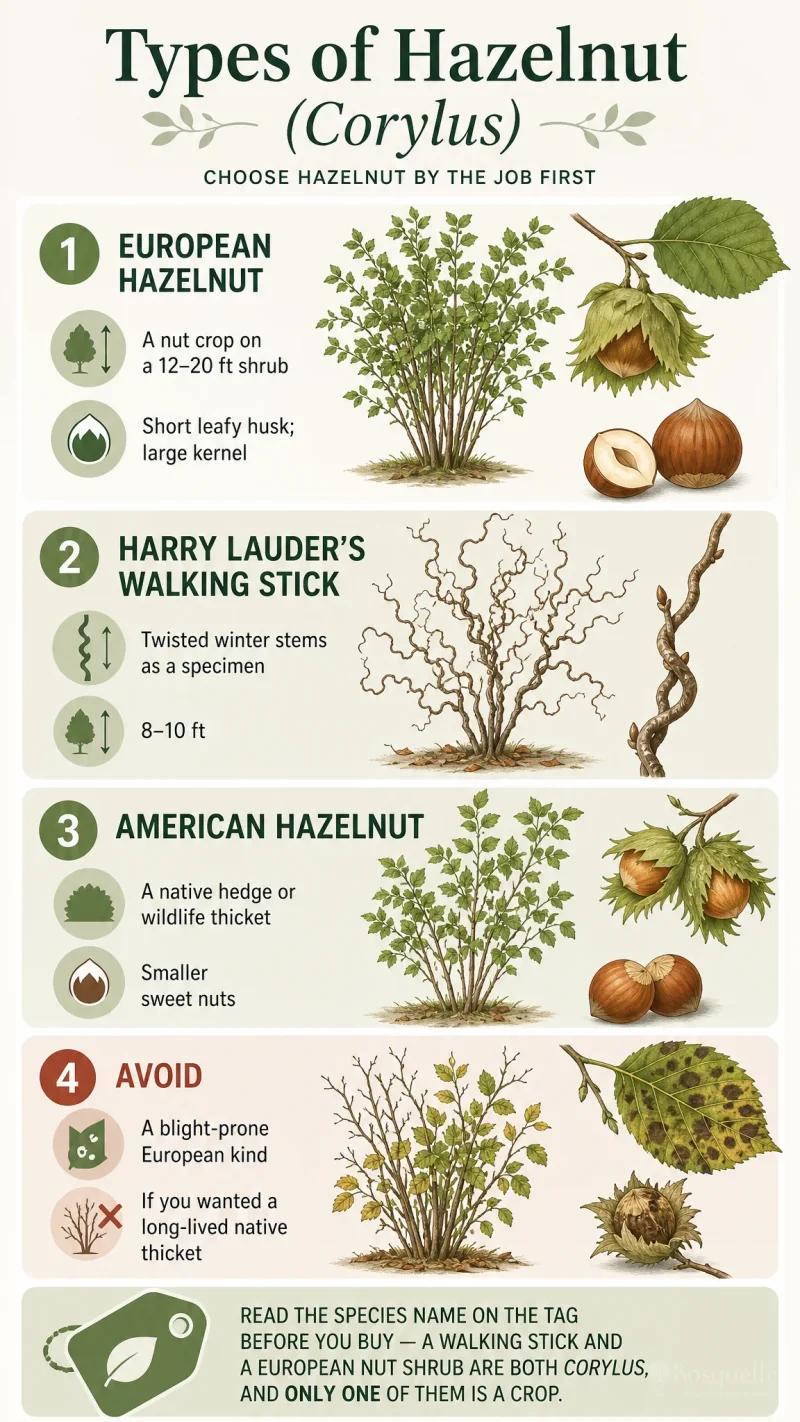
Choose a European hazelnut for nuts, a walking stick for winter twigs, or a native thicket
| Kind | Best for | Not for |
|---|---|---|
| European hazelnut | A nut crop on a 12–20 ft shrub; short leafy husk; large kernel | A blight-prone European kind if you wanted a long-lived native thicket |
| Harry Lauder's walking stick | Twisted winter stems as a specimen; 8–10 ft | A reliable nut harvest — fruit is uncommon |
| American hazelnut | A native hedge or wildlife thicket; smaller sweet nuts | A thin-shelled orchard kernel the size of a European nut |
| Beaked hazelnut | A native planting in sun or part shade; the husk has a long tube | A heavy kitchen crop |
Know your USDA hardiness zone before you pick a type of corylus that will take your winter. Type your ZIP below.
2023 USDA ZIP listings (PRISM / USDA-ARS). Find Your USDA Hardiness Zone · Official USDA map.
European hazelnut is the hazelnut grown for a large kernel. Eastern filbert blight can kill susceptible plants of this species. [1] Harry Lauder's walking stick is the twisted-stem form of the same species, grown for winter twigs, not a crop. Home-orchard lists treat European, American, and beaked as different jobs, not one shrub with four names. [2] American hazelnut is the eastern native thicket with smaller nuts. [3] beaked hazelnut is the native whose husk sticks out past the nut in a tube. [4] Site and watering stay on How to Grow Hazelnut.
European vs American vs beaked?
European is the large kitchen nut. American is a native thicket with smaller nuts. Beaked is a native with a tubular husk and a smaller crop.
Which hazelnut for winter twigs?
Harry Lauder's walking stick. It is still Corylus avellana, grown for twisted stems, not for a nut crop.
Browse by kind
European hazelnut
Corylus avellana. The commercial nut shrub: 12–20 ft, a short leafy husk, and a large kernel.
Harry Lauder's walking stick
Corylus avellana ‘Contorta’. Twisted winter stems on an 8–10 ft shrub; nuts are uncommon.
American hazelnut
Corylus americana. A native suckering thicket with smaller nuts in a ragged husk.
Beaked hazelnut
Corylus cornuta. A native shrub whose husk extends into a tube, or beak, past the nut.
Beaked hazelnut on the West Coast is sometimes sold as Corylus cornuta var. californica. It is still beaked hazelnut, not a fifth species here.
Filbert is still a hazelnut, and Turkish filbert is a different tree
Filbert is a shop name for this genus, especially for European hazelnut. It is not a second plant. Turkish filbert (Corylus colurna) is a larger landscape tree, and large filbert (Corylus maxima) is another species. Named orchard kinds such as Barcelona sit inside European hazelnut — they are not a fifth plant on the tag.
Is a filbert a hazelnut?
Yes in US garden-center talk. Filbert and hazelnut both mean Corylus.
Read the species name on the tag before you buy — a walking stick and a European nut shrub are both Corylus, and only one of them is a crop.
FAQ
Is Harry Lauder's walking stick a nut crop?
Seldom. Grow it for twisted winter stems. Plant a European or native kind if you want a harvest.
Do I need two walking sticks?
Not for the winter twigs. One specimen is enough.
Do you list Turkish filbert or Barcelona?
Those are other Corylus names. If the tag says C. avellana, americana, cornuta, or Contorta, match it to the four kinds above.
Related guides


References
- [1] University of Wisconsin–Madison Extension -
https://cropsandsoils.extension.wisc.edu/hazelnuts/ - [2] Utah State University Extension -
https://extension.usu.edu/yardandgarden/research/hazelnuts-in-the-home-orchard - [3] North Carolina Extension Gardener Plant Toolbox -
https://plants.ces.ncsu.edu/plants/corylus-americana/ - [4] North Carolina Extension Gardener Plant Toolbox -
https://plants.ces.ncsu.edu/plants/corylus-cornuta/
This note is part of Corylus Guides.
More type comparisons by plant are gathered in Types of Plants Guides.
Updated: Reviewed by Bosquelle Editors