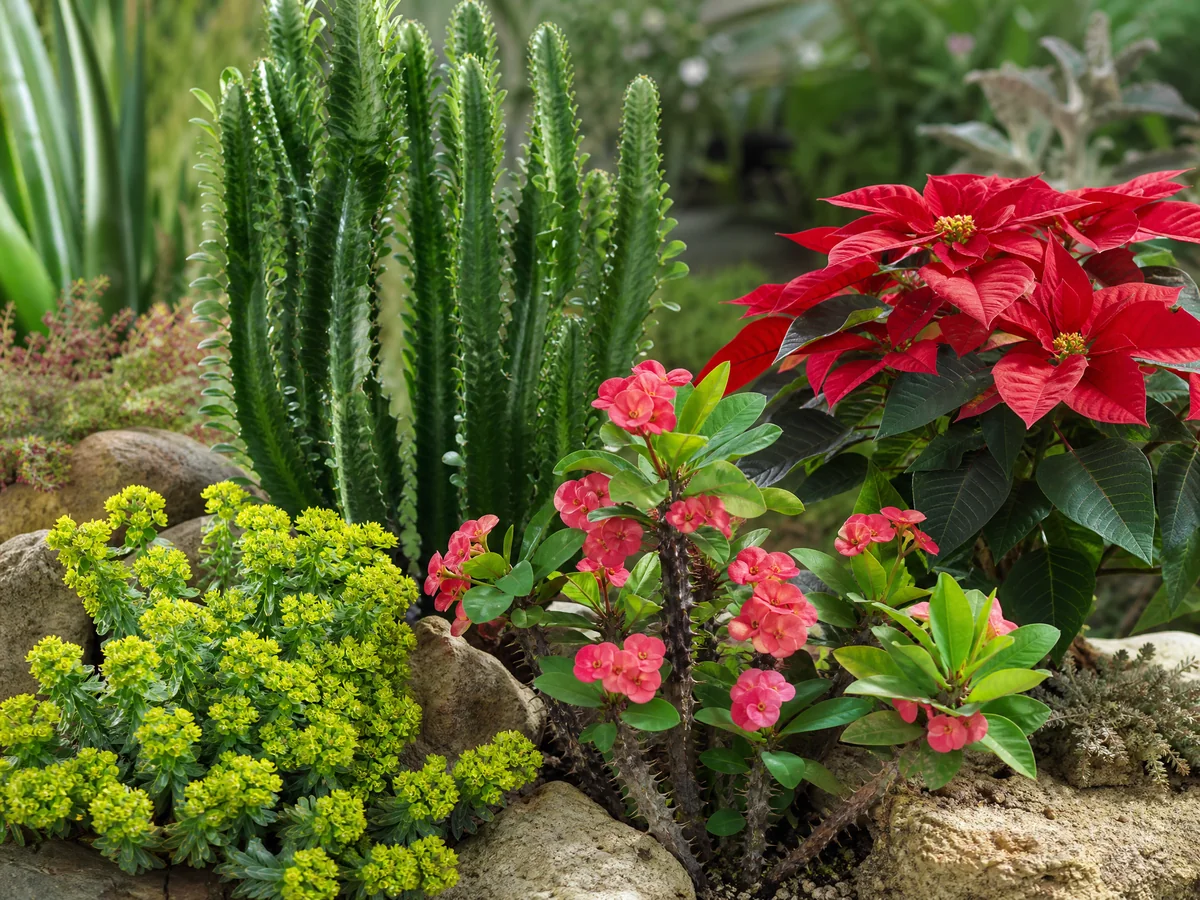
Choose euphorbia by class: hardy garden spurge, a frost-tender succulent, holiday poinsettia, or a bedding annual. Read the tag for the habit, then pick that class.

Choose garden spurge, a succulent, poinsettia, or a bedding plant
| Factor | Recommended | Avoid |
|---|---|---|
| Hardy garden | Sun and drain, or dry shade for wood spurge | Do not grow it as a holiday houseplant |
| Succulent | Frost-tender stems; water when the mix is dry | Do not plant it in a wet border, and do not treat a cactus label as a different genus |
| Poinsettia | Bright room and moist mix through the holidays | Do not keep it cactus-dry, and do not cut it like a hardy border plant |
| Bedding | Seasonal filler such as Diamond Frost | Do not expect a hardy clump next spring |
Know your USDA hardiness zone before you pick a type of euphorbia that will take your winter. Type your ZIP below.
2023 USDA ZIP listings (PRISM / USDA-ARS). Find Your USDA Hardiness Zone · Official USDA map.
Read the habit, not a shop nickname. Hardy kinds are border plants. [1] Cushion and wood spurge sit in that class. [2]
What are the different types of Euphorbia succulents?
Milk tree, crown of thorns, pencil stems, globes, and candelabra kinds. All are frost-tender. None are true cactus.
What are the best euphorbias to grow?
Match the class to the job: hardy mound for a border, succulent for a dry pot, poinsettia for a holiday window, bedding for a season.
Browse by kind
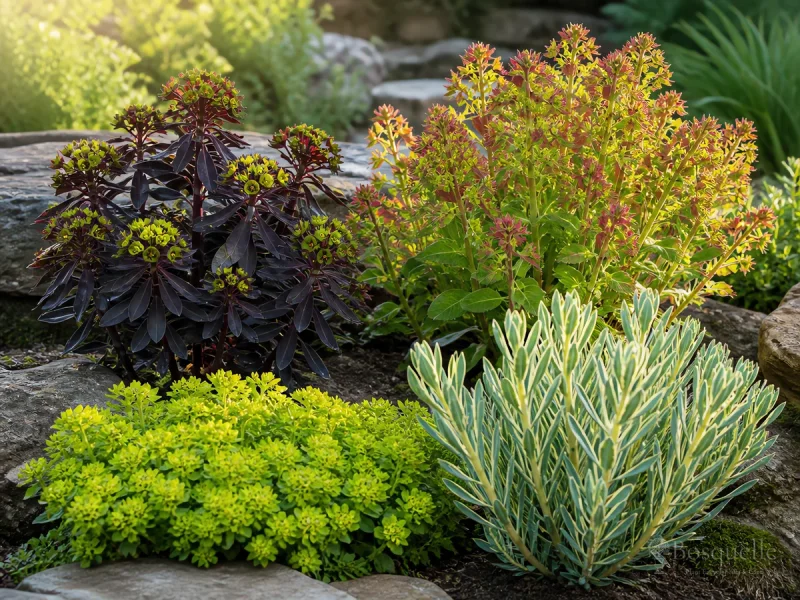
Hardy garden spurge
cushion spurge is the spring mound. Robb’s wood spurge is the dry-shade runner. Mediterranean and Martin’s types sit in the same hardy class — sun and drain, not a holiday pot.
Succulent and cactus-form
African milk tree and crown of thorns are frost-tender succulents. Pencil-stem and globe kinds live here too. They look like cactus; they are still euphorbia.
Poinsettia
poinsettia is the holiday tropical. Colored bracts, moist mix, and a bright room — not the soak-dry calendar of a milk tree.
Bedding annuals
Diamond Frost is an airy annual filler. Snow-on-the-mountain is the white-bract annual in this list. Neither is a hardy clump.
Succulent kinds share frost-tender culture. [3] Poinsettia is its own indoor job on How to Grow Poinsettia. [4]
Not extra shop names — and not a lawn weed
Thai hybrid nicknames and extra color sports are still these four habits, not extra kinds in this list. Spotted spurge in pavement is a weed, not a border plant. The religious “crown of thorns” relic is not this shrub.
How can I identify an Euphorbia plant?
Milky sap on a cut, and bracts around tiny true flowers. Succulent kinds lack cactus areoles. Poinsettia shows colored bracts around yellow cyathia.
Pick the class on the tag first — hardy border, succulent pot, holiday poinsettia, or bedding — then grow to that job.
FAQ
Is the religious crown of thorns this plant?
No. The houseplant is Euphorbia milii. The relic is a different search.
Is Diamond Frost hardy?
No. It is a bedding annual in this list. Do not expect a hardy clump next spring.
Is a pencil cactus a cactus?
No. It is Euphorbia tirucalli, a succulent in this genus. Same sap. No areoles.
Related guides



References
- [1] Fine Gardening -
https://www.finegardening.com/article/all-about-growing-euphorbia - [2] NC State Extension Gardener -
https://plants.ces.ncsu.edu/plants/euphorbia-epithymoides/ - [3] NC State Extension Gardener -
https://plants.ces.ncsu.edu/plants/euphorbia-milii/ - [4] NC State Extension Gardener -
https://plants.ces.ncsu.edu/plants/euphorbia-pulcherrima/
This note is part of Euphorbia Guides.
More type comparisons by plant are gathered in Types of Plants Guides.
Updated: Reviewed by Bosquelle Editors