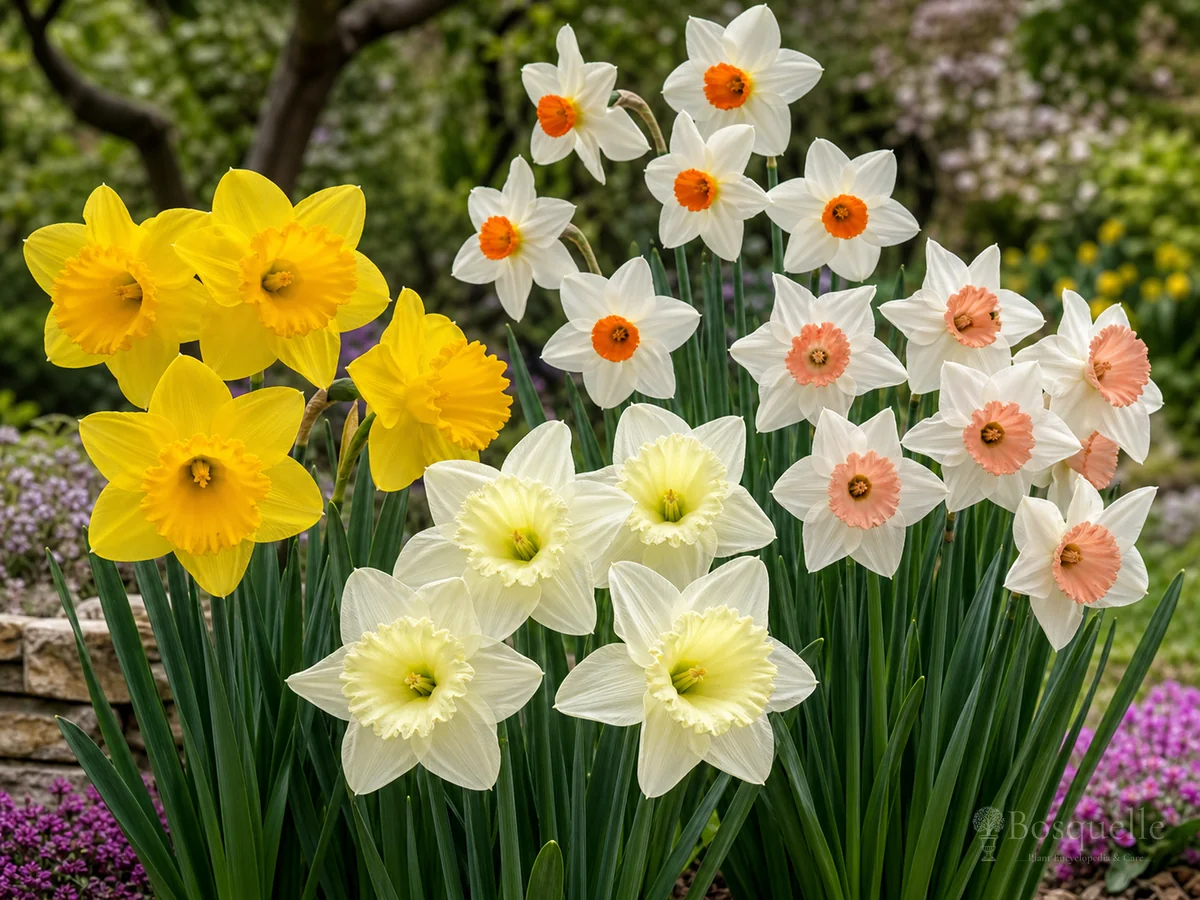
Choose daffodils by cup and form, not by yellow. King Alfred and Tete a Tete share spring bloom and not a height. Paperwhites are not the hardy-border default.

Browse all 92 garden daffodils. Leave the foliage to ripen after bloom — that rule stays on How to Grow Daffodils.
Choose daffodils by cup and form
| Factor | Recommended | Avoid |
|---|---|---|
| Tall spring border | Trumpet or large-cup types | Assuming every yellow bag is the same height |
| Front edge or pot | Cyclamineus / miniature types | A tall trumpet in a shallow trough |
| Scent by a path | Jonquilla, tazetta, poeticus, known doubles | Buying any yellow trumpet for perfume |
| Indoor winter bloom | Paperwhite / some tazettas | Forcing a hardy border type as if it were a paperwhite |
Know your USDA hardiness zone before you pick a type of daffodil that will take your winter. Type your ZIP below.
2023 USDA ZIP listings (PRISM / USDA-ARS). Find Your USDA Hardiness Zone · Official USDA map.
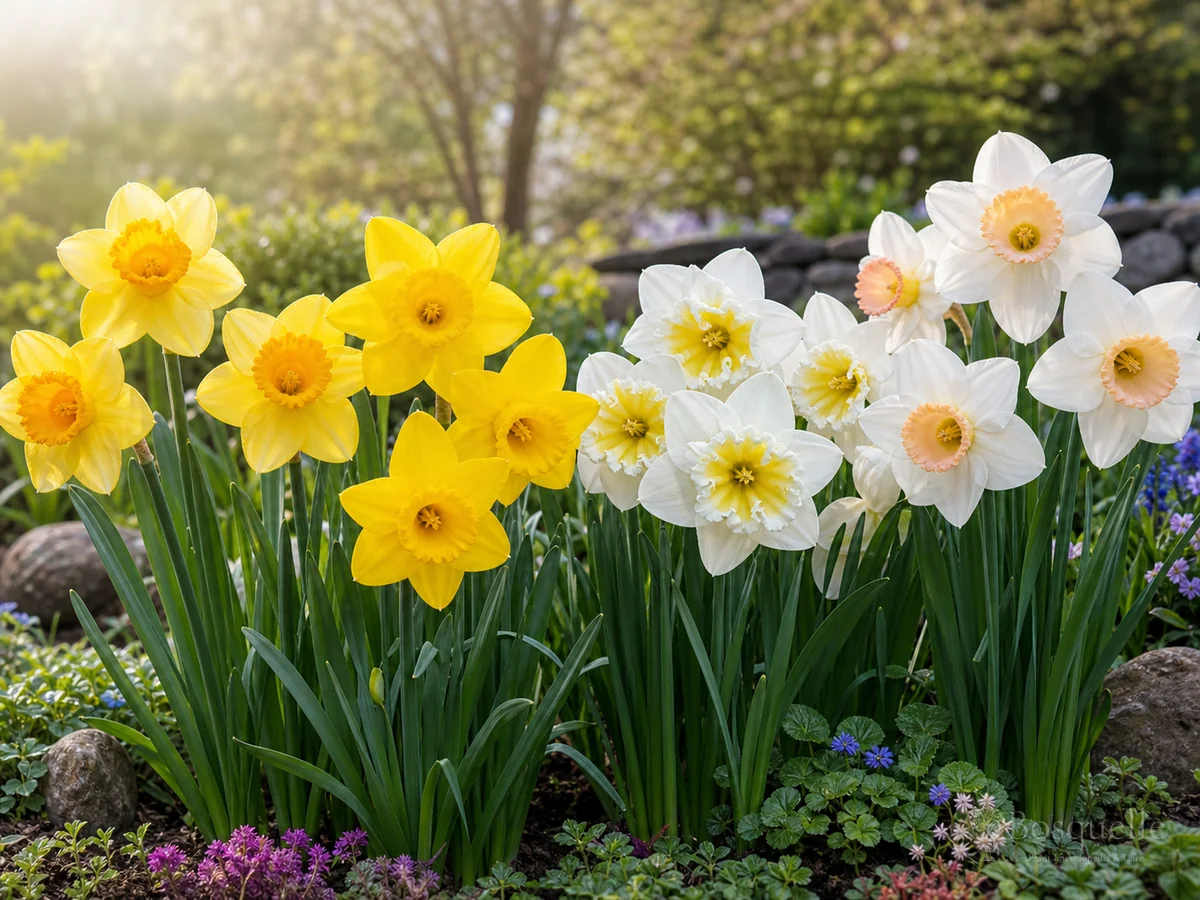
Yellow is not a type. King Alfred is a tall trumpet. Ice Follies is a large-cup. Tete a Tete is a low cyclamineus. Read the cup and the listed inches before you match two bags by photo.
Trumpet and large-cup types are the usual beginner border. Cyclamineus such as Jetfire and Tete a Tete bloom early and stay low. Doubles such as Cheerfulness carry extra petal weight in wind. Jonquilla and triandrus such as Pipit and Thalia often carry several flowers and more scent. Poeticus such as Actaea opens late, white, with a small eye. Hoop-petticoat types such as Golden Bells want lean drainage, not a wet border.
We group by catalog name cues. We do not invent RHS division numbers the catalog does not carry. Unlabeled hybrids sit in garden hybrid until a profile says otherwise.
Wrong daffodil buys that look like a types page
Paperwhite in a hardy border: indoor-force tazettas are not King Alfred outdoor stock. Geranium can be grown outside in some gardens — confirm the profile.
Tete a Tete height from a King Alfred bag: miniatures stay low. Tall trumpets belong at the back.
A double in an open windy site: Cheerfulness heads are heavy. Give shelter or a shorter type.
A mixed “daffodil” bag as one depth line: sort trumpet, miniature, and double before you dig. One trench does not fit all.
Jonquil as any yellow daffodil: jonquilla is a form group, often multi-flowered and fragrant. It is not a synonym for every yellow cup.
What each type actually offers
Trumpet / large-cup: Trumpet daffodils carry a cup as long as or longer than the petals — the classic yellow spring silhouette; plant deep and leave foliage. Large-cupped daffodils show a cup about one-third to nearly trumpet length — classic spring bedding and naturalizing stock.
Cyclamineus / miniature: Cyclamineus daffodils sweep petals back from a projecting cup — often early and compact; good for edges, pots, and naturalistic drifts.
Scent-leaning groups: Jonquilla and jonquil daffodils are often multi-flowered and sweetly scented on slender stems — plant in drained sun and leave foliage. Tazetta and paperwhite daffodils carry bunched florets — many are fragrant; hardy tazettas need outdoor chill, while paperwhites are often forced indoors and are not the whole-genus method. Poeticus and pheasant’s-eye daffodils open late with white petals and a small contrasting cup — often fragrant; grow with the shared chill and foliage rules.
Flower color does not rewrite aftercare. Every hardy type still needs foliage left until yellow. Types only sorted form and scale. Open How to Grow Daffodils for that rule, Planting Daffodil Bulbs for the hole, Containers for pots, and Fragrant Garden Daffodils if scent was the job.
Shop lists outside this catalog include extra names. Grow them on the same fall plant and foliage rule unless a grower sheet says otherwise. Do not invent a new care recipe from a pretty cup.
A mix packet with one yellow trumpet photo may hide three heights. Match the cup and the listed inches, then the Latin if two packets still look the same. That check takes ten seconds and saves a year of the wrong height in the wrong place.
Full catalog by form group (92)
Groups follow trumpet, large-cup, double, tazetta, jonquilla, cyclamineus, triandrus, poeticus, bulbocodium, and related cues. Read the type first, then open two plants inside it. Every group still wants fall planting and foliage left to ripen unless the card is a paperwhite indoor path.
Use the groups as a shop filter, not as fourteen care essays. Confirm height on the tag. A low hoop-petticoat is not a back-border trumpet. A late poeticus is not an early cyclamineus. Timing is a types-page job. Watering is not.
Hoop-petticoat / bulbocodium (1)
Hoop-petticoat and bulbocodium daffodils carry flared corona cups on fine foliage — plant in lean, drained sun and leave foliage to ripen.
Poeticus / pheasant’s-eye (2)
Poeticus and pheasant’s-eye daffodils open late with white petals and a small contrasting cup — often fragrant; grow with the shared chill and foliage rules.
Split-corona daffodils (2)
Split-corona daffodils flatten or split the cup for a showy spring silhouette — full sun, drainage, and planting depth about three times the bulb height.
Tazetta and paperwhites (13)
Tazetta and paperwhite daffodils carry bunched florets — many are fragrant; hardy tazettas need outdoor chill, while paperwhites are often forced indoors and are not the whole-genus method.
Jonquilla / jonquil (9)
Jonquilla and jonquil daffodils are often multi-flowered and sweetly scented on slender stems — plant in drained sun and leave foliage.
Cyclamineus daffodils (8)
Cyclamineus daffodils sweep petals back from a projecting cup — often early and compact; good for edges, pots, and naturalistic drifts.
Triandrus daffodils (3)
Triandrus daffodils nod several refined blooms per stem — often fragrant whites; plant in drained sun with the shared depth rule.
Double daffodils (15)
Double daffodils pack extra petal layers for a fuller spring look — stake tall doubles in wind and keep drainage sharp.
Small-cupped daffodils (3)
Small-cupped daffodils keep a cup shorter than one-third of the petal length — elegant border color with the shared autumn plant.
Large-cupped daffodils (21)
Large-cupped daffodils show a cup about one-third to nearly trumpet length — classic spring bedding and naturalizing stock.
Trumpet daffodils (14)
Trumpet daffodils carry a cup as long as or longer than the petals — the classic yellow spring silhouette; plant deep and leave foliage.
Species daffodils (1)
Species daffodils (wild-type binomials without cultivar quotes) often suit lean, drained naturalistic plantings — still follow autumn depth and foliage ripening.
Where care, planting, pots, and scent live
Foliage and drainage: How to Grow Daffodils. Fall plant-out: Planting Daffodil Bulbs. Pots: Daffodils in Containers. Scent shortlist: Fragrant Garden Daffodils. Partners: Daffodil Companion Plants.
FAQ
Are paperwhites the same as all daffodils?
Paperwhites are a tazetta path, often forced indoors. Most hardy garden Narcissus chill outdoors.
Why aren’t these labeled by RHS division number?
Division numbers are not on every catalog row. We group by form cues. Unlabeled hybrids stay in garden hybrid.
Trumpet or miniature for a patio pot?
Prefer cyclamineus such as Tete a Tete or Jetfire. Tall trumpets need a deeper, heavier pot.
Is a jonquil any yellow daffodil?
No. Jonquilla is a form group, often multi-flowered and fragrant, not a synonym for every yellow cup.
Do types change how I leave the foliage?
No for hardy outdoor types. Leave leaves until yellow. See How to Grow Daffodils.
Where do I learn planting depth?
Planting Daffodil Bulbs. Types only sorted form.
Which type is fragrant?
Often jonquilla, tazetta, poeticus, and some doubles. See Fragrant Garden Daffodils. Confirm the profile.
What is a hoop-petticoat daffodil?
A bulbocodium type with a flared cup on fine foliage. Give it lean, drained sun.
Related guides



This note is part of Daffodil Guides.
More type comparisons by plant are gathered in Types of Plants Guides.
Updated: Reviewed by Bosquelle Editors