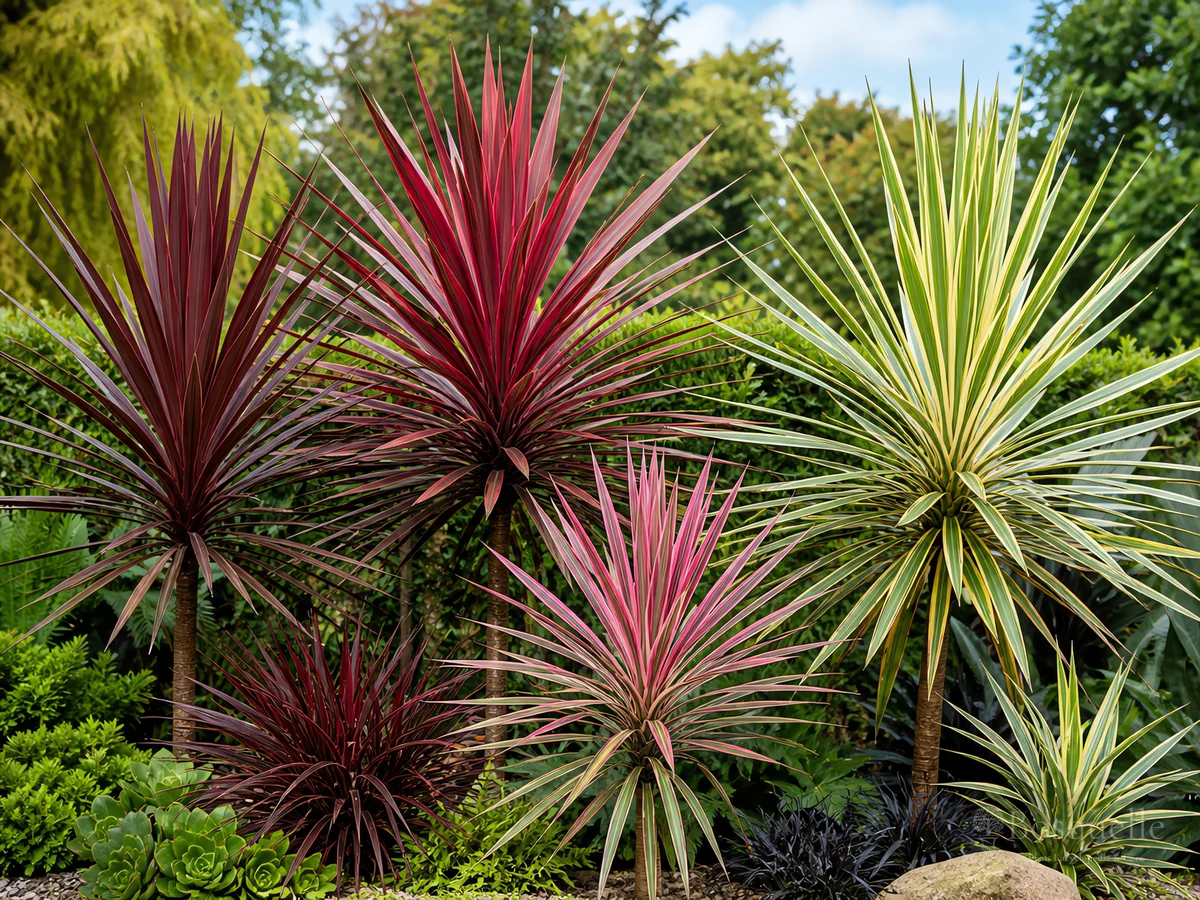
Shop “cordyline” and you will meet two plants that share a genus and almost no winter tolerance. Sword fountains are Cordyline australis — New Zealand cabbage palm / cabbage tree. Colorful canes are C. fruticosa — Hawaiian ti. This page is the shortlist we actually hold. Care stays on How to Grow Cordyline.

Choose by leaf — sword fountain vs colorful cane
C. australis cultivars have narrow, ribbon-like foliage that forms a fan on young plants, then a palm-like trunk with age. C. fruticosa has wider, lance-shaped leaves that spiral up a colorful cane. Cordyline roots are typically white; many Dracaena roots read orange or yellow. Buy by the Cordyline tag, not a vague “dracaena palm” or “spike” label.
- Sword fountain — gray-green, bronze, or pink-edged narrow leaves. Patio australis. Same deep-pot, moist-drain culture.
- Colorful cane — broader pink, burgundy, or striped leaves on a ti stem. Warmer, more humidity-hungry, more fluoride-sensitive.
- Young fountain with no trunk yet — still australis if the leaves are narrow swords. Young plants sold as houseplants often look grassy until they cane.
Is a ti plant the same as cordyline?
Ti usually means Cordyline fruticosa, one species inside the genus. Cabbage-palm types are mostly C. australis — related, not identical culture. Both are Cordyline; they are not one houseplant recipe.
A second shop trap: this catalog’s live plant titled cabbage-tree is C. fruticosa — Hawaiian ti — not New Zealand cabbage palm. Treat the Latin, not the common-name blur.
Color on australis is a cultivar, not a species change. A pink patio sword is still australis culture. Color on ti is also a cultivar story. Do not assume a colorful leaf means you bought ti — check width and habit first. If a mixed “tropical assortment” has no Latin, use that leaf test before you copy a neighbor’s watering.
Grocery and big-box “spikes” sold as cheap annual color are often young australis, or a Dracaena lookalike, not a named ti cane. Narrow swords in a tiny pot: treat as australis — sun, a deep pot, and a winter move — not as a disposable annual you toss at frost. Broader colorful leaves already on a cane: treat as ti. A mislabeled spike with orange or yellow roots is Dracaena. It is not a Cordyline type even when the sticker says palm.
Cabbage-palm C. australis we hold
‘Pink Passion’ and ‘Red Sensation’ are colored australis forms — Pink Passion with neon-pink margins, Red Sensation purplish-red. ‘Red Star’ is bright bronze-red. We also hold dance-named colored forms ‘Can Can’ and ‘Cha Cha’, plus ‘Paso Doble’ and ‘Salsa’. Same species story: moist fertile well-drained mix, full sun to part shade, a deep pot for the taproot, summer moisture with a hard winter cutback indoors.
These are not types of ti plant. Do not copy a low-light indoor ti calendar onto a patio sword. If you want year-round landscape height in a warm frost-light climate, australis is the outdoor candidate — it can take more sun and a cooler winter than ti, and it wants that taproot in a tall pot. If you want a colorful indoor cane, skip this band and read ti below. Do not mix the two in one water jar or one overwinter cupboard and expect both to look like the tag photo.
Trade sheets also name Burgundy Spire, Charlie Boy, Dark Star, Jive, and Pink Champagne. Those are real named forms in the trade. They are not extra cards here — we do not invent plants we do not hold. If a tag matches one of those names, still treat it as australis culture, then come back to this shortlist for the seven we link.
Ti C. fruticosa (and the cabbage-tree slug)
C. fruticosa is the colorful cane houseplant and tropical landscape accent. In temperate zones it usually summers on a porch and winters indoors. Give it bright indirect light, humidity, and a peat or coir mix that stays moist without wet feet. Fluoride tipburn is common — distilled or rainwater beats “just water more.” An older synonym you will still see on tags is Cordyline terminalis; that is ti, not a third species in this catalog.
The live slug and title cabbage-tree on this plant are marketing blur. New Zealand cabbage tree / cabbage palm is C. australis. Hawaiian ti is C. fruticosa. If you bought the plant we link as cabbage-tree, grow it as ti: warmer, brighter-indirect, humidity, and fluoride-aware water. Do not put it in the ground as if it were a hardy australis sword.
Trade names you will see on other sites — Red Sister, Baby Doll, Florica, Electric Pink, Singapore Twist — are real ti or related cultivars in the wider market. They are not extra cards in this catalog. Grow unlabeled red ti as fruticosa culture, then use the one ti we link.
Not types — Dracaena, Sabal, indivisa, invented extras
- Dracaena — lookalike foliage, often sold as a spike or “dracaena palm.” Roots often orange or yellow; Cordyline roots typically white. Ti leaves have grooved petioles; common Dracaena foliage often lacks them. Not a type of Cordyline.
- True cabbage palm — Sabal palmetto is a different plant. The common name “cabbage palm” on australis is a New Zealand / Cordyline usage, not a palmetto.
- Cordyline indivisa — a mountain cabbage tree with its own search volume. We do not hold it. Do not treat a shop “Dracaena indivisa” spike as a type in this shortlist; those are often young australis mislabeled.
- Phormium / flax — strappy colored leaves, different genus. Not Cordyline.
Moist drain, fluoride checks, and the winter move live on How to Grow Cordyline. Cane and ti-log cuttings live on How to Propagate Cordyline. A deep pot and a 1–2 inch width step live on How to Repot Cordyline.
When the tag already says Cordyline and the leaf matches one of the eight we hold, stop shopping for a ninth invented kind. Narrow swords in a fountain = australis band. Broad colorful spirals on a cane = ti. Orange roots on a cheap spike = probably Dracaena, not this shortlist. A pink patio sword still wants sun and a deep pot; a burgundy indoor cane still wants humidity and fluoride-aware water. The leaf tells you which winter move to plan before you buy a second plant for the same porch.
FAQ
Is cordyline the same as Dracaena?
No. Young foliage can look similar. Cordyline roots are typically white; many Dracaena roots are orange or yellow. Check the tag.
What is the difference between cabbage palm and ti?
Cabbage palm / cabbage tree here means C. australis — narrow sword fountains. Ti means C. fruticosa — broader colorful canes. Related genus, different winter and light.
Why does this catalog call ti a cabbage-tree?
The live common-name slug is marketing blur. Treat PLANT-005544 as Cordyline fruticosa ti, not as New Zealand cabbage palm.
Is Cordyline terminalis a different type?
No. Terminalis is an older name for C. fruticosa. It is ti, not a third species in this shortlist.
Do you cover Cordyline indivisa?
No. We do not hold it. Do not invent a mountain cabbage tree card from search volume.
Is Red Sister in this shortlist?
No. It is a real ti cultivar in the wider trade. We do not invent extra bands. Grow unlabeled red ti as fruticosa culture, then use the one ti we link.
Are Can Can and Cha Cha types of ti?
No. Those dance-named forms in this catalog are colored C. australis cabbage-palm types, same sword culture as Red Star.
Will container cordyline flower?
Rarely. Container plants seldom bloom. Buy these for foliage.
Which Cordyline is better indoors?
Ti (C. fruticosa) is the usual indoor cane. Australis swords want more sun and a deeper pot; they still overwinter indoors, but they are patio plants first.
Is a true cabbage palm a Cordyline?
Sabal palmetto is not Cordyline. The cabbage-palm name on australis is a New Zealand usage.
Related guides


This note is part of Cordyline Guides.
More type comparisons by plant are gathered in Types of Plants Guides.
Updated: Reviewed by Bosquelle Editors