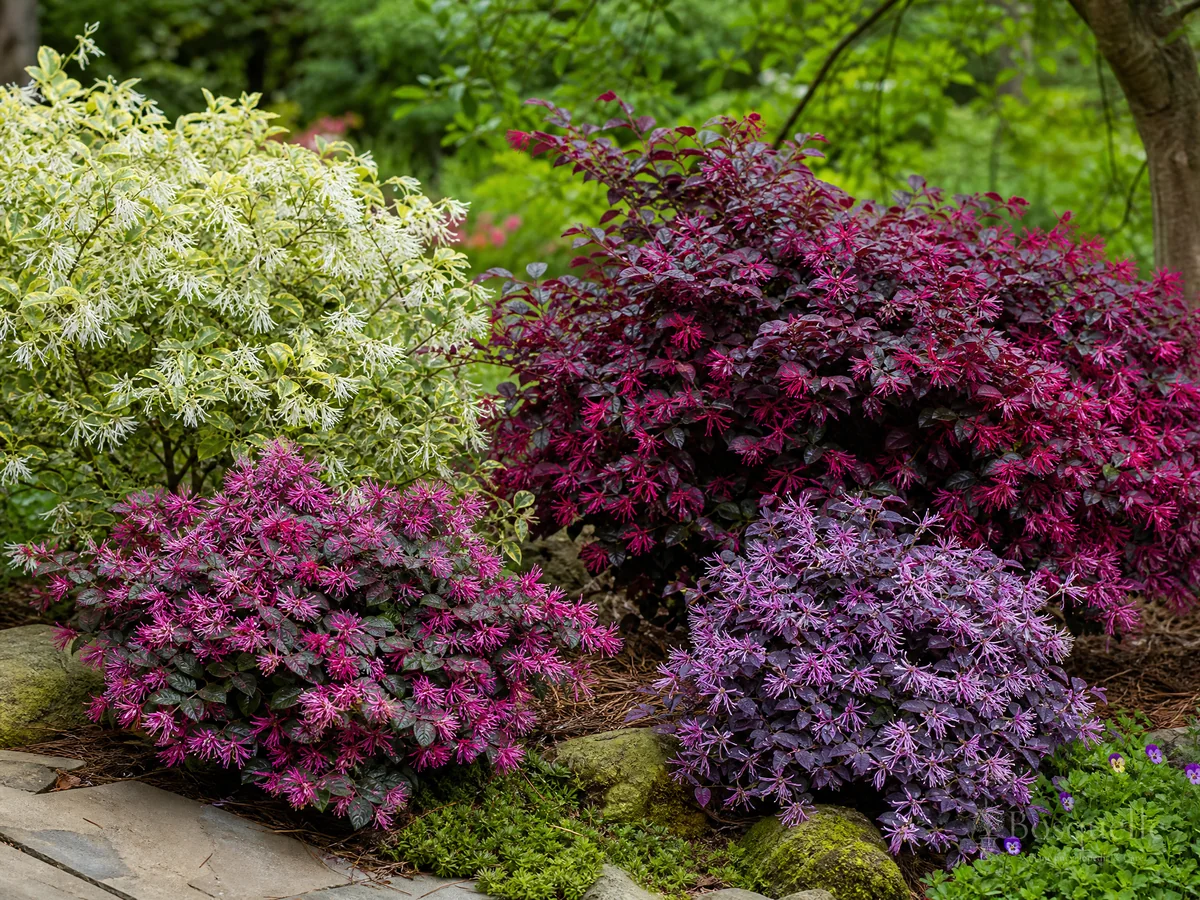
Choose Chinese fringe flower by class first: a white-flowered green shrub, a burgundy pink-flowered shrub, or a compact mound.

Choose a white-flowered green shrub, a burgundy pink-flowered shrub, or a compact mound
| Factor | Recommended | Avoid |
|---|---|---|
| White on green | The species form: creamy-white fringe and olive to emerald leaves | Do not expect burgundy foliage on a white-flowered tag |
| Pink or red on burgundy | var. rubrum for a purple screen; color is stronger in sun | Do not use a shady wall if dark leaves are the point |
| Compact mound | A named dwarf for a foundation or a pot | Do not treat every burgundy tag as a 3-foot plant |
| Mature size | Read the width on the tag before you plant a row | Do not treat a shop photo of a young pot as the finished hedge |
Know your USDA hardiness zone before you pick a type of loropetalum that will take your winter. Type your ZIP below.
2023 USDA ZIP listings (PRISM / USDA-ARS). Find Your USDA Hardiness Zone · Official USDA map.
Read flower color and mature size before you buy. White-flowered kinds have green leaves. Burgundy kinds carry pink to red fringe. [1] [2] Sizes run from a 1-foot mound to a small tree. Compact is a habit, not a second genus. [3] [4] A shop dwarf tag is a habit class, not a height guarantee. Some plants sold as compact still reach 8 to 10 feet in a few years, so read the mature width before you plant a foundation row. Once you know the kind, site it on How to Grow Chinese Fringe Flower. Cut after bloom on Pruning Chinese Fringe Flower.
What is the difference between green and burgundy loropetalum?
Green-leaf kinds flower white. Burgundy-leaf kinds are var. rubrum, with pink or red flowers. Burgundy color is stronger in sun.
Browse by kind
These are the kinds in this catalog. Match the job first: a white-flowered green shrub, a burgundy screen, or a compact mound. Do not buy on a purple photo alone when mature width also changes what you get.
White-flowered, green-leaf
Carolina Moonlight is a 6-foot white-flowered shrub with olive-green leaves. Emerald Snow stays smaller, with a heavy white spring show.
Burgundy-leaf, pink or red flowers
Ever Red holds dark red flowers and burgundy leaves through summer. Sizzling Pink and Jazz Hands Bold are the usual pink-on-purple landscape screen.
Compact and dwarf mounds
Jazz Hands Mini is a low magenta mound. Purple Daydream and Jazz Hands Dwarf White are the foundation-scale plants. Read the mature width — some dwarf tags still reach head height.
Pick by flower color and the width on the tag, not by a shop list of extra names.
If the tag says only fringe, read the Latin before you buy — this shrub is not fringe tree.
FAQ
Is Purple Pixie, Cerise Charm, or Zhuzhou in this list?
No. Those names are not cards here. They still follow the same color-and-size split if the tag says loropetalum.
Is Razzleberri a separate kind?
No. Razzleberri is an older shop name, not a card in this catalog. Treat it as burgundy-leaf var. rubrum.
Will a dwarf tag stay under 4 feet?
Not always. Some plants sold as compact reach 8 to 10 feet. Read the mature width, not only the word dwarf.
Is Chinese fringe tree the same plant?
No. Chinese fringe tree is Chionanthus, in the olive family. Chinese fringe flower is Loropetalum, in the witch-hazel family.
Related guides


References
- [1] Clemson HGIC -
https://hgic.clemson.edu/factsheet/loropetalum-chinese-fringe-flower-care-cultivars-growing-guide/ - [2] Walter Reeves -
https://www.walterreeves.com/landscaping/loropetalum-varieties-and-sizes/ - [3] NC State Extension Gardener -
https://plants.ces.ncsu.edu/plants/loropetalum-chinense/ - [4] Proven Winners -
https://www.provenwinners.com/how-plant/loropetalum
This note is part of Loropetalum Guides.
More type comparisons by plant are gathered in Types of Plants Guides.
Updated: Reviewed by Bosquelle Editors