
Choose bellflowers by habit and risk before colour: a clumping mound, an upright spike, a wall mat, or a vigorous runner. Flower colour does not rewrite spread or drainage.
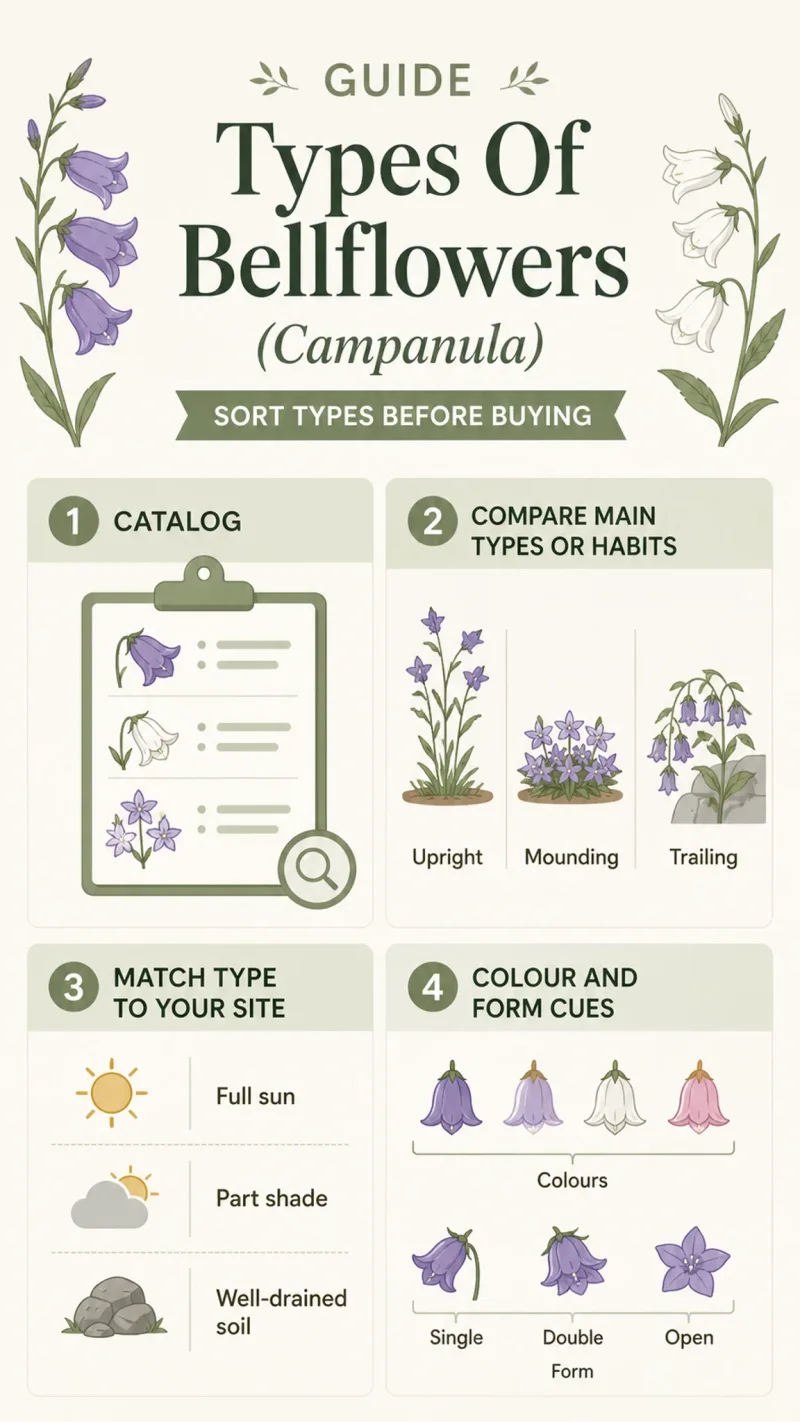
Match a band across 33 catalog plants, then open cultivars. Culture stays on How to Grow Bellflowers. Spacing on Planting Bellflowers.
Choose by mound, spike, mat, or runner
| Factor | Recommended band | Avoid |
|---|---|---|
| Front-edge bowl | Carpathian mound (Carpathian Bellflower ‘Deep Blue Clips’) | A wall mat in a 15 cm formal knot |
| Mid-border vertical cups | Tall spike (Campanula persicifolia ‘Alba’, Campanula lactiflora ‘Loddon Anna’) | Dense shade with no stake room |
| Wall and path skirt | Wall mat (Campanula poscharskyana) | A miniature alpine trough you cannot edit |
| Spotted bells that travel | Vigorous runner (Campanula punctata ‘Cherry Bells’) in a dedicated lane | Mixed jewels with no edging |
Know your USDA hardiness zone before you pick a type of campanula that will take your winter. Type your ZIP below.
2023 USDA ZIP listings (PRISM / USDA-ARS). Find Your USDA Hardiness Zone · Official USDA map.
Lock the lane, then open the matching band. Colour comes last. If you cannot say whether you want a polite mound or a wall skirt, stop shopping until that sentence exists.
Carpathian Bellflower ‘Deep Blue Clips’ is the neat front-edge mound many gardeners mean by a tidy bellflower. Method stays on How to Grow Bellflowers.
Thug literacy before you browse cards
Campanula rapunculoides (creeping bellflower) is widely flagged as invasive in gardens. Your labelled hybrid may be kinder — still learn the difference between a mat you invited and a root system that ignores the bed edge.
Biennial Canterbury bells (Campanula medium ‘Champion Pink’) are a different life-cycle story than long-lived perennial clumps. Read the Latin name. Wrong buys that look like colour decisions: Serbian bellflower for a 15 cm formal knot, spotted runners beside alpines, or expecting every bluebell label to mean a tidy cottage spike.
Wrong bellflower buys that look like a types page
- Creeping bellflower (C. rapunculoides): a root thug, not a polite hybrid.
- Unnamed groundcover bellflower: assume edit work, not politeness.
- Pond Sagittaria / true bluebell mixes: different plants; confirm Latin.
- A pink novelty that still runs: petal shape does not cancel root travel.
Full catalog by habit (33)
Bands below follow mound, tall spike, wall mat, vigorous runner, and other jobs. Lock the job first, then open one or two plants.
Carpathian mounds (4)
Low clumping cups — Deep Blue Clips and other carpatica.
Tall spikes (13)
Upright peach-leaved, milky, and clustered bells.
Wall and path mats (3)
Creeping skirts — Serbian, Dalmatian, and Adriatic types.
Vigorous spotted types (4)
Travel by root — Cherry Bells, punctata, takesimana.
Other Campanula (9)
Confirm habit on the tag — harebells and remaining species.
Label decoder
- carpatica — mound / clips habit
- persicifolia — peach-leaved spike
- glomerata — clustered heads on upright stems
- lactiflora — tall milky bells
- poscharskyana / portenschlagiana / garganica — mat / wall
- punctata / takesimana — check vigour
- medium — Canterbury bells life cycle
- rapunculoides — thug — verify before keeping
For a first Campanula bed, one mound and one spike beat five mats you cannot edit. Add wall types only when the edge is ready to be theirs. Three plants can teach the genus: one carpatica mound, one persicifolia spike, and one mat if you truly want an edge.
Refuse packets that will not state a Latin name. Common names recycle across habits. If a plant is sold as groundcover bellflower, assume edit work. For small urban beds, prefer mounds and spikes. Save mats for walls, steps, and gravel that can take a skirt.
Re-check Latin names when common labels say bluebell, fairy bells, or Adriatic bellflower — those words hide different habits. Specialty novelty colours still obey habit rules. A pink form that runs is still a runner. Do not let petal shape cancel risk.
When two plants seem equal, prefer the one matching your edit time. Low maintenance favours clumping mounds and peach-leaved spikes. High colour on walls favours mats you will shear. Limit new vigorous types to one trial patch per year. Document where runners stop.
Prefer named carpatica and persicifolia when gifting plants to new gardeners. Gifting a mat without an edit warning is how friendships cool. Retire mystery unlabeled Campanula from mixed jewels until identified. Unknown root behaviour is not a bargain.
Clustered glomerata heads are still an upright spike job, not a wall mat. Peach-leaved persicifolia carries cups along a stem; glomerata packs bells in a tight head. Both need air and a stake. Neither belongs in a 10 cm trough. Canterbury bells (medium) are a biennial spike: enjoy the second-year show, then replace or let a few seedlings stay if you can name them.
Harebell (rotundifolia) is a finer wild-type face, not a Serbian skirt. If the tag only says bluebell, read the Latin before you copy a neighbour’s cottage script onto the plant. Side-by-side in temporary pots for one season teaches more than another hour of catalogue browsing when mound versus mat is still unclear before you buy.
Where care, partners, and planting live
Sun, moisture, deadhead, and containment: How to Grow Bellflowers. Partners by habit zone: Bellflower Companion Plants. Spacing and plant-out: Planting Bellflowers. Types only sorted habit and risk.
FAQ
How do I choose a bellflower type?
Pick habit first: mound, spike, mat, or vigorous runner — then colour.
Is creeping bellflower the same as Serbian bellflower?
No. Creeping bellflower (C. rapunculoides) is the thug many regions warn about. Serbian bellflower (C. poscharskyana) is a different, still vigorous, mat/wall plant.
What is a good beginner bellflower?
Carpathian mounds and peach-leaved spikes are usually clearer first choices than aggressive runners.
Are Canterbury bells perennial?
Campanula medium is typically biennial or short-lived compared with many perennial species.
Which types spill over walls?
Serbian, Dalmatian, and related mats — useful when the edge is meant to be theirs.
Which types stay in a neat clump?
Many carpatica and persicifolia selections — still verify the tag.
Why does my bellflower keep popping up elsewhere?
You may have a runner or seeder. Identify the species and contain or relocate.
Can I mix mats and mounds?
Yes if the mat has a defined edge lane and the mound has its own circle — do not let the mat write the whole bed.
Where is care detail?
How to Grow Bellflowers covers moisture, deadhead, and containment.
How many plants are listed here?
33 Campanula in this catalog, grouped by habit bands above.
Related guides


This note is part of Campanula Guides.
More type comparisons by plant are gathered in Types of Plants Guides.
Updated: Reviewed by Bosquelle Editors