
Choose ash by job: a large eastern shade tree (white or green), a wine-red Raywood, or another regional kind. We list six kinds. All are Fraxinus.

Choose white ash, green ash, or a wine-red Raywood
| Factor | Recommended | Avoid |
|---|---|---|
| Eastern native | White ash for upland shade; green ash for wetter or tougher ground | Treating either as emerald-ash-borer proof |
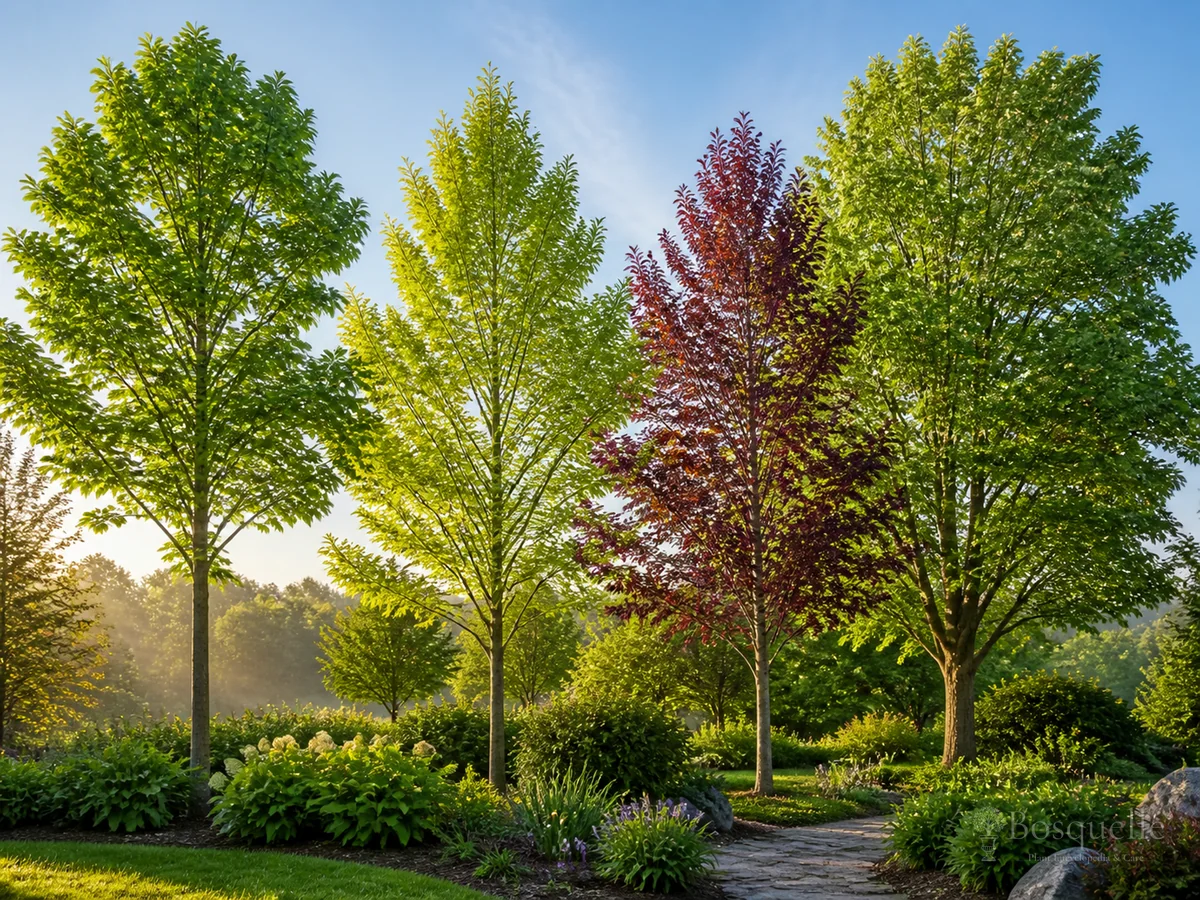
| Wine-red fall | Raywood (Claret) ash for finer leaves and claret color | Reading fall color as beetle immunity |
| Regional or ornamental | European, Oregon, or flowering ash matched to the site | Inventing extra nursery names as extra kinds |
| Latin on the tag | Fraxinus | Sorbus (mountain ash) or a bag of fireplace ash |
Know your USDA hardiness zone before you pick a type of fraxinus that will take your winter. Type your ZIP below.
2023 USDA ZIP listings (PRISM / USDA-ARS). Find Your USDA Hardiness Zone · Official USDA map.
Read the Latin. The large eastern pair we list is F. americana and F. pennsylvanica. [1] Green ash is usually the more adaptable of the two, and shops still prefer male or seedless trees to cut samara litter. [2] Raywood is the wine-red fall selection — still a borer host. [3] Kind is a shop choice. The beetle does not care which catalog name you bought.
White ash vs green ash — what’s the difference?
White ash is often the larger upland native with paler leaflet undersides and strong fall color. Green ash is usually more adaptable to wet and tough urban soils. Both are killed by emerald ash borer if untreated.
Is Raywood or Claret ash immune to emerald ash borer?
No. Raywood is grown for wine-red fall color, but it is still Fraxinus and remains at risk where the beetle is established.
Browse by kind
White and green ash
F. americana is the large upland native with leaflets paler beneath and strong fall color. F. pennsylvanica is the floodplain native that takes wetter and tougher ground. Both die if emerald ash borer is left untreated.
Raywood (Claret) ash
F. angustifolia ‘Raywood’, also sold as Claret ash, is grown for wine-red fall color and a finer leaf. It is still Fraxinus. Fall color is not beetle immunity.
European, Oregon, and flowering ash
F. excelsior is the Old World check. F. latifolia is the western wet-site native with wider leaflets. F. ornus (manna ash) brings showier spring panicles. Treat each as ornamental Fraxinus, not as an emerald-ash-borer exception.
Not mountain ash — that is a different tree
- Mountain ash (Sorbus) is in the rose family. Its compound leaves look similar at a glance, but the arrangement is alternate, and it is not an emerald ash borer host. [4]
- Wood ash from a fireplace is a soil amendment, not a tree.
- Prickly ash (Zanthoxylum) is another different genus. It is not true ash.
True ash has opposite pinnately compound leaves — leaflets in pairs along a stalk — and mature bark often furrowed in diamond ridges. If the tag says mountain ash or rowan, that is not Fraxinus.
What does an ash tree look like?
Opposite pinnately compound leaves, leaflets in pairs, and mature bark often furrowed in diamond ridges. Do not confuse true ash (Fraxinus) with mountain ash (Sorbus).
Is this about wood ash fertilizer?
No. Wood ash is a soil amendment. Ash here means the tree Fraxinus.
If the tag says mountain ash or rowan, that is Sorbus — read the Latin before you plant.
FAQ
Do we list black ash or Texas ash as extra kinds?
No. Those are other species. We list six kinds: white ash, green ash, Raywood, European ash, Oregon ash, and flowering ash.
Is Claret ash a different plant?
No. Claret ash is another common name for Raywood (Fraxinus angustifolia ‘Raywood’). Same wine-red fall tree, same borer risk.
Related guides


References
- [1] NC State Extension Gardener -
https://plants.ces.ncsu.edu/plants/fraxinus-americana/ - [2] NC State Extension Gardener -
https://plants.ces.ncsu.edu/plants/fraxinus-pennsylvanica/ - [3] NC State Extension Gardener -
https://plants.ces.ncsu.edu/plants/fraxinus-angustifolia-subsp-oxycarpa-raywood/ - [4] Gardener's Path -
https://gardenerspath.com/plants/landscape-trees/grow-ash-trees/
This note is part of Fraxinus Guides.
More type comparisons by plant are gathered in Types of Plants Guides.
Updated: Reviewed by Bosquelle Editors