
Pair snowdrops with same-week late-winter bloomers and with later perennials that cover fading leaves. Site the group under deciduous trees, not evergreen shade.

Same late-winter bloomers
| Factor | Recommended | Avoid |
|---|---|---|
| Same week | Hellebore, winter aconite, early crocus, glory-of-the-snow, small daffodils | Summer-only perennials with no winter show |
| Canopy | Deciduous trees or shrubs — winter light, summer shade | Dense evergreen cover over the bulbs |
| Skirt | Hosta, fern, epimedium, spotted deadnettle, candytuft | A mat that never lets winter light through |
| View | Near a path or a window you use in February | A far corner you will not walk in the cold |
Winter aconite, Siberian squill, glory-of-the-snow, and small early daffodils share the snowdrop week. Hellebore gives a darker leaf behind the white bells. [1]
What grows well with snowdrops?
Hellebore, winter aconite, early crocus, squill, and small daffodils for the same week. Hosta or fern later to cover fading leaves.
Skirts that cover fading leaves
Snowdrop leaves must stay until they yellow. Plant neighbours that leaf out in late spring and hide that foliage without shading the February bloom. Hosta, hardy ferns, and epimedium do that job. Spotted deadnettle and candytuft work as low evergreen edges if they do not smother the bulbs.
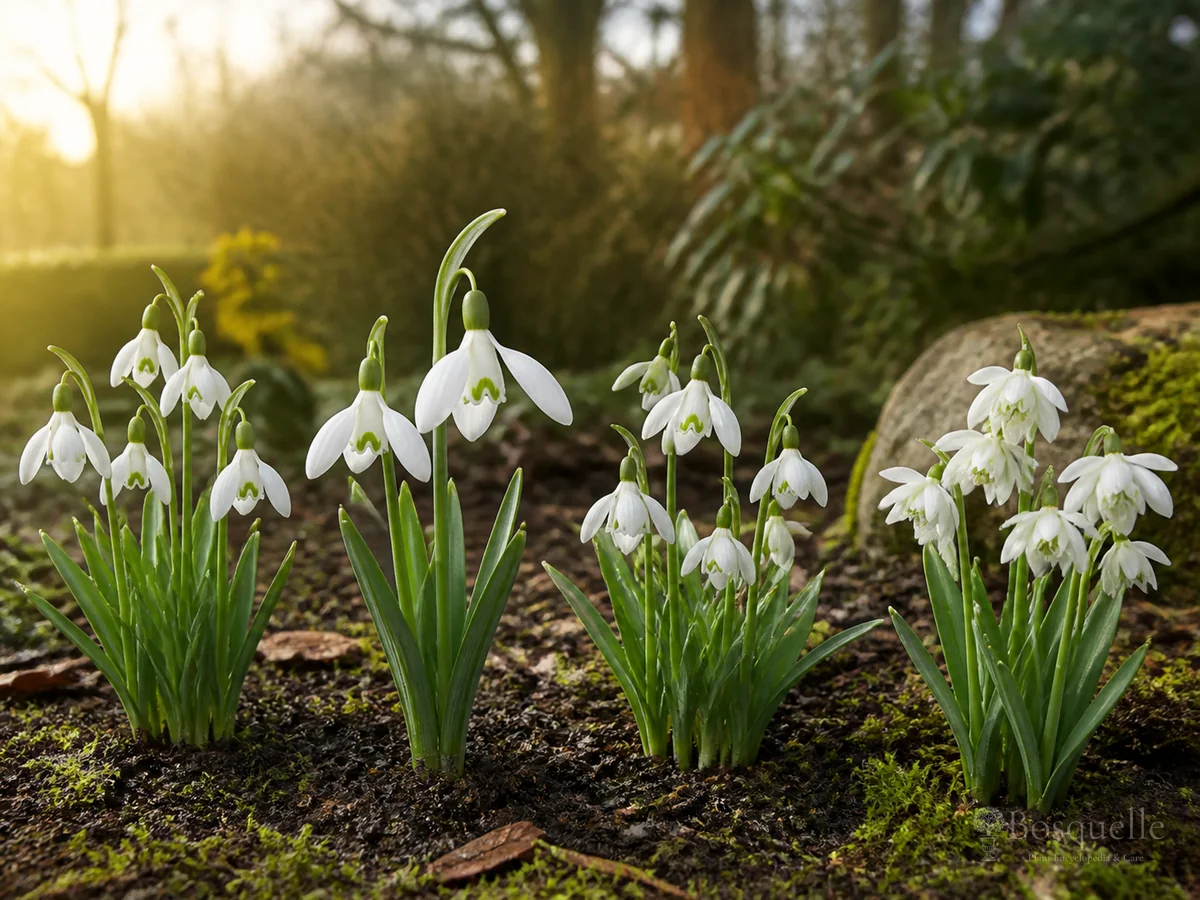
Place clumps under deciduous trees — winter sun, then summer shade and leaf litter. [2] They belong in a woodland or rock garden with room to spread. [3] Site common snowdrop or Flore Pleno where you can see them from a path or a window. [4]
Can I plant snowdrops under a tree?
Yes — deciduous trees are the usual site. Evergreen canopy blocks the winter light bloom needs.
What hides yellowing snowdrop leaves?
Later-emerging perennials such as hosta or fern. They cover the fading leaves by late spring so you do not need to cut them early.
What fails beside snowdrops
- Dense evergreen groundcover over the bulbs.
- Mowing a lawn planting before the leaves yellow — about six weeks after bloom.
- A second heavy spreader that swallows a small clump.
- Digging the bed in summer while the bulbs are dormant and unmarked.
Grow method stays on How to Grow Snowdrops. Depth and in-the-green timing stay on Planting Snowdrops.
Pair the same late-winter week, then a skirt that hides fading leaves. Keep evergreen shade off the bulbs.
FAQ
Can I plant snowdrops in a lawn?
Yes, if you will not mow that area until the foliage yellows. Otherwise use a bed or the edge of a path.
What pairs with yellow-marked snowdrops?
Winter aconite is a yellow echo in the same week. Keep nearby foliage simple so the marks stay visible.
Can I mix snowdrops with later summer bulbs?
Around the edge, yes. Do not dig through a snowdrop clump in summer rest.
Related guides
Recommended plants



References
- [1] Wisconsin Horticulture -
https://hort.extension.wisc.edu/articles/snowdrops-galanthus-spp/ - [2] Missouri Botanical Garden -
https://www.missouribotanicalgarden.org/PlantFinder/PlantFinderDetails.aspx?taxonid=275672 - [3] NC State Extension -
https://plants.ces.ncsu.edu/plants/galanthus-nivalis/ - [4] Old Farmer's Almanac -
https://www.almanac.com/plant/snowdrops
This note is part of Galanthus Guides.
More neighbour shortlists by plant live in Companion Plant Guides.
Updated: Reviewed by Bosquelle Editors