
Cut shiny xylosma back when you plant it, then shear it as a hedge with the base wider than the top. Prune to live leaves, not to bare wood.
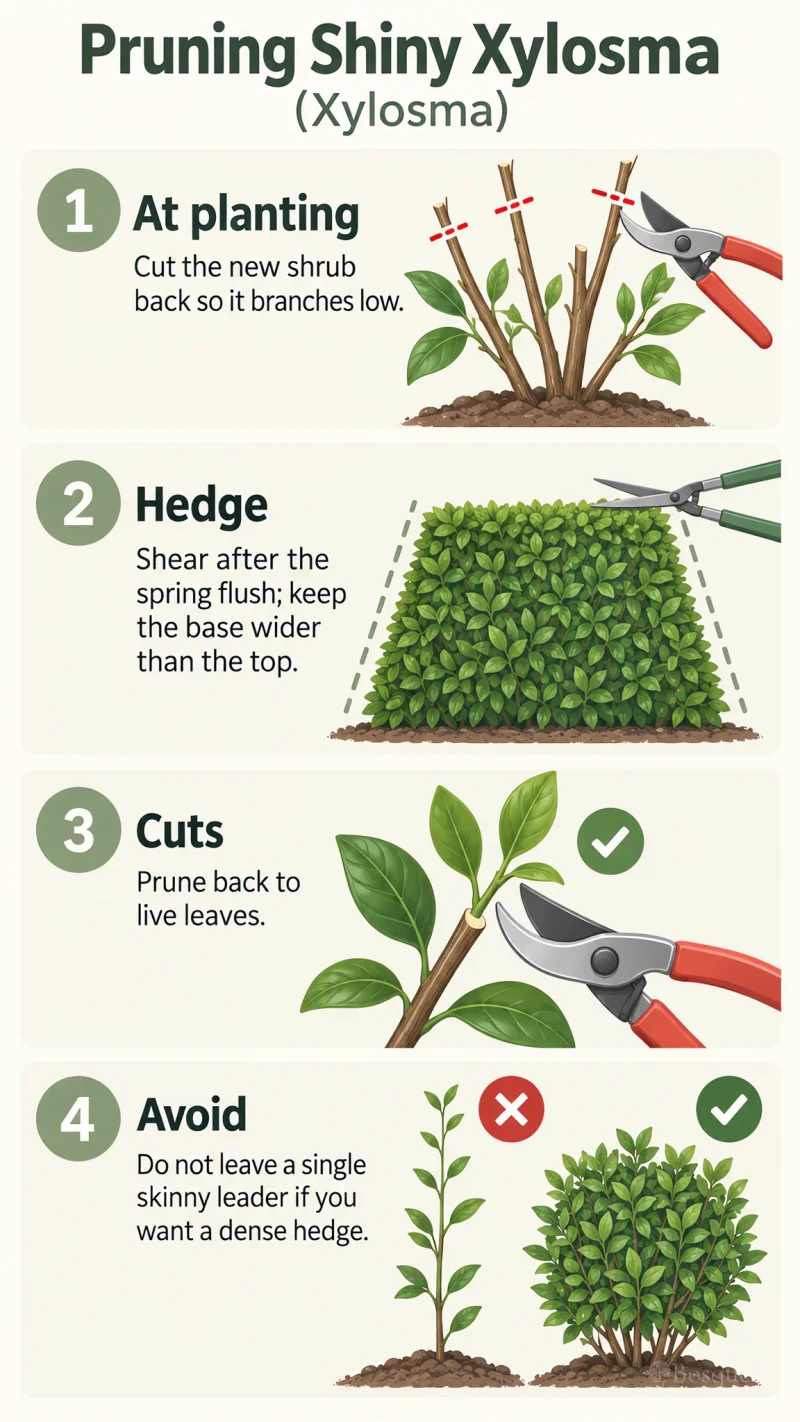
Cut it back when you plant, then shear for a hedge
| Factor | Recommended | Avoid |
|---|---|---|
| At planting | Cut the new shrub back so it branches low | Do not leave a single skinny leader if you want a dense hedge |
| Hedge | Shear after the spring flush; keep the base wider than the top | Do not cut only a few inches off the top and leave the sides wide, which shades out the bottom |
| Cuts | Prune back to live leaves | Do not skin trunks to bare wood and hope the bottom leafs out |
| Overgrown | In spring before bud burst, a hard cut can rebuild a vigorous hedge | Do not skin the base in midsummer and expect a full green skirt the same week |
shiny xylosma takes frequent shearing, so it is a good formal hedge. At planting, cut the shrub back so it branches low. In Arizona heat, extension takes the top third. In the San Joaquin Valley, Master Gardeners cut six to eight inches. [1] The next year, shear about half of the new growth. By the third season you can hold the shape you want. After that, trim when new shoots stand a few inches to about a foot above the line. [2] Site and water live on How to Grow Shiny Xylosma.
When should I prune shiny xylosma?
Cut a new plant back at planting so it branches low. Shear an established hedge after the spring flush, and again as needed to hold the line.
- At planting, cut the shrub back so it branches low — the top third in hot desert plantings, or six to eight inches in milder valley heat.
- The next year, shear about half of that new growth so the plant fills from the base.
- From the third season, hold the shape with regular shearing after spring growth, then as needed through the year.
Keep the base wider than the top
A hedge that is narrower at the bottom than at the top shades its own lower branches, and those leaves drop. Keep the base a little wider so light reaches the skirt. Round, peaked, or slightly sloped tops need less follow-up than a razor-flat box. When you reduce width, cut to live leaves. Bare old wood on this evergreen often stays bare. [3]
- Shear so the base stays a little wider than the top, and so light hits the lower leaves.
- Take only a few inches of green at a time on a tight formal hedge, so you do not open leafless stubs.
- If you must reduce width, cut back to foliage, not to smooth brown trunks.
If it is overgrown, cut it hard in spring
An old, vigorous xylosma hedge can take a hard rebuild. In spring, before bud burst, cut the stems about twelve to eighteen inches above the ground. New shoots come from below those cuts by midsummer. Then thin about half of them and cut the rest to mixed heights so the canopy is not a solid mat. [4] The same large shrub can be trained as a small tree if you start while it is young: pick one trunk or a few stems, and keep suckers off the base as it grows. An established solid hedge that was skinned at the bottom may put out a little adventitious growth, but shaded trunks often stay bare, so do not count on a full green skirt coming back there.
Will it come back from a hard cut?
A vigorous plant often resprouts if you cut it hard in spring before bud burst, down to about twelve to eighteen inches. Do not skin the trunks to bare wood in midsummer and expect the bottom to leaf out at once.
Cut a new plant back so it branches low, shear with a wider base, and prune to live leaves. If the hedge is overgrown, wait for spring, then cut hard.
FAQ
Will the bottom grow back if I skin the trunks?
Often no. Once lower trunks have been shaded for years, those buds die. Prune to live leaves, and keep the base wider than the top so the skirt does not go bare.
Can I train shiny xylosma as a small tree?
Yes, if you start while the plant is young. Pick one trunk or a few stems, and keep suckers off the base. An old solid hedge is harder to convert.
Related guides
Recommended plants
References
- [1] University of Arizona Cooperative Extension -
https://extension.arizona.edu/publication/pruning-shrubs-low-and-mid-elevation-deserts-arizona - [2] UC Master Gardeners of Tulare and Kings Counties -
https://ucanr.edu/sites/default/files/2020-08/287101.pdf - [3] Ask Extension -
https://ask.extension.org/kb/faq.php?id=779966 - [4] Arizona State University -
https://www.asu.edu/lib/camartin/plants/Plant%20html%20files/xylosmacongesta.html
This note is part of Xylosma Guides.
More pruning timing notes by plant live in Pruning Guides.
Updated: Reviewed by Bosquelle Editors