
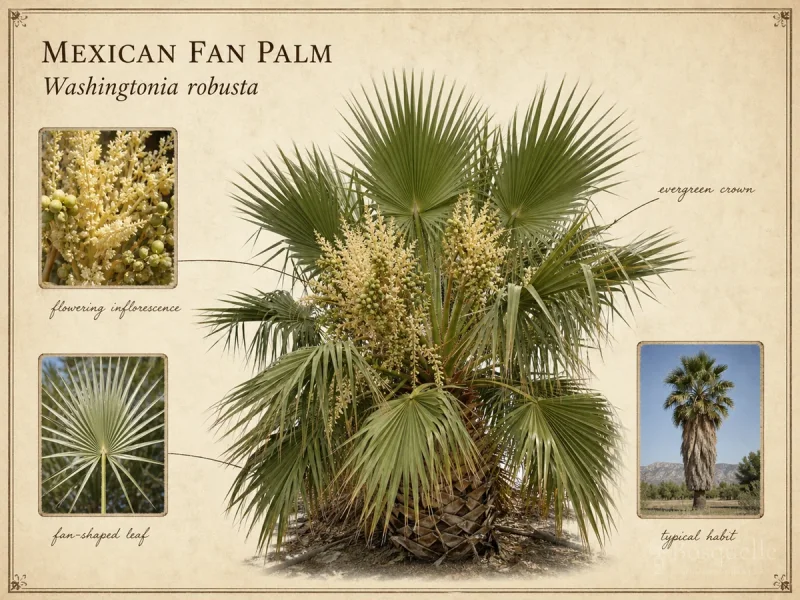
Cut only fully brown fronds on Mexican fan palm, and never hurricane-cut the crown. Wear gloves on the toothed leaf stalks.

Cut only fully brown fronds, and never hurricane-cut the crown
| Factor | Recommended | Avoid |
|---|---|---|
| What to cut | Fully gray-brown fans, and flower stalks if fruit is a mess | Do not cut green or yellowing fans to make a skinny crown |
| Tools | A sharp saw or lopper; wipe the blade before the next palm | Do not use climbing spikes on the trunk |
| Gloves | Heavy gloves and eye cover; the leaf stalks are toothed | Do not yank a green leaf base off the trunk |
Mexican fan palm has one growing point, hidden in the heart of the crown. Green fans feed that bud and also shield it in wind. A hurricane cut that leaves a tuft of new leaves makes the palm weaker in a storm, not stronger, and it can start a thin spot in the trunk. [1] Yellowing oldest fans are often a potassium shortage, not a reason to prune. Leave them until they are fully brown, and feed from the grow page. California fan palm follows the same brown-only rule. [2]
- Stand back and look for fans that are fully gray-brown, with no green left in the blade.
- Put on gloves and eye cover. The leaf stalks carry sharp teeth.
- Cut the brown fan close to the trunk, without gouging the bark.
- Leave yellow and green fans, even if they look tired. Cutting them pushes the shortage up into the next ring.
- Wipe the blade before you move to another palm, so you do not carry a wilt fungus on a dirty saw.
- Never belt climbing spikes into the trunk. Those wounds let a trunk rot in.
Should I hurricane-cut Mexican fan palm?
No. Leave a full crown. Cutting green fans into a tuft makes the palm more likely to snap, and it does not protect the bud.
Take the skirt if fire or rodents force it, not on a calendar
Young Mexican fan palm keeps dead fans as a skirt around the trunk. After the tree is about 30 feet tall, those old bases often drop on their own, and the palm is then self-cleaning. California fan palm keeps a thicker petticoat for many years. That thatch does not hurt the tree. It can be a fire hazard, and it can house rats, so some towns require it off. [3] [4] Owls and bats also use a skirt. Cut it because of fire, a walkway, or a local rule, not because a crew is on a calendar.
- Decide why the skirt has to come off: fire risk, a walk, rodents, or a town rule.
- If you leave it, leave it. Do not lion-tail the trunk into a few green fans at the top.
- If you take it, cut only dead fans and loose bases. Do not pull green bases that still cling.
- Work in cooler months if you can, so a newly bare trunk is not scorched the next afternoon.
- On a tall tree, hire a climber who will not spike the trunk. A dropped fan from 50 feet is a real hazard.
Do I have to remove the petticoat?
Only if fire, rodents, a walk, or a local rule force it. The skirt does not hurt the palm. Mexican fan palm often sheds it once the trunk is about 30 feet.
Leave green and yellow fans, skip a hurricane cut, and take the skirt only when fire or a walk forces the issue.
FAQ
What does a reddish stripe on the leaf stalk mean?
Fans dying on one side with a reddish stripe down the stalk can be a wilt. There is no spray that cures it. Stop sharing a dirty saw between palms, and do not wound the trunk.
Related guides


Recommended plants

References
- [1] UF/IFAS Extension Orange County -
https://blogs.ifas.ufl.edu/orangeco/2024/10/09/palms-to-prune-or-not-to-prune/ - [2] UF/IFAS Extension -
https://ask.ifas.ufl.edu/publication/ST670 - [3] North Carolina Extension Gardener Plant Toolbox -
https://plants.ces.ncsu.edu/plants/washingtonia-robusta/ - [4] UF/IFAS Extension -
https://ask.ifas.ufl.edu/publication/ST669
This note is part of Washingtonia Guides.
More pruning timing notes by plant live in Pruning Guides.
Updated: Reviewed by Bosquelle Editors