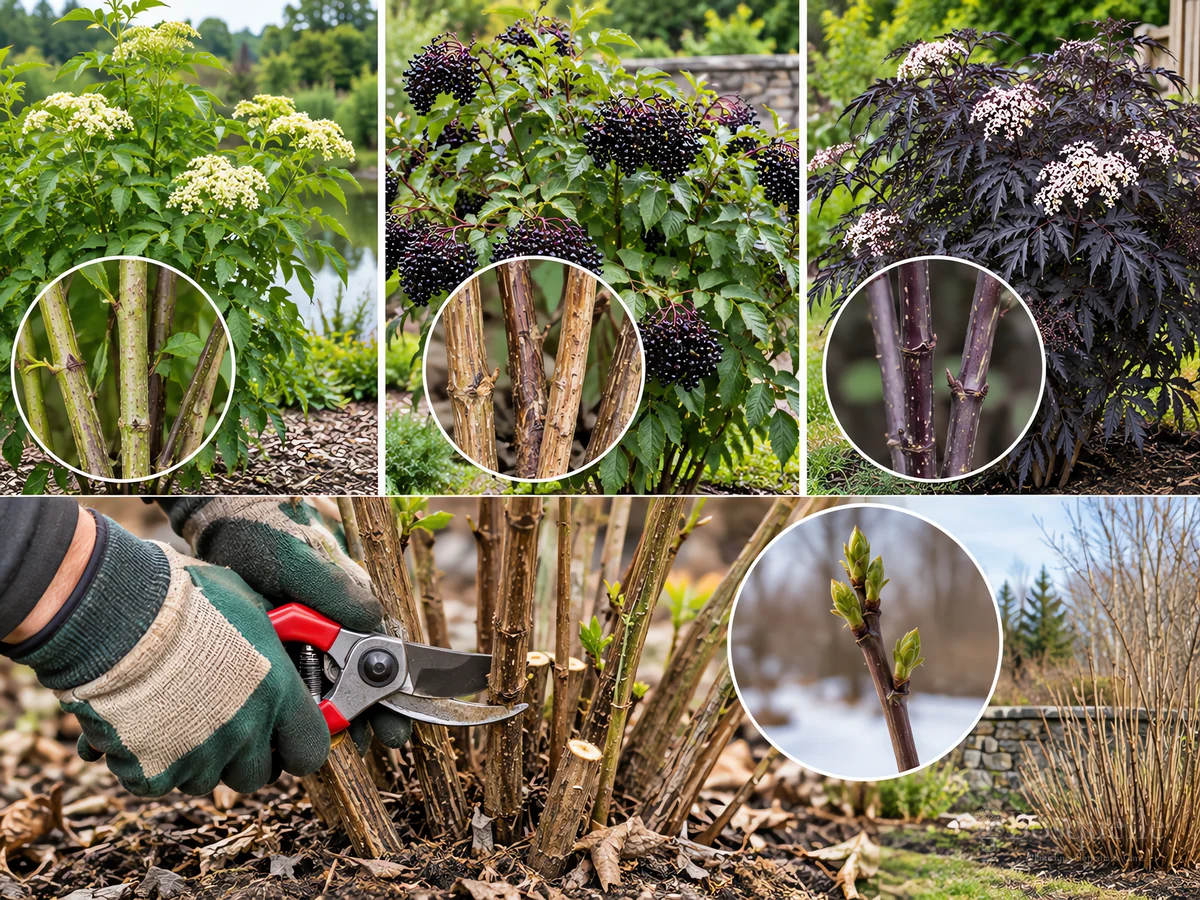
Prune elderberry in late winter while the canes are dormant. Remove canes that are three years old or older so younger, more fruitful wood takes over.

Prune in late winter while the canes are dormant
| Factor | Recommended | Avoid |
|---|---|---|
| When | Late winter to early spring, after the coldest weather and before bud break | Do not prune in fall and remove next year's flower wood |
| Years 1–2 | Little or no pruning; strip flower buds only | Do not cut a young plant hard before roots are set |
| Mature bush | Remove canes older than three years at the crown; keep a mix of one-, two-, and three-year wood | Do not shear the top like a hedge |
| Fruit wood | Second-year canes with laterals fruit the most | Do not keep a thicket of gray, weak old canes |
| Hard renewal | Cut American kinds to about 1 foot only when the plant is overgrown; accept one lean crop | Do not coppice European black elder or Black Lace if you want flowers that year |
Fruit sits on one- and two-year-old wood. [1] A mature American elderberry sends up several new canes each season. Cut the oldest wood so picking stays in reach. [2] Black Lace blooms on older wood. If you want flowers and berries, prune it right after it finishes blooming, not in late winter. A hard dormant cut gives you foliage and skips that year's bloom. [3] [4]
When should I prune elderberry?
Late winter, while the plant is still dormant. You can see winter damage, and you do not cut into next year's fruit wood.
How do I prune Black Lace elderberry?
If you want flowers, prune right after it blooms. A hard late-winter cut is for foliage size and color, and you will miss that year's bloom.
How to prune elderberry
Stand back once to count the canes by age, then cut the oldest and weakest wood first.
- In the first two seasons, only rub off flower buds. Let the plant build roots.
- On a mature plant, cut dead, broken, or rubbing canes at the crown first.
- Find canes older than three years — the bark is gray and thick. Cut them at the crown. Leave no stubs.
- Keep a mix of one-, two-, and three-year canes. About six to eight strong canes is a workable home plant.
- Head extra-tall new whips at a comfortable picking height. Do not hedge-shear the whole plant.
- On an overgrown American plant, you can cut all canes to about 1 foot. Fruit will be light for one season.
What happens when you skip pruning
An unpruned elderberry becomes a mass of old, weak canes that fruit only at the tips, out of reach. New canes crowd in the middle with no light. Yield drops, and the plant spreads by sucker. A missed year is not permanent. Go back to dormant renewal, and the plant recovers within two seasons. Mow or pull suckers outside the area you want at the same time.
Can I cut elderberry to the ground?
A hard renewal to about 1 foot works on American elderberry. Fruit will be light for one season. Do not do this on Black Lace if you want flowers that year.
If the plant is a thicket of old canes, cut the oldest wood to the crown this winter.
FAQ
Should I prune elderberry in summer?
Only to remove a diseased cane, or to shape Black Lace after it blooms. Main renewal on fruit kinds is dormant.
How do I manage elderberry suckers?
Mow around the planting twice a season, or dig suckers with roots in spring. A root barrier about 18 inches deep stops spread in a tight site.
Related guides


Recommended plants


References
- [1] Cornell Fruit Resources -
http://www.hort.cornell.edu/fruit/mfruit/elderberries.html - [2] Ontario Ministry of Agriculture -
https://www.ontario.ca/page/growing-elderberries-home-gardens - [3] Penn State Extension -
https://extension.psu.edu/elderberry-in-the-garden-and-the-kitchen/ - [4] NC State Extension Gardener -
https://plants.ces.ncsu.edu/plants/sambucus-nigra/
This note is part of Sambucus Guides.
More pruning timing notes by plant live in Pruning Guides.
Updated: Reviewed by Bosquelle Editors