
Prune beauty bush right after the flowers fade. Take out about one-third of the oldest stems at the ground, or cut the whole shrub down if you need a fresh start.
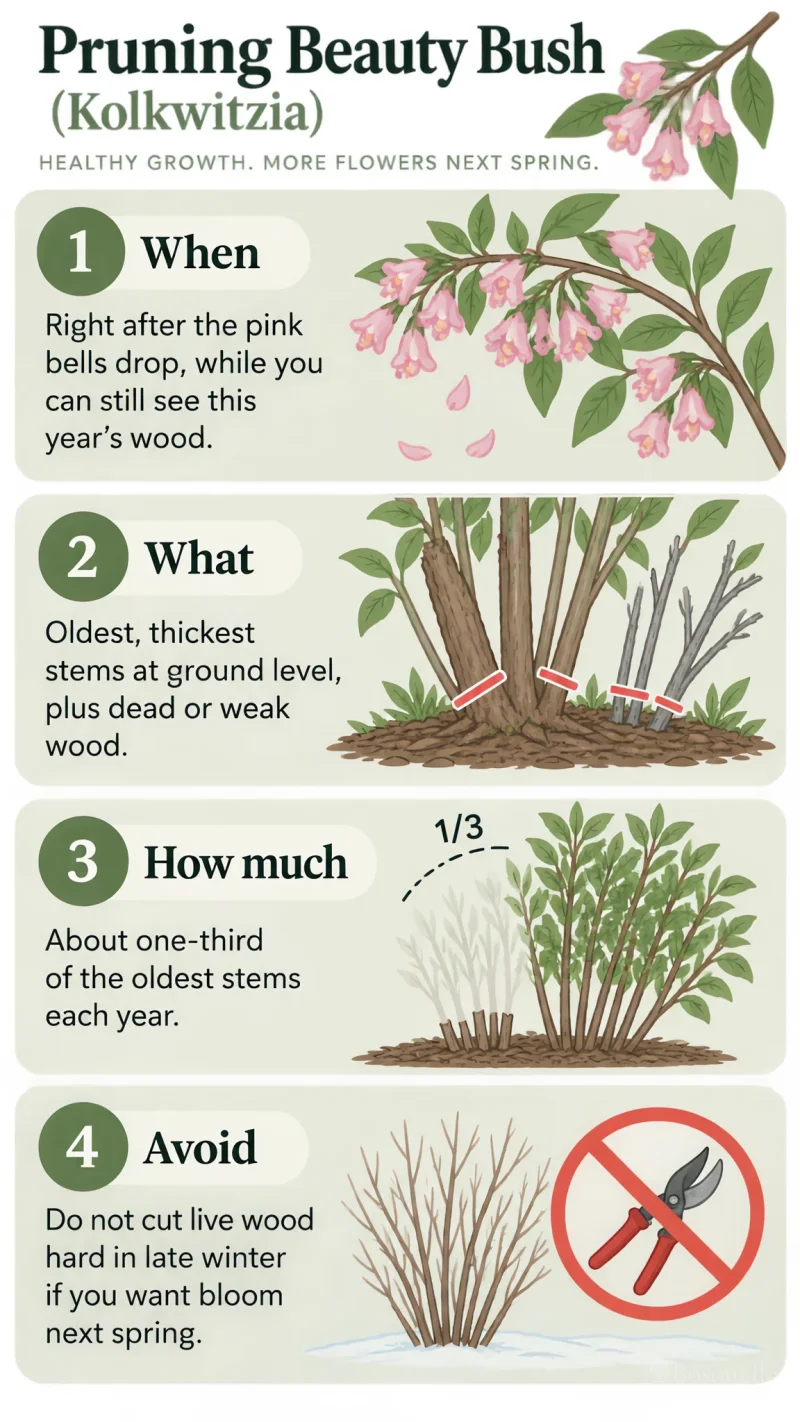
Prune right after the flowers fade
| Factor | Recommended | Avoid |
|---|---|---|
| When | Right after the pink bells drop, while you can still see this year's wood | Do not cut live wood hard in late winter if you want bloom next spring |
| What | Oldest, thickest stems at ground level, plus dead or weak wood | Do not shear the shrub into a box |
| How much | About one-third of the oldest stems each year | Do not strip every flowering stem in one pass unless you accept a missed bloom |
| Tools | Loppers or a pruning saw at the base of each stem you remove | Do not leave tall stubs that sprout a thicket of weak shoots |
Beauty bush sets next spring's flowers on wood it grew this year. If you want that crop, wait until the bells fade, then cut. [1] A late-winter cut on live wood takes the buds that would have opened in April and May. [2] Take a whole stem back to the ground, not halfway up. Chopping the top and leaving stubs makes a thicket of weak shoots and a bare base. [3] Do not shear it. An arching shrub looks wrong as a box, and you would be cutting the wood that carries next year's bells.
- Wait until the pink bells have dropped.
- Stand back and mark the oldest, thickest stems and any dead or weak wood.
- Cut those stems at the ground, about one-third of the shrub each year.
- Leave the younger arching stems. They carry next spring's flowers.
When do I prune beauty bush?
Prune right after the flowers fade. A hard cut in late winter takes next spring's bloom, because the buds sit on last year's wood.
Take out the oldest stems, or cut the shrub to the ground
With age, leaves sit toward the tips and the base goes bare. The yearly fix is to remove about one-third of the oldest shoots at the ground so new stems can fill from below. [4] If the shrub is a dense, leggy thicket, you can cut every stem to near ground level after bloom. That is a legal refresh. You will miss most or all of the next spring's flowers, then get a new crop of young stems. Do not do that hard cut every year; use it when the plant has gone past a yearly thin.
- Each year after bloom, take about one-third of the oldest stems at the ground.
- If the whole shrub is bare at the base, cut all stems to near ground level after the flowers fade.
- Expect little or no bloom the next spring after a full cut-down, then resume the yearly one-third thin.
Can I prune it in late winter?
A light tidy of a broken or dead stem is fine any time. Save the real thinning for after bloom, because a hard late-winter cut takes the next flowers.
If the base is bare and the top is a thicket, take the oldest stems out after this bloom, or cut the whole shrub down and wait a year for flowers.
FAQ
Will a hard cut kill the plant?
No. Cutting the stems to the ground after bloom is a refresh, not a kill. You skip the next spring's flowers, then new stems grow from the base.
How do I site and water the plant I just shaped?
Sun, drain, and first-year water are on How to Grow Beauty Bush.
Related guides

Recommended plants
References
- [1] Virginia Cooperative Extension -
https://www.pubs.ext.vt.edu/content/dam/pubs_ext_vt_edu/2901/2901-1036/2901-1036.pdf - [2] NC State Extension -
https://plants.ces.ncsu.edu/plants/kolkwitzia-amabilis/ - [3] Oregon State University -
https://landscapeplants.oregonstate.edu/plants/kolkwitzia-amabilis - [4] UMass Extension -
https://www.umass.edu/agriculture-food-environment/landscape/publications-resources/plant-identification/beautybush--kolkwitzia-amabilis
This note is part of Kolkwitzia Guides.
More pruning timing notes by plant live in Pruning Guides.
Updated: Reviewed by Bosquelle Editors