
Plant water poppy in a mesh aquatic basket of heavy loam after frost, with only a few inches of water over the rim so the pads float. Divide rooted runners at the same time if you want more plants.
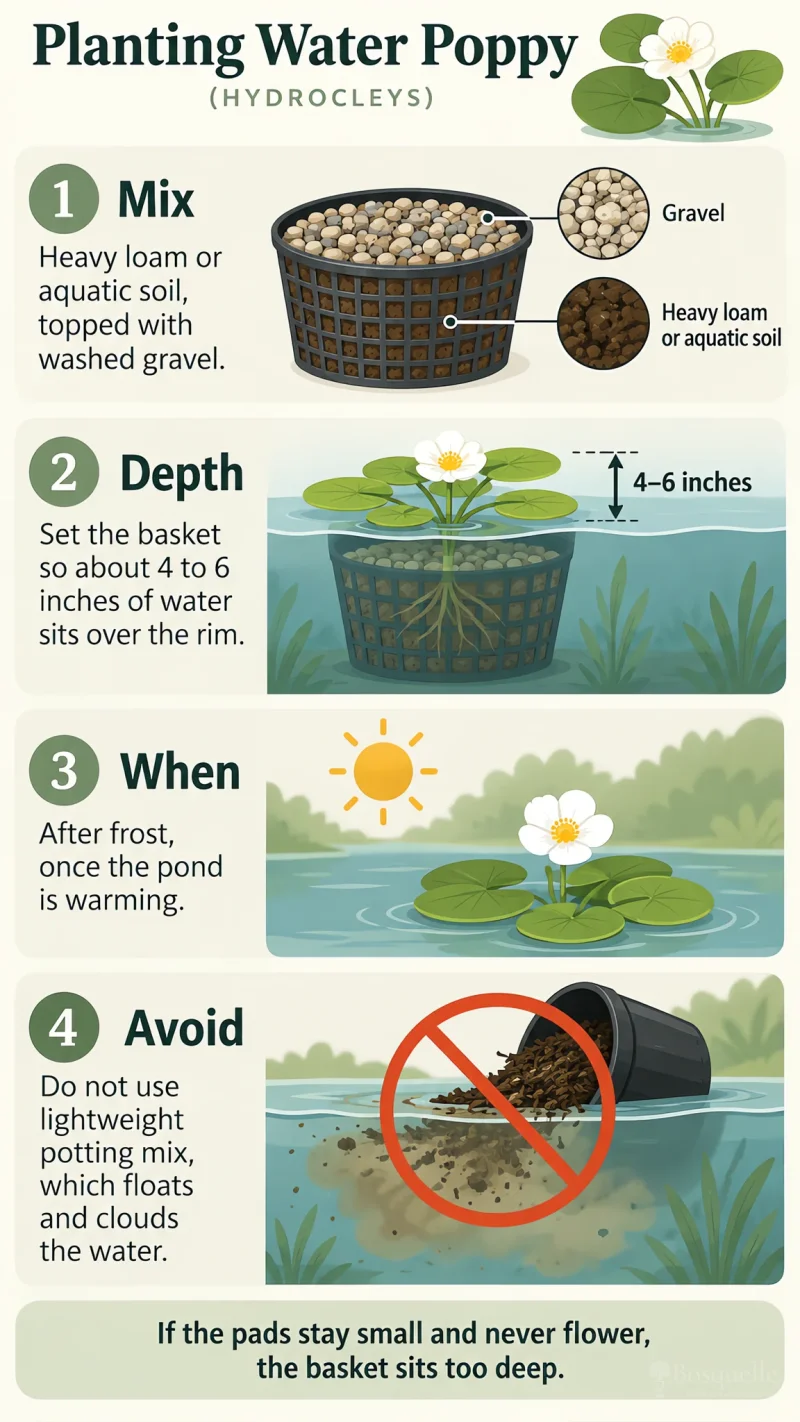
Plant it in a mesh basket of heavy loam, only a few inches under water
| Factor | Recommended | Avoid |
|---|---|---|
| When | After frost, once the pond is warming | Do not plant into a frozen shelf or a pond that is about to dry |
| Basket | A fine-mesh aquatic basket that holds the roots | Do not plant it loose in a small liner if you need to contain the run |
| Mix | Heavy loam or aquatic soil, topped with washed gravel | Do not use lightweight potting mix, which floats and clouds the water |
| Depth | Set the basket so about 4 to 6 inches of water sits over the rim | Do not sink it so deep that the pads never reach good light |
Water poppy goes in as a rooted piece, not as a dry-bed transplant. Fill a fine-mesh basket about two-thirds full with heavy loam or aquatic soil, spread the roots, and cover the crown with about an inch of the same mix. [1] Finish with a thin layer of washed gravel so the soil stays put when you lower the basket. Light potting mix floats and fouls the water, so skip it. [2] Set the basket on a shelf so about 4 to 6 inches of water sits over the rim. It will survive deeper water, about 12 to 15 inches, but the pads stretch and flowers thin out. [3] The sun and never-dry water plan for the season is on How to Grow Water Poppy.
- After frost, fill a fine-mesh aquatic basket about two-thirds full with heavy loam or aquatic soil.
- Spread the roots and cover the crown with about an inch of the same mix. Do not bury the pads.
- Top the basket with washed gravel so the soil does not wash out.
- Lower it onto a shelf so about 4 to 6 inches of water sits over the rim. Keep the pads wet from that day on.
How deep do I plant water poppy?
Set the basket so about 4 to 6 inches of water sits over the rim. Deeper water keeps the pads stretching for light and cuts the flowers.
Divide rooted runners and pot them as new plants
Division is how this plant multiplies in a garden. Through the warm season the runners make plantlets with their own roots at the nodes. Lift a rooted piece, keep the roots attached, and pot it the same day so it does not dry. [4] Use the same basket recipe you used at planting for each new piece.
- Choose a runner that already has roots at a node, not a floating leaf with no roots.
- Cut it free and keep the roots attached. Do not let the piece dry on the bench.
- Pot it in a mesh basket of heavy loam, topped with gravel, the same day.
- Set the new basket at the same shallow depth, with the pads floating.
How do I get more water poppies?
Divide rooted runners. Keep pieces that already have roots, and pot them the same day so they do not dry.
If the pads stay small and never flower, the basket sits too deep. Raise it so only a few inches of water sit over the rim, with the pads in the light.
FAQ
Can I grow it from seed?
Not as the usual home method. The plant sets few seeds that are hard to collect. Split a rooted runner instead.
Can I leave it floating with no basket?
A broken pad may root in still water, but growth is poorer without heavy loam. Pot it in a basket if you want a full clump.
Can I plant it straight into the pond mud?
Yes, on a large wet shelf, if you want a colony. In a small liner, use a mesh basket so the runners cannot take the whole pond.
Related guides


Recommended plants
References
- [1] Pond Informer -
https://pondinformer.com/water-poppy-hydrocleys-nymphoides/ - [2] MyGardenLife -
https://mygardenlife.com/plant-library/water-poppy-hydrocleys-nymphoides - [3] NC State Extension Gardener -
https://plants.ces.ncsu.edu/plants/hydrocleys-nymphoides/ - [4] USGS Nonindigenous Aquatic Species -
https://nas.er.usgs.gov/queries/FactSheet.aspx?speciesID=1101
This note is part of Hydrocleys Guides.
More planting notes by plant are gathered in Planting Guides.
Updated: Reviewed by Bosquelle Editors