
Plant royal palm at the old soil line, no deeper than the root ball. Leave room for falling fronds, and water through the first months.

Plant it at the old soil line, no deeper than the root ball
| Factor | Recommended | Avoid |
|---|---|---|
| When | Warm months, when rain can help the first weeks | Do not plant into a freeze window |
| Hole | About twice as wide as the pot, no deeper than the root ball | Do not bury the stem in a deep hole that settles |
| Depth | Set the top of the ball even with finished grade; on a container plant, the stem base about an inch below | Do not plant to the top of mix that has already sunk in the pot |
| Backfill | The soil you dug out | Do not pack a rich pocket of mix the roots will not leave |
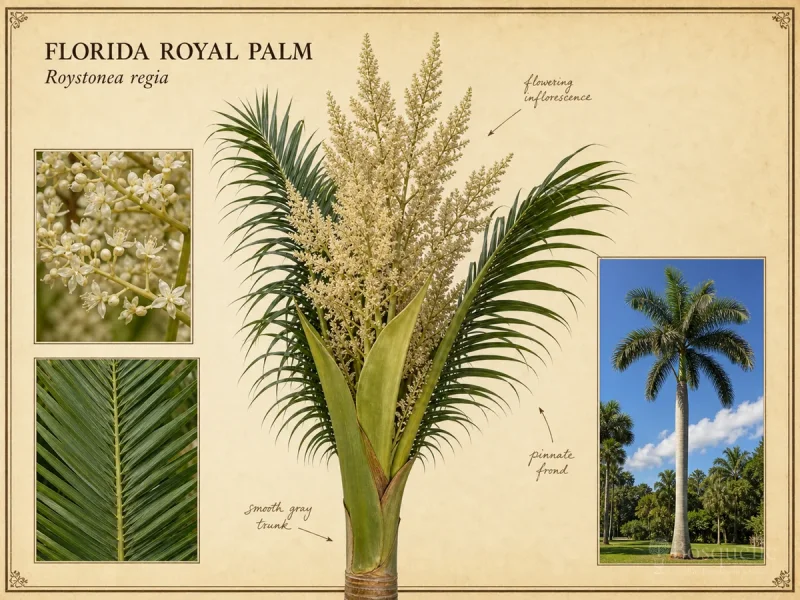
royal palm is a container plant from the nursery in most yards, and that is the easier plant-out. Dig the hole about twice as wide as the pot so you can pack soil against the whole root ball, and no deeper than that ball. If the mix in the pot has sunk, ignore that sunken surface. Set the base of the stem about an inch below the finished soil so new roots can enter the ground. Backfill with the soil you dug out. Do not amend a pocket of mix the roots will refuse to leave. [1] This palm becomes too large for a typical small lot, so plant it where a 50 to 70 foot trunk and a 20 to 25 foot crown can stay. [2]
- Water the nursery pot, then slide the plant out. Do not tease the roots apart the way you would a shade tree.
- Set the palm upright in the hole. Check that the stem base sits about an inch below grade on a container plant, or that the top of a field ball sits even with grade.
- Backfill, water to settle air pockets, then finish the soil.
- Build a low berm just outside the root ball so the first waterings soak that mix, not the lawn.
- Brace a tall, top-heavy palm for the first months. Do not drive nails into the trunk.
When should I plant royal palm?
Plant in warm months, when rain can help the first weeks. Do not plant into a freeze.
How deep do I plant the root ball?
Set the top of a field ball even with grade. On a container plant, set the stem base about an inch below the finished soil. Do not bury the trunk.
Leave room for falling fronds, and water through the first months
A mature crown spreads about 20 to 25 feet, and a dying frond can be 10 to 15 feet long and about 50 pounds when it drops, so keep the plant off walks, driveways, play yards, and overhead lines. You cannot cut this palm back to clear a wire the way you would a shade tree. Avenue and roadside rows are the fit, not a tight side yard. [3] Keep the berm watered through the first months: daily at first, then often until the palm is in, usually four to six months. After that, water when the soil has dried some. Do not band fertilizer against the trunk. [4] Sun, watering, and fertilizer stay on How to Grow Royal Palm.
If the berm dries in the first months, water until the whole root ball is moist, then let extra water drain away.
FAQ
Can I move a large royal palm that is already in the ground?
A mature field-grown plant needs a crew and a large root ball. A nursery container is the easier plant-out. Do not bury the trunk to even up a row of heights.
Related guides


Recommended plants
References
This note is part of Roystonea Guides.
More planting notes by plant are gathered in Planting Guides.
Updated: Reviewed by Bosquelle Editors