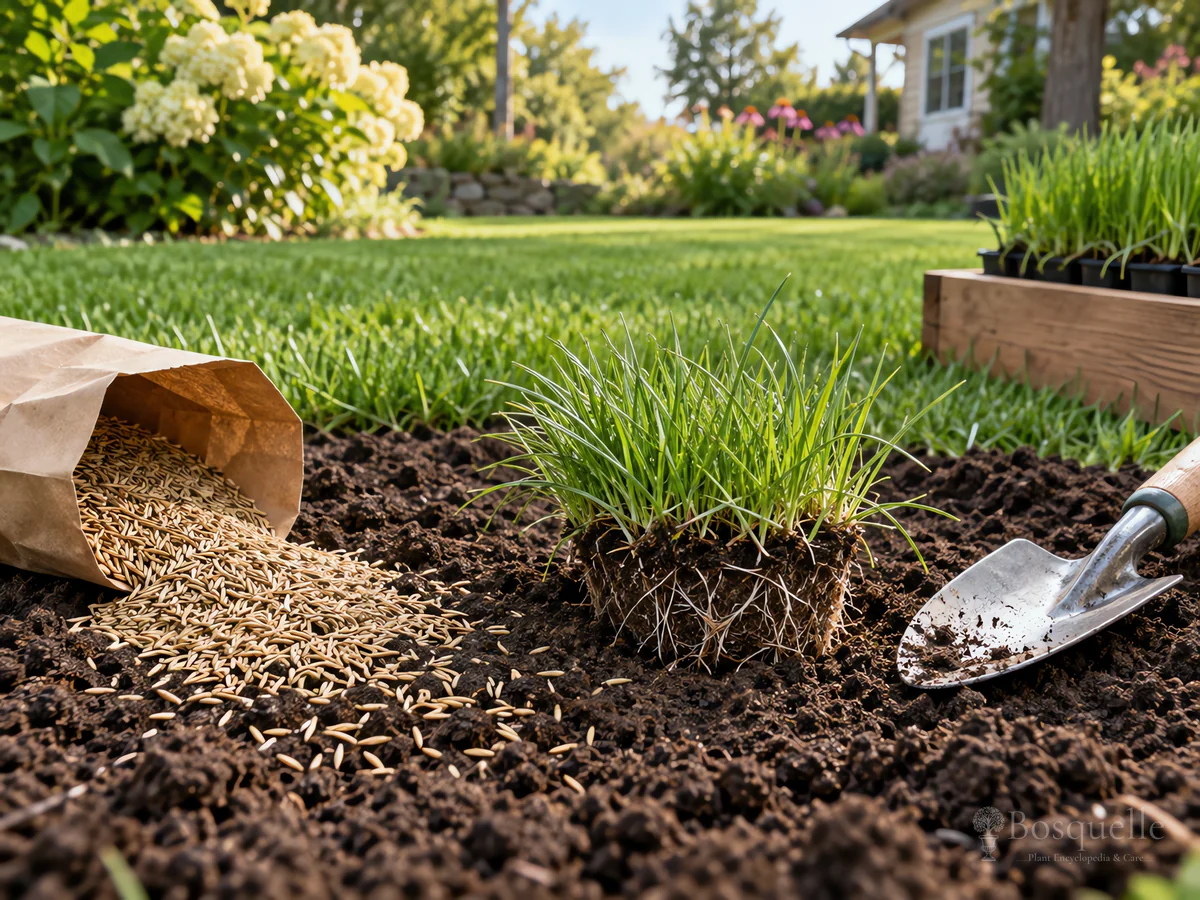
Plant Kentucky bluegrass from seed in early fall at 2 to 3 pounds per 1,000 square feet, or lay sod on firm, moist soil. Keep a seeded surface moist until the seedlings show, usually in two to three weeks.

Seed in early fall at 2 to 3 pounds per 1,000 square feet, and keep the surface moist until it sprouts
| Factor | Recommended | Avoid |
|---|---|---|
| When | Late summer into early fall, while the soil is still warm and weeds are fewer | Do not count on a spring seeding unless you can water through the first summer |
| Rate | 2 to 3 pounds of seed per 1,000 square feet, split into two passes | Do not dump the whole bag in one pass, which leaves stripes |
| Cover | Rake lightly so most of the seed sits under a thin film of soil, no deeper than 1/4 to 1/2 inch | Do not bury the seed, and do not leave it sitting dry on top |
| Water | Keep the surface moist until seedlings show, often 14 to 21 days | Do not let the seedbed crust dry, and do not puddle so the seed floats |
Kentucky bluegrass is slow to sprout compared with ryegrass, so pick early fall and stay with the watering. Spread half the seed in one direction and the other half across it [1]. Use 2 to 3 pounds per 1,000 square feet [2]. September is the usual window: soil is still warm, nights are cooler, and weed pressure is lower. If you keep the surface constantly moist, seedlings show in 14 to 21 days [3]. Cover no deeper than 1/4 to 1/2 inch [4].
- Test the soil, then till in compost if the ground is thin or compacted. Firm the bed with a roller so it is smooth, not fluffy.
- Split the seed in half. Walk one pass, then a second pass at a right angle.
- Rake lightly so about 10 to 15 percent of the seed still shows. Roll once so the seed touches moist soil.
- Water lightly several times a day until green fuzz shows. Then water less often and deeper as the roots go down.
- Do not let this new lawn go dormant in its first summer. Keep watering weekly until the roots are down.
How much Kentucky bluegrass seed do I need?
Two to three pounds per 1,000 square feet. Split that amount into two passes so you do not leave stripes.
How long until the seed sprouts?
About 14 to 21 days if the surface stays moist. It is slower than ryegrass, so do not give up and let the bed dry.
Lay sod on firm, moist soil, with the seams staggered
Sod is the faster cover. Most cool-season sod is a blend of Kentucky bluegrass cultivars. Lay it as soon as it arrives, on a bed you prepared the same way as for seed.
- Moisten the soil, then lay the pieces with the seams staggered, like bricks. On a slope, run the rolls across the slope and stake them.
- Fill gaps with soil so the edges do not dry. Roll once so the roots touch the bed.
- Keep the sod moist, not soupy, until it resists a gentle tug, usually 10 to 14 days. Then water less often.
- Fall sod takes with less heat stress. Spring or summer sod needs careful water until the roots are down.
Once the sod resists a tug, keep the established lawn on How to Grow Kentucky Bluegrass.
Should I seed or sod?
Seed costs less and lets the roots start in your soil. Sod is instant cover and holds a slope. Prepare the bed the same way for both.
If the surface dries before the seedlings show, water lighter and more often so the seed stays against moist soil.
FAQ
Can I seed in spring?
You can, if you can water through the first summer. Early fall is easier because weeds are fewer and the seedlings have a long cool season to root.
Can I overseed an existing lawn?
Yes. Rake or slice so you see soil, then use the same 2 to 3 pounds per 1,000 square feet and keep the surface moist until the new plants show. Late summer into early fall is the usual window.
Do I mow as soon as it is green?
Wait until the new grass is about 3 to 3 1/2 inches tall, then take a light first cut. After that, keep the established lawn on How to Grow Kentucky Bluegrass.
Related guides

Recommended plants

References
- [1] University of Minnesota Extension -
https://extension.umn.edu/lawns-and-landscapes-minnesota/seeding-and-sodding-home-lawns - [2] University of Maryland Extension -
https://extension.umd.edu/resource/starting-new-lawn - [3] Kansas State University -
https://www.ford.k-state.edu/lawn-garden/kentucky-bluegrass.html - [4] NRCS Plant Materials -
https://plants.sc.egov.usda.gov/DocumentLibrary/factsheet/pdf/fs_popr.pdf
This note is part of Poa Guides.
More planting notes by plant are gathered in Planting Guides.
Updated: Reviewed by Bosquelle Editors