Plant euonymus in a hole twice as wide as the root ball, no deeper, with the top of the ball slightly above grade, and space it for the mature width.
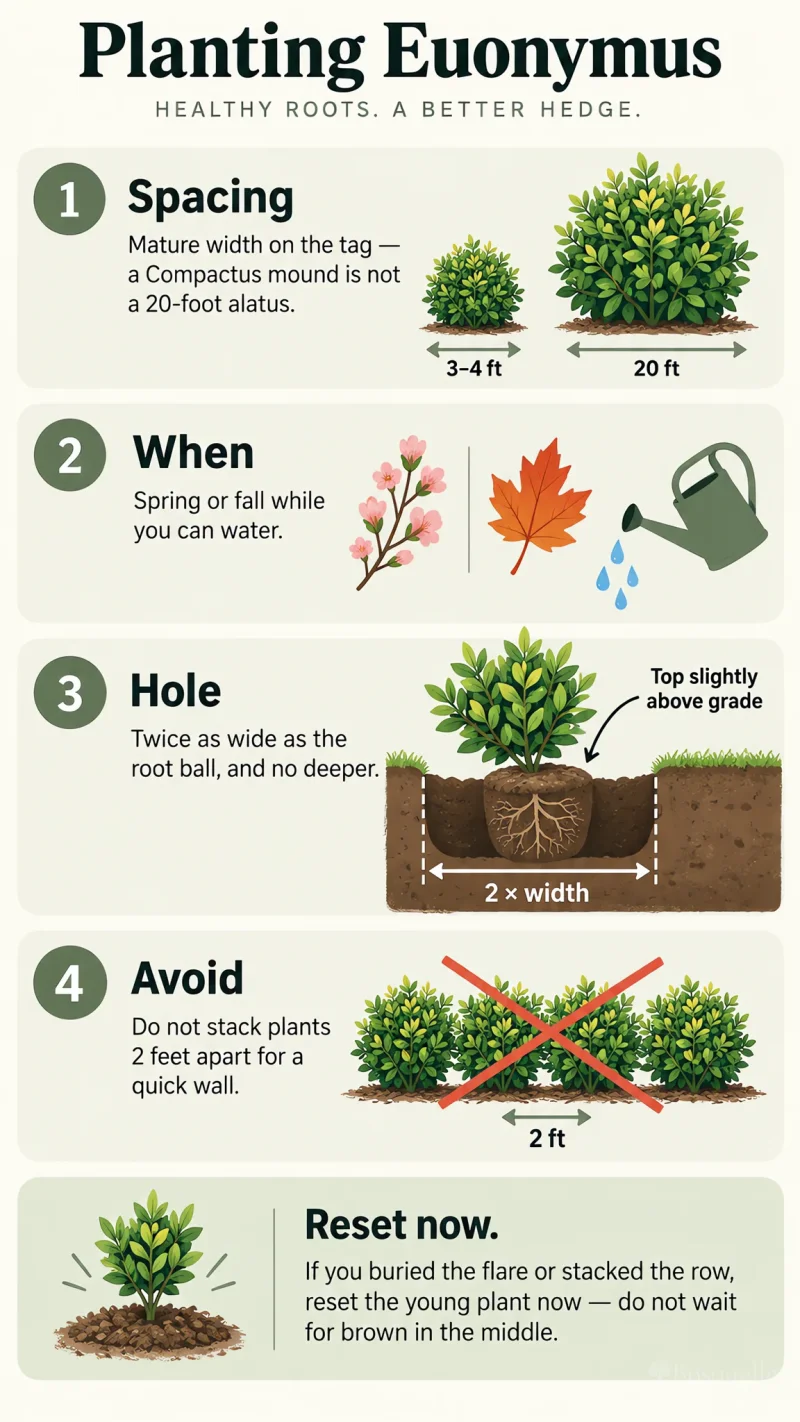
Space to the mature width, and set the root ball slightly high
| Factor | Recommended | Avoid |
|---|---|---|
| When | Spring or fall while you can water | Do not plant into a midsummer drought you cannot soak |
| Hole | Twice as wide as the root ball, and no deeper | Do not dig a tight, deep cup that holds water on the crown |
| Height | Top of the root ball about 1 inch above the soil | Do not bury the flare |
| Spacing | Mature width on the tag — a Compactus mound is not a 20-foot alatus | Do not stack plants 2 feet apart for a quick wall |
| Roots | Tease or slice a circling nursery mass | Do not drop a potbound ball into the hole as-is |
Know the mature spread before you dig. [1] Euonymus transplants readily if the hole drains. [2]
How far apart should you plant euonymus?
Use the mature width, not the nursery pot. A compact burning bush needs several feet. A species alatus or a wahoo needs the tag spread, often 8 to 12 feet or more.
How to plant euonymus
Work one hole at a time: confirm the kind, set the ball, space the plant, then water once.
- Confirm burning bush, wintercreeper, Japanese evergreen, or a native on the tag so the spacing matches the plant. If the tag is only a cultivar name, match it on Types of Euonymus. Do not plant winged burning bush or wintercreeper where your state lists them invasive. [3]
- Choose ground that drains. Raise or drain a wet pocket before you dig.
- Dig a hole twice as wide as the root ball, and no deeper. [4]
- Slide the plant out. Loosen circling roots with your hands or a knife.
- Set the top of the root ball about 1 inch high so it can settle without burying the flare.
- Backfill. Do not pile soil on the ball. Soak to the depth of the root ball. Keep the new plant moist for the first season if rain fails. After that, watering is on How to Grow Euonymus.
How deep do I plant euonymus?
No deeper than the root ball. The top of the ball sits about 1 inch above the soil.
A native wahoo and a Japanese hedge still want a wide hole and a slightly high ball.
What fails at planting
A tight, deep clay hole holds water on the crown. Soil piled on the root ball smothers the flare. Plants stacked two feet apart brown in the middle. A midsummer plant with no water fails before the first dry spell. A new alatus or fortunei in a listed county is the wrong plant, not a wrong hole.
Root a cutting if you need another plant
Named kinds are sold as nursery plants. If you already have a legal plant and want another, a summer cutting roots more reliably than seed, and it copies the parent.
- In early summer, snip a 4- to 5-inch tip of new wood. Strip the lower leaves so about three inches of stem are bare.
- Dip the cut end in rooting hormone. Stick it into a draining mix in a pot with a hole.
- Keep the mix moist, not soggy, in bright light out of hot noon sun. New growth means roots have formed.
- Do not take cuttings of winged burning bush or wintercreeper where your state lists them invasive, and do not pass those plants along.
If you buried the flare or stacked the row, reset the young plant now — do not wait for brown in the middle.
FAQ
Can I start euonymus from seed?
Named kinds are sold as plants. Seed is slow and will not copy a cultivar. Buy a nursery plant for the first one, and skip alatus where it is listed.
When should I take a cutting?
Early summer, from new wood that has started to firm. A midwinter hardwood cutting is slower. A nursery pot is still the usual first plant.
Related guides


Recommended plants


References
- [1] Gardener's Path -
https://gardenerspath.com/plants/ornamentals/grow-burning-bush/ - [2] Clemson HGIC -
https://hgic.clemson.edu/factsheet/euonymus/ - [3] University of Maryland Extension -
https://extension.umd.edu/resource/burning-bush - [4] NC State Extension Gardener -
https://plants.ces.ncsu.edu/plants/euonymus-alatus/
This note is part of Euonymus Guides.
More planting notes by plant are gathered in Planting Guides.
Updated: Reviewed by Bosquelle Editors