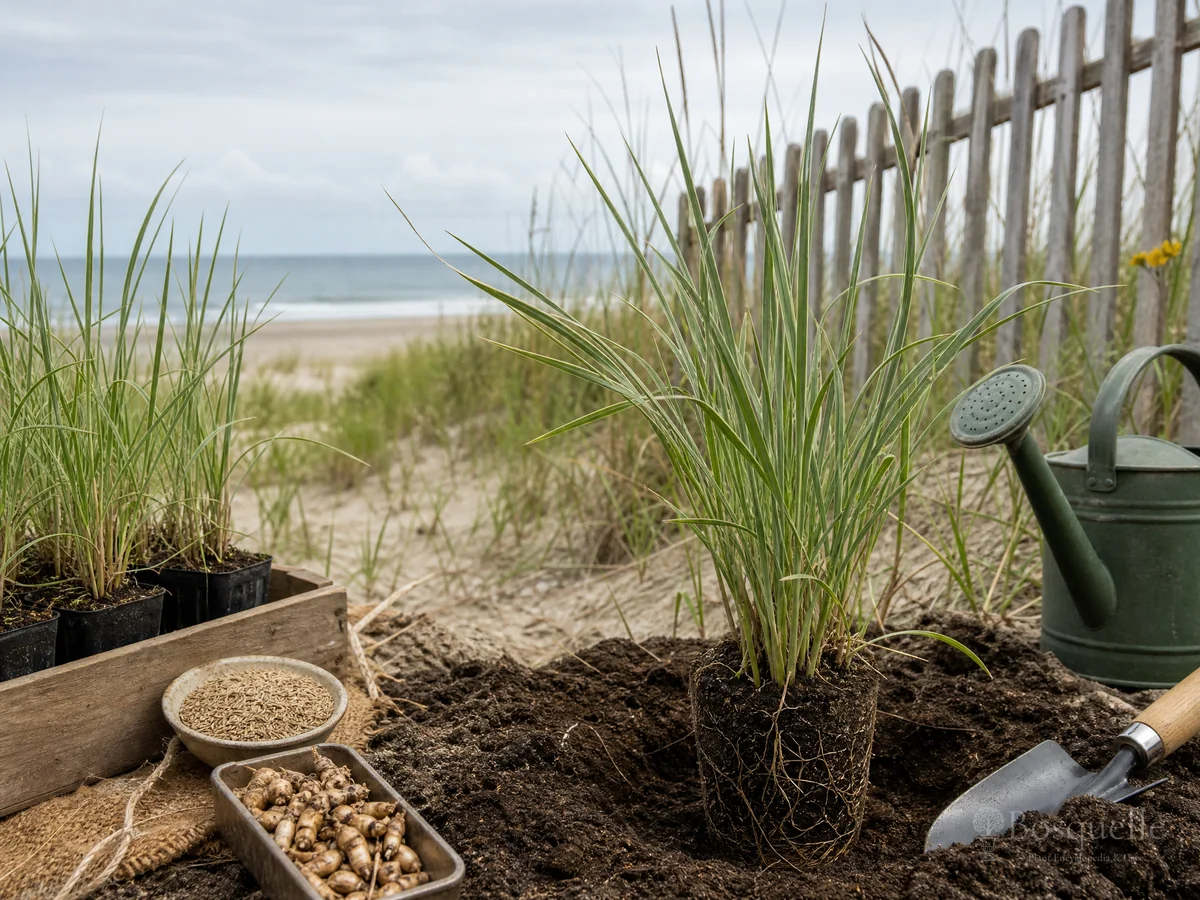
Plant American beachgrass while it is dormant, from fall into early spring. Set two stems at least eight inches deep, then firm the sand so wind cannot pull them.

Plant dormant culms from fall into early spring
| Factor | Recommended | Avoid |
|---|---|---|
| When | From about mid-October through March, while the sand is not frozen | Do not plant into hot, dry summer sand |
| Start | Dormant bareroot culms, or a nursery plug if you missed the dormant window | Do not count on seed for a dune this year |
| Depth | At least eight inches, or about three-quarters of the stem | Do not leave the growing point in the hot surface sand |
| Spacing | Twelve to eighteen inches on a staggered grid; closer on a steep, blowing slope | Do not set a single thin row and expect it to catch sand |
This is a cool-season grass, so plant American beachgrass while the culms are dormant and the surface sand is cool. [1] Mid-October through March is the usual window. Skip a freeze day. Summer planting of bareroot stems fails because the surface sand cooks the growing point. [2] Sun, salt, and keeping people off the stand stay on How to Grow American Beachgrass.
When do I plant American beachgrass?
Plant from mid-October through March, while the sand is not frozen. Skip a hot, dry summer week for bareroot stems.
How to plant American beachgrass
Work one hole at a time. Keep the bases of the culms moist until they are in the sand. The growing point is the firm white node at the bottom of the stem. Roots may not show yet, and that is normal.
- Keep the bundle in the shade, wrapped so the bases stay moist. Dry wind on the nodes is the usual reason a planting fails before it starts. [3]
- Open a hole with a dibble, a tiling spade, or the heel of a shovel, eight to ten inches deep.
- Set two stems in the hole, sometimes three on a harsh slope. The growing points sit deep, with most of each stem buried.
- Fill and firm the sand with your foot so there are no air pockets. A loose hole dries the node and lets the wind pull the stems.
- Space holes twelve to eighteen inches apart on a staggered grid. Use twelve inches on a steep or blowing face, and you can open the grid a little on a level, quiet bank. [4]
- On an ocean dune, start the seaward row well above the normal high-tide wrack, and plant several rows deep so the strip can catch blowing sand.
How deep do I plant a culm?
At least eight inches, or about three-quarters of the stem. Two stems per hole. Firm the sand so the wind cannot pull them.
Split a bundle into culms
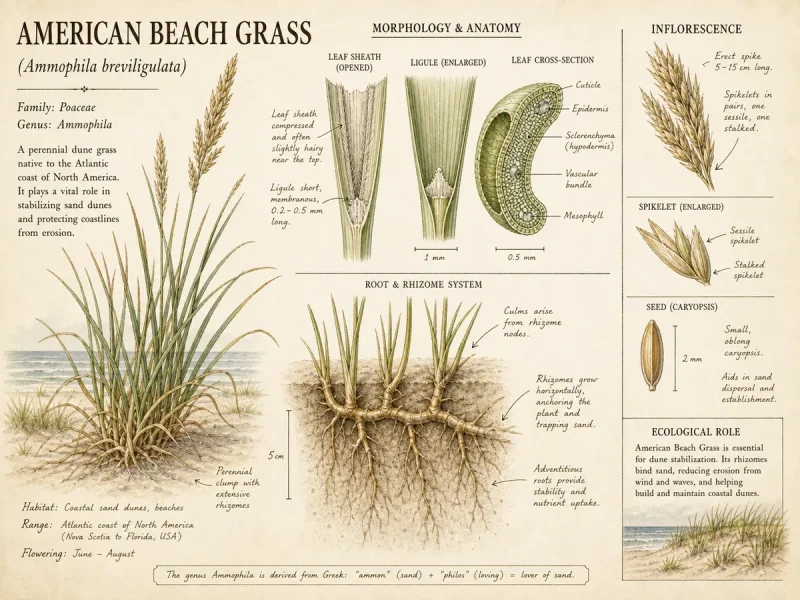
American beachgrass is increased by stems with a live basal node, not by a seed packet this year. A planting unit is two stems in one hole.
- Keep the bundle moist while you work.
- Pull or cut the bunch into single culms, or into small clusters if you want a more natural look. Each piece needs the firm white node at the base. A stem with no node will not root.
- Replant at once, two stems per hole, at the same depth, and firm the sand.
Can I divide a bundle?
Yes. Split the bundle into culms that each have a live basal node, then plant two stems per hole the same day.
What fails at planting
A shallow hole leaves the growing point in hot surface sand, and the stem dries or blows out. A summer planting of bareroot culms hits the same problem. Seed heads look useful in August, but seed is sparse and seedlings rarely take on a live dune, so do not sow a packet and call the job done. Do not dig plants from a wild dune to stock a new strip; buy nursery culms. If you cannot plant within a few days, keep the bases moist in the shade, or heel the bundle into a trench of damp sand until you can finish.
Can I grow it from seed?
Not for a dune you need this season. Seed is sparse, and seedlings dry out. Plant dormant culms.
If a new hole is shallow or loose, reset the culms today so wind and sun cannot pull them dry.
FAQ
Can I plant it in summer?
Bareroot culms want the dormant window. If you missed it, a nursery plug is the safer summer start. Do not push dry bareroot stems into hot sand.
Can I move a mature dune?
A mature mat is hard to lift without killing it. Start a new strip with dormant culms rather than trying to move a whole stand.
Related guides

Recommended plants
References
- [1] USDA NRCS -
https://plants.sc.egov.usda.gov/DocumentLibrary/plantguide/pdf/pg_ambr.pdf - [2] New York Sea Grant -
https://www.seagrant.sunysb.edu/Images/Uploads/PDFs/themeareas/CComm-Habitat/AmericanBeachgrass.pdf - [3] Mason-Lake Conservation District -
https://www.mason-lakeconservation.org/beachgrass - [4] NC State Extension -
https://content.ces.ncsu.edu/restoration-and-management-of-coastal-dune-vegetation
This note is part of Ammophila Guides.
More planting notes by plant are gathered in Planting Guides.
Updated: Reviewed by Bosquelle Editors